

World News
Trump Orders US Navy to Blockade Strait of Hormuz
Move follows collapse of Pakistan talks over Iran’s nuclear program as Tehran warns US vessels will face “decisive” response
- Brian Racer
- | Updated
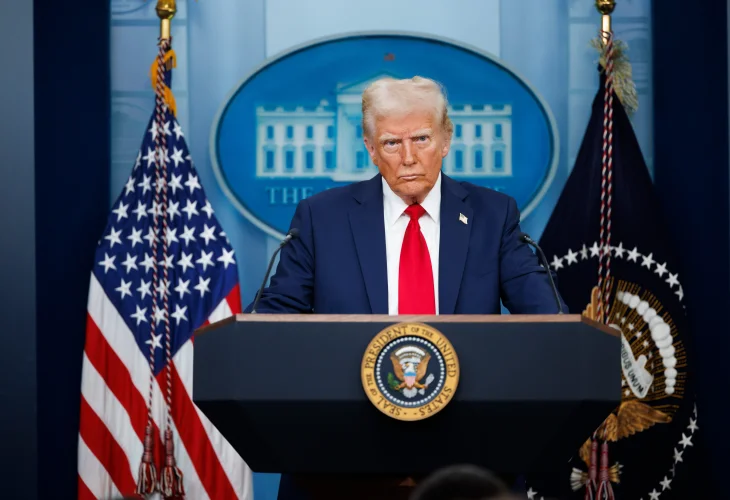 Donald Trump (Shutterstock)
U.S. President Donald Trump announced Sunday that the United States will begin blockading the Strait of Hormuz and intercept vessels linked to Iran, following the collapse of high-stakes negotiations aimed at ending the six-week war.
The move comes after nearly 21 hours of talks in Islamabad, mediated by Pakistan, failed to produce an agreement on Iran’s nuclear program, the central issue in the negotiations, leaving the fragile two-week ceasefire in place but increasingly unstable.
In a post on Truth Social, Trump said, “Effective immediately, the United States Navy… will begin the process of BLOCKADING any and all Ships trying to enter, or leave, the Strait of Hormuz.” He added, “No one who pays an illegal toll will have safe passage on the high seas,” outlining a sweeping policy that extends beyond the strait to vessels operating in international waters. Trump also warned, “Any Iranian who fires at us, or at peaceful vessels, will be BLOWN TO HELL!”
The Strait of Hormuz has become a central point of contention in the war and the failed negotiations. The U.S. accuses Iran of effectively shutting down the waterway by threatening to mine it, while Tehran insists it remains open to civilian shipping.
Despite Trump’s declaration of an immediate blockade, official U.S. military statements describe a more limited initial operation. United States Central Command said it has begun mine-clearing efforts and is working to establish a secure maritime corridor through the strait. “Today, we began the process of establishing a new passage, and we will share this safe pathway with the maritime industry soon to encourage the free flow of commerce,” said Adm. Brad Cooper. Additional U.S. forces, including underwater drones and guided-missile destroyers, have been deployed to support the effort.
The Islamabad talks, led on the U.S. side by senior envoys and hosted by Pakistan’s leadership, focused on ending the war, addressing maritime security in the Gulf, and resolving disputes over Iran’s nuclear program. Trump said the sides “got just about every point we needed except for the fact that they refuse to give up their nuclear ambition,” underscoring the issue that ultimately derailed the negotiations. U.S. officials, including Vice President JD Vance, have insisted that any agreement must include a firm Iranian commitment not to pursue nuclear weapons capability.
Iran responded sharply to the U.S. announcement. The Islamic Revolutionary Guard Corps warned that any military vessels approaching the Strait of Hormuz would be treated as violating the ceasefire and would be dealt with “harshly and decisively.” Iranian officials have also emphasized that the strait remains under their control and is open to non-military shipping, even as the threat of naval mines continues to deter traffic.
Tensions have already surfaced on the water. Iranian state media published footage of a naval exchange in which an IRGC vessel warned a U.S. destroyer to turn back, threatening to open fire, while the American ship responded that it was operating in accordance with international law. The incident highlighted competing claims over control of the waterway and the risk of direct confrontation.
According to U.S. military officials, Iran has laid naval mines in the strait, contributing to the current disruption. Even a limited number of mines can effectively halt commercial traffic, as shipping companies are unwilling to risk high-value vessels in uncertain conditions. The U.S. Navy has begun efforts to locate and remove the mines, a process that could take days or longer.
While the ceasefire technically remains in effect, it is set to expire later this month, and both sides are now signaling readiness for further escalation. Pakistan and other international actors have indicated they will continue efforts to revive negotiations, but with the nuclear issue unresolved and military activity increasing in and around the Strait of Hormuz, the situation remains volatile.

