

Faith (Emunah)
Why Life on Earth Is So Rare: 10 Astonishing Conditions That Make It Possible
Discover the precise cosmic, atmospheric, and planetary conditions that make life on Earth possible — and why moving to another planet is far less simple than science fiction suggests.
- Gilad Shmueli
- | Updated
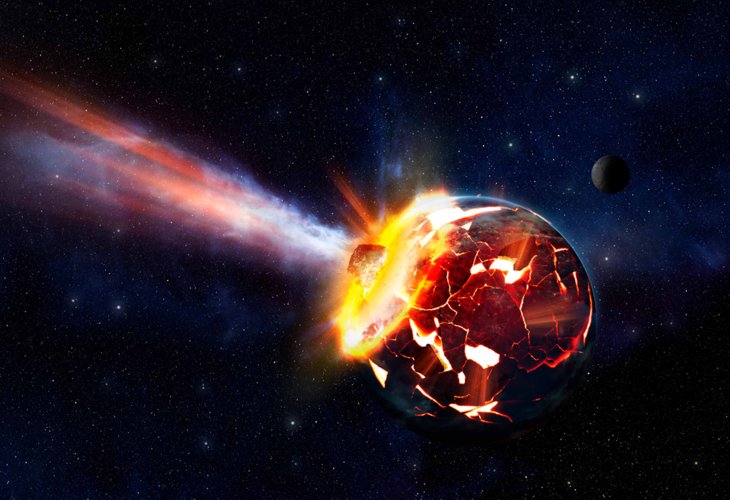 (Photo: Shutterstock)
The entertainment industry loves to play with the idea that if a global ecological disaster were to break out, or a foreign asteroid threatened to collide with us, and Earth stood on the brink of destruction, humanity could simply abandon the sinking ship and move to another planet. Simple, right?
Is the existence of life on a planet really such a simple thing? Let us look at several fascinating facts that leave us with one clear conclusion: Life on Earth is anything but self-evident.
1. Earth’s Location in the Galaxy
Earth must be located far from the center of the galaxy, because in that region radiation levels are much higher due to the dense concentration of stars.
Such intense radiation would not allow life to exist.
2. The Exact Distance From the Sun
Earth must be at a precise distance from the Sun in order for life to be possible.
If it were too close, temperatures would become far too high. If it were too far away, the planet would freeze.
This region is often called the habitable zone or the Goldilocks zone.
3. A Stable Sun
The Sun must have a relatively stable energy output.
This is not something to take for granted, because many stars in the universe vary significantly in brightness and radiation in ways that would make stable life extremely difficult.
4. Protection From Dangerous Radiation
Most of the radiation that reaches Earth comes from the Sun, including solar radiation and additional cosmic radiation from elsewhere in the galaxy. Only a small portion in the form of heat and visible light passes through Earth’s atmosphere.
Much of the dangerous charged radiation is trapped by two protective rings surrounding Earth, known as the Van Allen radiation belts. Without these belts, dangerous radioactive radiation would reach the surface and make life far more difficult.
5. The Moon’s Critical Role
The existence of the Moon, with its specific size and location, helps stabilize Earth’s axial tilt.
This results in a more stable climate and controlled exposure to sunlight over long periods of time.
6. Jupiter as a Shield
The planet Jupiter, due to its enormous size and position, acts as a kind of shield for Earth by gravitationally attracting many comets and asteroids. This helps reduce the number of potential impacts on Earth.
Its size and distance from the Sun are also part of the broader stability of our solar system.
7. Earth’s Rotation Speed
Earth’s rotation speed allows for an ideal cycle of day and night.
If Earth rotated much more slowly, days and nights would last far longer, creating prolonged extremes of heat and cold.
This would significantly affect plant life, which depends on controlled exposure to sunlight.
8. The Ozone Layer
The density of the ozone layer is also crucial.
On one hand, it filters harmful ultraviolet radiation from the Sun. On the other, it still allows the sunlight necessary for life.
9. Gravity at the Right Strength
Gravity must be within a very precise range.
If it were significantly weaker, we would have difficulty remaining on the ground. If it were much stronger, movement and biological processes would become far more difficult.
10. Oxygen Levels
The oxygen content in the air we breathe is about 21%.
If it were significantly lower, complex life would struggle to survive. If it were significantly higher, even a small spark could lead to enormous fires.
The atmosphere helps stabilize this level, with oxygen continuously replenished through the remarkable process of photosynthesis.
All of this is only a brief sample.
In the past, scientists believed that only a small number of conditions were required for life. Given the enormous number of stars in the universe, many assumed that life elsewhere would be easy to find. However, as research advanced, scientists realized that far more conditions are necessary than originally thought.
Today, science identifies well over 200 highly specific conditions that must align for life as we know it to exist on a planet.
Professor Paul Davies, an astrophysicist, famously said that what is truly astonishing is not merely that life on Earth is balanced on a knife’s edge, but that the entire universe itself appears balanced on a knife’s edge.
Likewise, astronomer Fred Hoyle spoke about the remarkable sequence of highly improbable conditions that seem necessary for life.
Perhaps, for now, we will need to postpone our move to another planet.

