

World News
Iran Threatens to Charge Google and Amazon for Internet Cables Running Through the Strait of Hormuz
Experts are warning of a "cascading digital disaster" that could hit global internet traffic, banking, and the oil and gas industry if Iran follows through on its threat to charge fees for the use of undersea internet cables passing through the Strait of Hormuz.
- Yoav Dagan
- | Updated
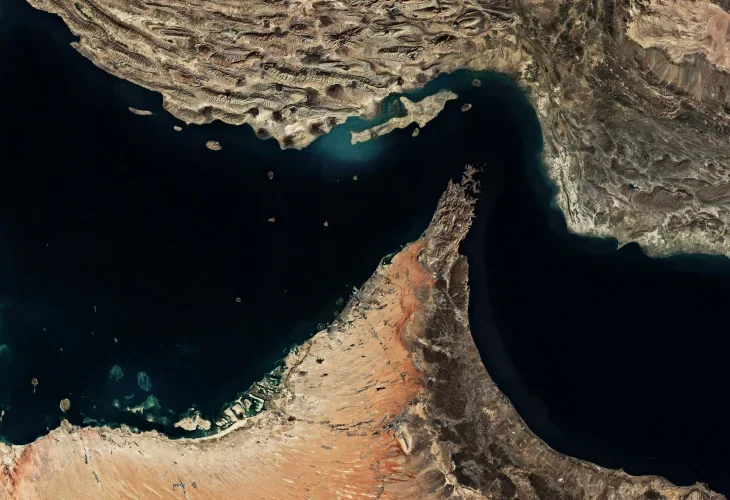 Hormuz (Credit: shutterstock)
Iran is threatening to charge fees to the world’s biggest tech companies for using undersea internet cables that pass through the Strait of Hormuz. The threat was voiced by Iranian military spokesperson Ebrahim Zolfaghari, who wrote on X: "We will collect fees on internet cables." The announcement comes amid stalled negotiations between Tehran and Washington, about two and a half months after Iran began blocking the passage of ships and oil tankers through the strait.
According to reports in media outlets affiliated with the Revolutionary Guards, Iranian lawmakers discussed a plan last week to collect usage fees from companies like Google, Microsoft, Meta, and Amazon. Under the proposal, the companies would be required to pay licensing fees for the cables’ passage through the strait, while repair and maintenance rights for the underwater infrastructure would be granted exclusively to Iranian companies. Media outlets close to the Revolutionary Guards added a veiled warning that refusing to pay could harm global internet traffic.
These undersea cables are the backbone of the global internet, carrying the overwhelming majority of worldwide data traffic — from banking systems to cloud services, military communications, and remote work. The cables connect Europe, Asia, and the Persian Gulf states, carrying a huge volume of financial data flowing between markets.
It remains unclear how enforceable the threat is legally. Most of the cables were laid in a narrow strip along the Omani side of the waterway, far from Iranian territorial waters. Still, Alan Mauldin, research director at TeleGeography, noted that two major cables — Falcon and Gulf Bridge International — do in fact pass through Iran’s territorial waters. Irini Papanicolopulu, a professor of international law at SOAS University of London, explained that "for existing cables, Iran must comply with the contract signed when the cable was laid, but for new cables, any state, including Iran, can decide whether and under what conditions cables may be laid in its territorial sea."
A major obstacle to carrying out the threat is U.S. sanctions, which prevent American tech companies from transferring money to Iran. Industry sources estimate that this is mainly a declarative move meant to demonstrate Tehran’s ability to influence sensitive global infrastructure, and also to deter future military strikes. The American side has not officially responded to the possibility of damage to the "digital corridor."
That said, security experts are not ruling out the possibility of real physical damage to the cables. Mostafa Ahmed, a senior researcher at the UAE-based Al Habtoor Research Centre, said Revolutionary Guards forces have professional divers, mini-submarines, and advanced underwater drones capable of damaging the infrastructure. According to him, such an attack could cause a "cascading digital disaster" across several continents. For comparison, Houthi attacks in the Red Sea previously disrupted nearly a quarter of regional internet traffic.
The possible fallout stretches far beyond the strait itself. Gulf countries like Oman and Qatar could face severe disruptions affecting their oil and gas exports. India, whose IT outsourcing and software development industry is worth billions of dollars, could see significant harm to its network traffic, and parts of East Africa could also run into major disruptions. Ahmed described the strait as a "digital corridor" between data centers in Asia and Europe, warning that damage there would significantly slow international financial trade.
Iranian media compared the plan to the way Egypt uses the Suez Canal to collect hundreds of millions of dollars a year in transit fees and communication cable charges. International law experts reject the comparison: the Suez Canal is an artificial canal dug in Egyptian territory, while the Strait of Hormuz is a natural waterway governed under an entirely different international legal framework. As negotiations between Iran and the United States remain stuck and fears of renewed fighting grow, experts say the likelihood is rising that Tehran will try to carry out the threats it has made.

