

Interesting
Can AI Translate Your Dog’s Bark? A Startup Claims 95% Accuracy
A new AI system claims it can translate dog barks and cat sounds, sparking curiosity and skepticism worldwide.
- Shira Dabush
- | Updated
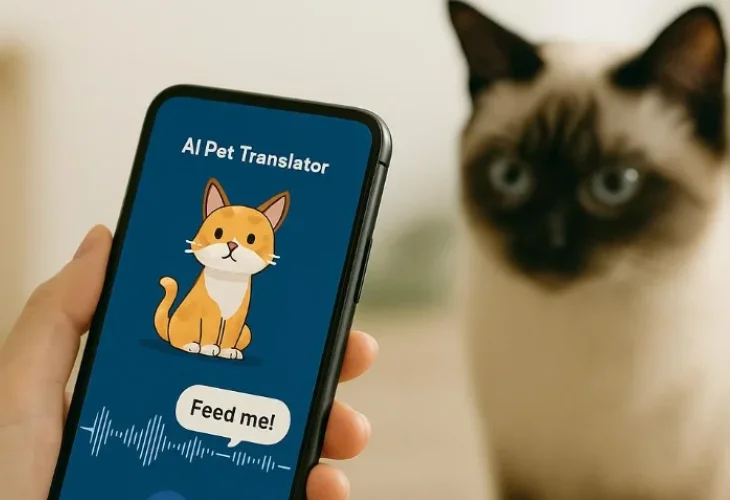
A new Chinese startup called Meng Xiaoyi has sparked worldwide curiosity after unveiling a project that sounds like something straight out of a science fiction movie: an AI based translator designed to interpret the sounds and emotions of pets.
According to the company, the technology can understand dogs and cats with roughly 95% accuracy.
Naturally, many people are skeptical.
Until now, pet owners have mostly relied on guesswork when trying to figure out why a dog is barking nonstop or why a cat suddenly starts yowling in the middle of the night. The company claims its new system could offer a much deeper understanding of pets’ emotional states and needs.
How the AI Pet Translator Works
According to the developers, the system uses artificial intelligence to analyze barking, meowing, purring, howling, and other animal sounds. But the technology does not stop there.
The AI also examines body language, facial expressions, movement, and behavior patterns. It then compares all of this information to a massive database collected over time.
Using that analysis, the system generates what the company describes as a possible “translation” of what the animal may be feeling or trying to communicate.
For example, the technology may attempt to identify whether a dog is stressed, excited, anxious, lonely, or seeking attention.
Experts Urge Caution
Despite the excitement surrounding the project, many animal behavior experts say the claims should be approached carefully.
Researchers point out that even experienced pet owners and veterinarians cannot always fully understand what animals are feeling. Critics also question how any AI system could accurately “translate” a language humans themselves do not truly understand.
Some experts believe the technology is probably not translating actual thoughts or words, but rather identifying emotional and behavioral patterns.
In other words, the system may be able to recognize signs of stress, fear, excitement, or discomfort, without literally carrying on a conversation with an animal.
Animals Communicate More Than We Once Thought
Even so, the idea has fascinated millions of pet owners around the world.
Research has shown that dogs and cats communicate in more complex ways than scientists once believed. Dogs often use different types of barking depending on their emotional state, while cats frequently change their vocalizations specifically when interacting with humans.
In recent years, pet technology has advanced rapidly. There are already smart collars that track heart rate and activity levels, cameras that detect separation anxiety in dogs, and apps designed to monitor behavioral patterns.
The new AI translator appears to be the latest step in that growing trend.
Excitement, Curiosity, and Concerns
Many pet owners have responded enthusiastically to the announcement. Some say they would love to better understand when their pet feels anxious, sad, lonely, or unwell.
Others, however, worry the technology could create an unrealistic illusion of having full conversations with animals.
Despite the criticism and skepticism, the developers remain confident.
“We understood from the beginning that many people would not believe us,” the company said.

