

History and Archaeology
The Caribbean Jews Who Helped America Win Independence
From smuggling gunpowder to surviving British revenge, this remarkable story highlights the role of Caribbean Jews in America's struggle for independence.
- Shira Dabush
- | Updated
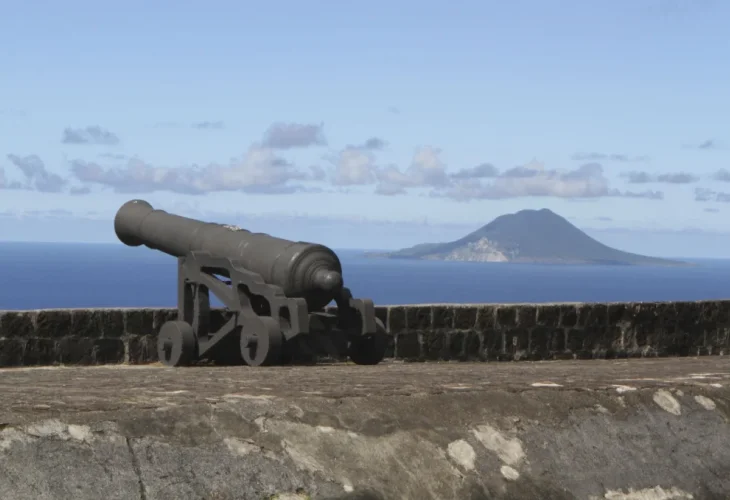
Jewish history is filled with remarkable stories that rarely make it into history textbooks. One of the most fascinating is the story of a small Jewish community on a tiny Caribbean island that played an outsized role in the birth of the United States.
The island was called St. Eustatius, known today as Statia. During the American Revolutionary War, its Jewish merchants became part of a secret supply network that helped provide the struggling American colonies with some of the resources they needed to continue fighting for independence.
Their contribution was so significant that British leaders viewed the island as a serious threat to the British Empire.
A Caribbean Trading Powerhouse
In the 18th century, St. Eustatius was one of the busiest trading centers in the Caribbean.
Ships arrived from Europe, North America, South America, and the Caribbean, making the island a vital hub for international commerce. Among the merchants who helped build this thriving economy was a large and prosperous Jewish community that maintained extensive trade connections throughout the Atlantic world.
At its peak, Jews made up an astonishing 40 percent of the island's population. Most were descendants of Sephardic Jews whose families had originally fled Spain and Portugal.
In 1739, the community built a magnificent two-story synagogue constructed from yellow bricks imported from Holland. It quickly became the center of Jewish life on the island.
Secret Support for the American Revolution
When people think about the American Revolution, names such as George Washington and the French allies usually come to mind.
Far less known is the role played by St. Eustatius.
Through their commercial networks, Jewish merchants on the island helped facilitate the flow of gunpowder, weapons, and other essential supplies to the American colonies. These materials were desperately needed by George Washington's forces as they fought against Britain.
The British were fully aware that something was happening on the island.
One furious British admiral reportedly described St. Eustatius as a "nest of vipers," arguing that without the island's assistance, the rebellion might never have survived.
The Most Important Commodity
The island's Jewish merchants traded in a wide variety of goods, including sugar, spices, corn, and meat.
But one product was especially valuable to the American cause: gunpowder.
Historians estimate that thousands of American vessels stopped at St. Eustatius during the war years to obtain supplies.
Although such trade was officially prohibited, it continued for years. Dutch authorities occasionally announced restrictions in an effort to ease tensions with Britain, but in practice much of the commerce continued behind the scenes.
The First Salute to the American Flag
One of the most famous moments in the island's history took place in November 1776.
The American ship Andrea Doria sailed into the harbor flying the newly adopted flag of the United States and carrying news of American independence.
In response, the Dutch fort overlooking the harbor fired a cannon salute.
The gesture may seem simple today, but it carried enormous symbolic significance. Many historians view it as one of the earliest international acknowledgments of the emerging United States.
British Revenge
As supplies continued reaching the American colonies, British leaders became increasingly determined to stop the island's activities.
In February 1781, British Admiral George Rodney arrived with a powerful fleet and approximately 3,000 soldiers.
The island fell quickly.
What followed was particularly devastating for the Jewish community.
British forces looted homes and warehouses, confiscated valuable property, imprisoned Jewish residents, and deported many men without their families. Historical accounts describe more than one hundred Jewish men being held in overcrowded conditions before being expelled from the island.
The Jewish cemetery was also desecrated after British troops suspected valuables had been hidden there.
A Community Lost to History
Although the synagogue survived, the Jewish community never recovered from the invasion.
Some residents fled to neighboring Caribbean islands. Others returned to Amsterdam. Many eventually settled in the newly independent United States, the very nation they had helped support during its struggle for freedom.
The final burial in the island's Jewish cemetery took place in 1816, marking the end of a once-thriving community.
Preserving Their Legacy
Today, efforts are underway to ensure that the story of St. Eustatius' Jewish community is not forgotten.
A recent exhibition at the National Museum of American Jewish History in Philadelphia highlights this remarkable chapter in both Jewish and American history.
Among the exhibition's most moving artifacts is a Chanukah menorah dating back to 1761, one of the few surviving objects from the island's historic Jewish community.
The exhibition's curator described the emotional experience of transporting the menorah to the United States, saying that he felt as though he was carrying the memory of an entire community with him.
More than two centuries after the community disappeared, its story continues to serve as a powerful reminder that even the smallest groups can leave a lasting mark on history.

