

Parashat Shelach
Why Send Spies If the Land Was Promised? Insights from Parshat Shlach
If Hashem had already promised the Land of Israel, why was there any need to send spies? The answer reveals a timeless lesson about faith, effort, and trust.
- Hadas Franco
- | Updated
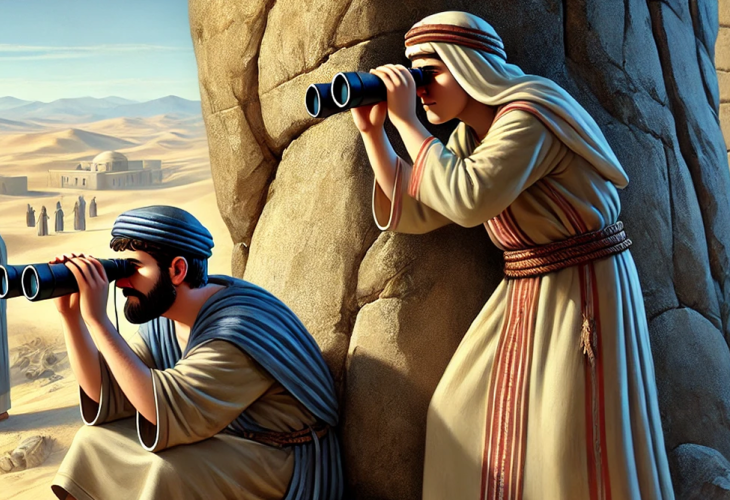
While reading Parshat Shlach this week, I found myself wondering about one of the most famous questions in the Torah. If Hashem had already promised the Jewish people the Land of Israel, why was there any need to send spies in the first place? Why wasn't the divine promise enough?
The story begins when Moshe appoints spies to scout out the land before its conquest. Their mission was to examine the land and assess the strength of the nations living there. When they returned, however, they brought back a frightening report.
"It is a land that devours its inhabitants," they claimed. They also concluded, "We cannot go up against the people, for they are stronger than we are"—a statement that our sages understood as implying that they viewed the enemy as stronger than Hashem Himself. Faced with such a report, the nation fell into despair. No one could convince them that the land was good or that they should trust in Hashem's promise.
Hashem became angry with the people. Although Moshe prayed on their behalf and Hashem accepted his prayer, saying, "I have forgiven, as you requested," a decree was issued that the generation of the Exodus would wander in the wilderness and would not merit entering the Land of Israel.
The spies' personal conclusions confused the nation and led to one of the greatest tragedies in Jewish history. Yet the original question remains: If Hashem had already promised the land, why send spies at all?
The Need for Human Effort
The answer carries an important lesson for every area of life.
A person might think that if Hashem commands something, there is no need to think, plan, or evaluate reality. But Judaism does not teach us to ignore the natural world. On the contrary, we are expected to use wisdom, judgment, and practical effort in fulfilling Hashem's will.
Moshe sent spies because the Jewish people still needed to determine the best and most effective way to conquer the land. They needed information, strategy, and preparation. The spies were sent to figure out how to accomplish the mission, not whether it should be accomplished.
Where the Spies Went Wrong
That distinction was precisely where the spies failed.
They were authorized to assess the challenges involved in conquering the land. What they were not authorized to do was decide whether the mission should proceed at all.
The spies confused strategy with authority.
Instead of asking, "How can we enter the land?" they began asking, "Should we enter the land?" In doing so, they stepped beyond their assignment and effectively challenged Hashem's command.
If Hashem had instructed the Jewish people to enter the land, then it was already possible. If natural means would be sufficient, those means would succeed. If a miracle was needed, Hashem would provide one. The outcome was never in doubt.
Their task was simply to determine the best path forward.
A Message for Every One of Us
The lesson extends far beyond the story of the spies.
Whenever Hashem places a mission before us, we are expected to think carefully, plan wisely, and do everything within our power to succeed. We are not meant to sit back and wait for miracles.
At the same time, we must remember that difficulty is not proof that something cannot be done.
Challenges do not determine whether a mission is possible. If Hashem has given us a responsibility, then He has also given us the ability to fulfill it.
Our role is to find the best way forward while maintaining confidence that obstacles can be overcome.
The Balance Between Faith and Action
The story of the spies teaches a delicate balance.
On one hand, we must engage with reality, gather information, and make practical decisions. On the other hand, we must never allow our assessment of reality to override Hashem's will.
The spies saw obstacles and concluded that success was impossible. Yehoshua and Kalev saw the same obstacles but understood that Hashem's promise remained unchanged.
That balance between faith and action remains as relevant today as it was in the wilderness. We must do our part, use our judgment, and prepare wisely, but we must never forget that the ultimate source of success comes from Hashem.

