

Israel News
Knesset Panel Advances Bill for a National Commission of Inquiry Into the October 7 Massacre
The Knesset Constitution Committee approved for first reading a bill to establish a national state commission of inquiry into the October 7 massacre. Opposition lawmakers were absent from the discussion.
- Shlomi Diaz
- | Updated
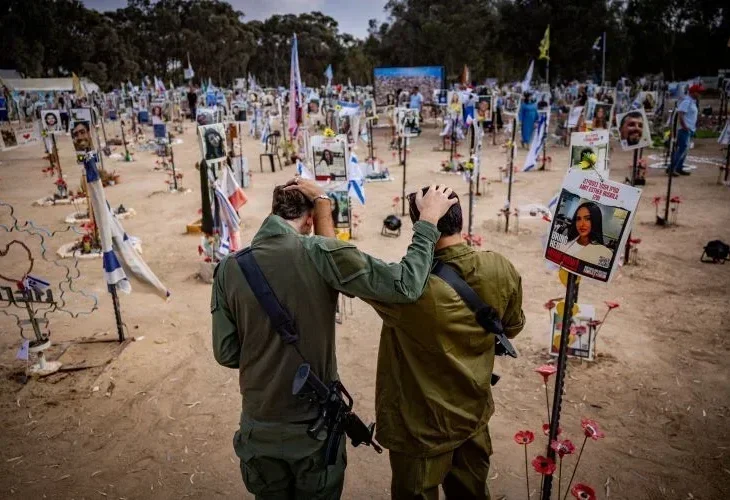 The memorial site in Re'im (archive photo: Yonatan Sindel/Flash90)
The Knesset Constitution Committee today (Tuesday) approved for first reading the bill for a "National-State Commission of Inquiry" into the events of the October 7, 2023 massacre. The proposal was initiated by MK Ariel Kallner. Opposition members were absent from the discussion.
The purpose clause emphasizes that "the purpose of the law is to bring about a full, thorough, and independent investigation of the events of the *Shemini Atzeret* massacre and the War of Revival, and the circumstances that led to them, through a commission of inquiry established in recognition of the public dispute over the identity of the body appointing its members, and in a way that will therefore allow the appointment of the commission members by broad agreement and in a balanced and fair manner among the representatives of the people."
The commission will include six members, all Israeli citizens. A person may not be appointed as a commission member if he or she is serving, or has served since June 6, 2004 (the date of the government decision regarding the revised disengagement plan), as a Supreme Court justice, a government minister, an officer with the rank of major general or above, the head of the Shin Bet or one of the agency's deputies, the attorney general, the military advocate general, or the Shin Bet legal adviser. It is also proposed that at least one of the commission members be someone qualified for appointment as a Supreme Court justice (an attorney with 10 years of seniority).
The commission members will be appointed by the Knesset. Within 14 days of the law's publication, the Knesset speaker will place on the Knesset table a proposal including the names of the commission chair and its members, after consulting as much as possible with representatives of the coalition and opposition factions.
The composition will be brought for Knesset approval within 7 days from the day it is placed on the Knesset table, and will require a majority of 80 MKs. In the absence of agreement, the commission members will be appointed by the chair of the Knesset Committee and the leader of the opposition—each of them will appoint 3 commission members, one of whom must be qualified to serve as a Supreme Court justice—on condition that the coalition appointments receive the written consent of at least 61 MKs from coalition factions, and the opposition appointments receive the written consent of a majority of MKs from opposition factions. If not all commission members are appointed within 14 days by the coalition or opposition, the state comptroller will appoint the remaining commission members within 14 days.
The commission members will choose a chair from among themselves within a week, and if no chair is chosen, the chair of the Knesset Committee and the leader of the opposition will appoint two commission members to serve as co-chairs. If members were appointed by the state comptroller, the bodies that made most of the coalition and opposition appointments will appoint a chair from among them to serve as co-chairs. The commission will be authorized to operate as long as its membership does not fall below five, and it is also clarified that "a commission member shall act according to his or her own judgment, and shall not be bound by the position of the body that appointed him or her to the commission."
It is also proposed that the commission appoint four observers with special status from among bereaved family members of those killed in the war and representatives of released hostages (as defined by law). The observers will be chosen by the commission members, will be entitled to salary and expenses, and will take part in the commission's discussions and consultations, without voting rights. The commission will be authorized to set rules in its procedures regarding how they participate in the proceedings, as well as cases in which their participation will be limited because of exposure to classified documents and materials that cannot be disclosed to them.
The sole person responsible for establishing the commission, its logistics, staffing, and ongoing operations will be the director-general of the Knesset. The commission will receive dedicated funding from the state treasury, subject to approval by the Knesset Committee (and not from the Knesset's regular budget), while the bill is not defined as a budgetary bill and its additional cost is negligible due to the use of the Knesset's existing systems.
The commission will be granted all powers under the Commissions of Inquiry Law, and wherever this law does not provide otherwise, the provisions of the general law will apply. The commission's powers to summon witnesses and demand documents may be exercised by any two members, and the authority to compel appearance will require the consent of a legal expert qualified to serve as a Supreme Court justice.
The commission's hearings will be held in public and broadcast to the public, but not live. The commission will have broad discretion to set rules and limitations regarding the broadcast, and to separate the decision on whether a hearing is public from the decision on whether it is broadcast. It will be authorized to impose restrictions or hold hearings behind closed doors/without broadcast in order to protect state security (including classified operational methods of the IDF and the Shin Bet), protect the privacy of crime victims and minors, or protect the well-being and privacy of witnesses from consequences and harm.

