

Interesting
A Second Sun in the Sky: The Science Behind the Spectacle
Known as a sun dog, this dazzling phenomenon can create bright, colorful patches of light that appear to be extra suns in the sky.
- Tehila Cohen
- | Updated
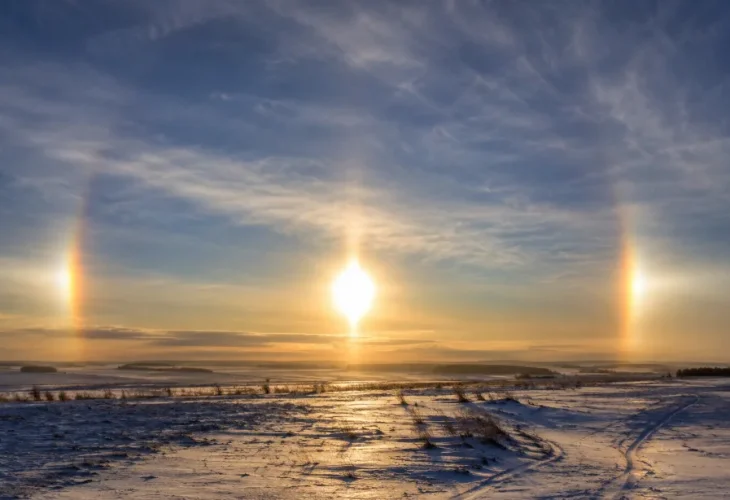
Imagine stepping outside on a freezing winter day, glancing up at the sky, and suddenly spotting what appears to be a second sun shining beside the real one. Sometimes it looks like a brilliant patch of light, and other times it resembles an actual duplicate sun glowing near the horizon.
While it may seem like something out of a science fiction movie, this stunning phenomenon is very real. Known as a sun dog, or parhelion, it is one of the most beautiful and fascinating optical displays found in nature.
What Is a Sun Dog?
A sun dog is a bright spot of light that appears on one or both sides of the sun. Under the right conditions, these glowing patches can become so bright that they look like additional suns suspended in the sky.
The phenomenon often appears alongside thin, wispy clouds and is most commonly observed when the sun is low on the horizon, such as during sunrise or sunset.
Although it may look mysterious, the explanation behind it is surprisingly simple: ice and sunlight.
How Does It Form?
Sun dogs form when sunlight passes through millions of tiny ice crystals floating high in the atmosphere, usually within thin cirrus or cirrostratus clouds.
These crystals are typically shaped like tiny hexagons. As sunlight enters and exits the crystals, it is bent, or refracted, at specific angles. At the same time, some of the light is reflected, creating bright concentrations of light on either side of the sun.
In a sense, the ice crystals act like countless miniature prisms suspended in the sky, working together to produce this remarkable display.
A Touch of Color in the Sky
One of the most beautiful features of a sun dog is its color.
Under favorable conditions, the bright patches can display delicate shades of red, orange, yellow, and blue, creating an effect similar to a rainbow. The colors are usually most visible along the inner edge closest to the sun, while the outer portions often appear white.
These colors occur because different wavelengths of light bend by slightly different amounts as they pass through the ice crystals.
Where Can You See It?
Sun dogs are most common in cold climates, especially in northern regions where ice crystals are frequently present in the atmosphere. They are often spotted in places such as Canada, Alaska, Scandinavia, and other snowy areas.
However, you don't need to live in the Arctic to witness one. Sun dogs can appear anywhere in the world when atmospheric conditions are right. Even relatively mild regions occasionally experience the phenomenon during particularly cold winter weather.
Why Does It Look So Unreal?
Many people who see a sun dog for the first time are convinced they are witnessing something supernatural or extraordinary.
The sight of what appears to be multiple suns glowing in the sky can be startling, especially when the bright spots are unusually vivid. Photographs of the phenomenon often look edited or computer-generated, despite being completely authentic.
Yet the reality is no less amazing. What seems like an impossible illusion is actually the result of the precise interaction between sunlight and ice crystals high above the Earth.
Nature's Own Light Show
Sun dogs are a powerful reminder that some of nature's most breathtaking spectacles arise from ordinary physical processes. No special effects, technology, or mystery are required—just sunlight, ice, and the remarkable laws that govern our world.
The next time you spot an unusual glow near the sun on a cold day, take a closer look. You may be witnessing one of the sky's most dazzling natural displays: a temporary "second sun" created by nothing more than light and ice working together in perfect harmony.

