

Interesting
Can You Picture a Red Apple? Not Everyone Can
Some people think in vivid pictures, while others think entirely through words and concepts. Here's what researchers know about aphantasia.
- Tehila Cohen
- | Updated
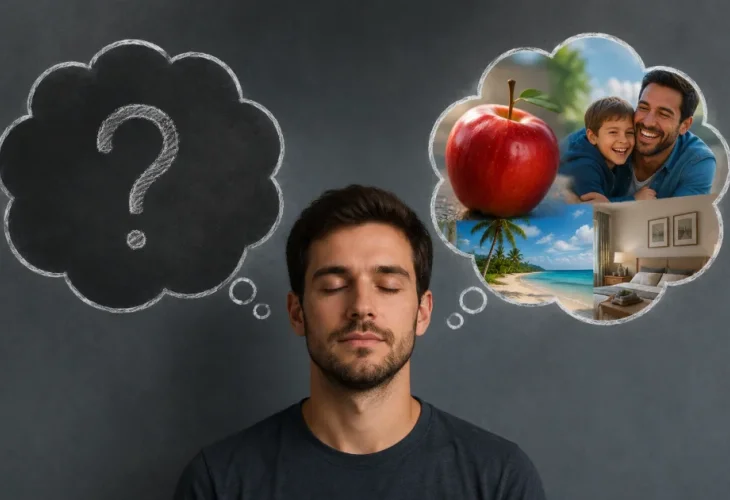
Close your eyes for a moment and picture a bright red apple. Most people can immediately imagine its shape, color, and even the shine on its skin. Now think of a close friend, your childhood bedroom, or a favorite vacation spot. Chances are, an image appears in your mind almost automatically.
But for some people, nothing appears at all.
No colors. No shapes. No mental picture.
This phenomenon is known as aphantasia, a condition in which a person is unable to create visual images in their mind. Although they know exactly what an object, person, or place looks like, they cannot "see" it in their imagination.
What Is Aphantasia?
People with aphantasia often describe their inner experience as entirely different from what most people assume is normal.
When asked to imagine a beach, a family member, or a familiar object, they do not see a mental image. Instead, they may think about the concept itself or describe it using words and facts. They know what the thing looks like, but they cannot generate a visual representation of it in their mind.
Many people with aphantasia spend years unaware that their experience is unusual. When teachers, books, or guided exercises encourage them to "picture" something, they often assume the instruction is figurative rather than literal.
Only later do they discover that many people can actually create vivid mental images at will.
Why Does It Happen?
Researchers believe aphantasia is related to differences in how certain regions of the brain communicate with one another during visual imagination.
Although scientists are still studying the phenomenon, there is no evidence that it reflects a problem with intelligence, memory, or mental health. Aphantasia is simply a different way of experiencing the world.
People with aphantasia can be highly intelligent, creative, and successful. Many work in fields such as science, technology, writing, education, and even the arts.
How Does It Affect Daily Life?
The experience varies from person to person.
Some individuals report that it can be harder to mentally revisit memories because they cannot visually replay past events in their minds. While they remember what happened, the memory may feel less like a picture and more like a collection of facts, ideas, or emotions.
Others say they naturally think in words, concepts, patterns, or logical structures rather than images. For them, aphantasia is not a limitation but simply the way their minds have always worked.
In many cases, people with aphantasia do not feel disadvantaged at all. They simply process information differently.
The Opposite Phenomenon
Interestingly, there is also an opposite condition known as hyperphantasia.
People with hyperphantasia experience exceptionally vivid mental imagery. They can create detailed, colorful, and lifelike scenes in their minds, sometimes with a level of clarity that feels almost as real as actual vision.
While people with aphantasia may see only darkness when they close their eyes and imagine something, those with hyperphantasia can mentally visualize entire landscapes, faces, and scenes in extraordinary detail.
Different Minds, Different Experiences
The discovery of aphantasia has revealed something fascinating about the human brain: not everyone experiences thought in the same way.
Some people think primarily through images. Others think through words, concepts, emotions, or abstract ideas. Most of us assume that everyone experiences the world internally the same way we do, but research continues to show that the human mind is far more diverse than we once believed.
Whether a person sees vivid pictures in their imagination or none at all, aphantasia is a reminder that there is no single "correct" way for the brain to think. It is simply one of the many remarkable variations that make each mind unique.

