

History and Archaeology
Ferenc Szálasi: The Man Who Turned Budapest Into a Nightmare
As Nazi Germany tightened its grip on Hungary, Ferenc Szálasi became the architect of one of the Holocaust's darkest chapters.
- Yosef Yaavetz
- | Updated
By the summer of 1944, much of European Jewry had already been destroyed. The Jews of Lithuania had been murdered in mass shootings, Polish Jewry had been decimated in the death camps, and hundreds of thousands of Hungarian Jews from the provinces had already been deported to Auschwitz.
Yet in Budapest, a fragile hope still remained.
Hundreds of thousands of Jews continued to live in the Hungarian capital. They faced discrimination, restrictions, and growing persecution, but they were still alive. For a brief period, Budapest became one of the last major centers of Jewish life in a Europe engulfed by destruction.
Many believed they might survive until the end of the war.
Then everything changed.
The Rise of Ferenc Szálasi
The turning point came in October 1944, with the rise of a man named Ferenc Szálasi.
Born in 1897 in the city of Kassa, then part of the Austro-Hungarian Empire, Szálasi came from a military family and followed a similar path, attending military academies and serving in the Hungarian army. The collapse of the empire after World War I profoundly shaped his worldview.
Convinced that Hungary's territorial losses and national decline needed to be reversed, he developed an extreme political ideology known as "Hungarism," combining radical nationalism, antisemitism, authoritarianism, and admiration for European fascist movements.
In 1935, he founded the movement that would later become known as the Arrow Cross Party. Its members wore military-style uniforms, embraced fascist symbolism, and presented themselves as a revolutionary alternative to Hungary's existing leadership.
Although Szálasi was imprisoned several times during the 1930s, his movement continued to grow, attracting supporters from nationalist circles and among segments of the urban poor. By 1939, the Arrow Cross had become a significant political force, though Szálasi himself remained outside the country's highest positions of power.
The Nazi Takeover of Hungary
The decisive moment came in October 1944.
Hungarian Regent Miklós Horthy attempted to withdraw Hungary from its alliance with Nazi Germany and negotiate an armistice with the Soviet Union. Germany responded immediately.
In a coup known as Operation Panzerfaust, Horthy was removed from power and Szálasi was installed as both prime minister and "Leader of the Nation." From that moment forward, his regime operated under direct German protection and support.
For Budapest's Jews, the consequences were devastating.
Terror in Budapest
Within weeks, the city became a scene of brutality and fear.
Arrow Cross militiamen stormed Jewish homes, confiscated property, and forced Jews into designated "Yellow Star Houses." Families were torn apart, possessions were looted, and arbitrary violence became a daily reality.
One of the most horrific crimes took place along the banks of the Danube River.
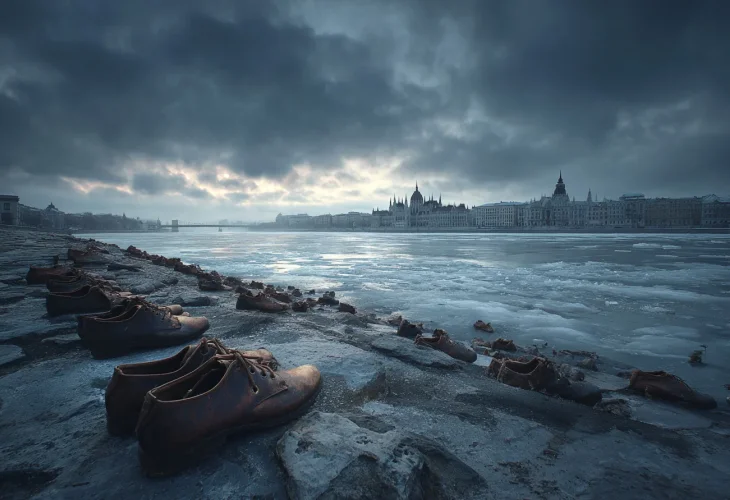
Jewish men, women, and children were marched to the water's edge, ordered to remove their shoes, and then shot. Their bodies fell into the river below. Today, the famous "Shoes on the Danube Bank" memorial stands as a reminder of those atrocities.
Others were forced onto brutal death marches toward Austria during the harsh winter months. Many died from exhaustion, starvation, disease, and abuse along the way.
Historians estimate that tens of thousands of Jews were murdered during Szálasi's brief rule, while approximately half a million Hungarian Jews perished in the Holocaust overall.
A Community Under Siege
Before the war, Budapest had been home to one of Europe's most vibrant Jewish communities.
Its Jews maintained synagogues, schools, newspapers, charitable organizations, and thriving communal institutions. Within a matter of weeks, that world was shattered.
Survivors later described a reality of constant fear, surprise raids, disappearances, and uncertainty about whether they would survive another day.
Yet even amid the darkness, there were those who acted courageously.
Foreign diplomats and Righteous Among the Nations established safe houses, issued protective documents, and risked their own lives to rescue Jews. Thanks to their efforts, tens of thousands were ultimately saved.
The Fall of the Arrow Cross Regime
Szálasi's reign of terror was intense, but it was also short-lived.
As the Soviet Red Army advanced toward Budapest, the Arrow Cross government began to collapse. By January 1945, the city had fallen, ending Szálasi's control over the capital.
He fled westward, hoping to escape justice.
He failed.
Justice After the War
Following Germany's defeat, Szálasi was captured and returned to Hungary.
In 1946, he stood trial in Budapest on charges that included war crimes, collaboration with Nazi Germany, and responsibility for mass murder. Witnesses testified about the crimes committed under Arrow Cross rule and the terror inflicted upon Hungarian Jewry.
The court found him guilty and sentenced him to death.
In February 1946, Ferenc Szálasi was executed by hanging.
A Dark Chapter in Jewish History
Ferenc Szálasi ruled Hungary for only a few months, yet the devastation inflicted during that short period left a lasting scar on Hungarian Jewry.
His rise to power transformed Budapest from one of the last remaining centers of Jewish life in Europe into a place of fear, violence, and mass murder. The story serves as a sobering reminder of how quickly hatred, when empowered by a government, can unleash unimaginable destruction.
Today, the memory of Budapest's Jewish community, and of those who suffered and perished during those final months of the Holocaust, continues to stand as a testament to both tragedy and resilience.

