

Magazine
She Went to the Army Synagogue for a Break: Then She Discovered Prayer
Muriel entered an army synagogue simply to take a break. What she discovered there eventually transformed her entire life.
- Michal Arieli
- | Updated
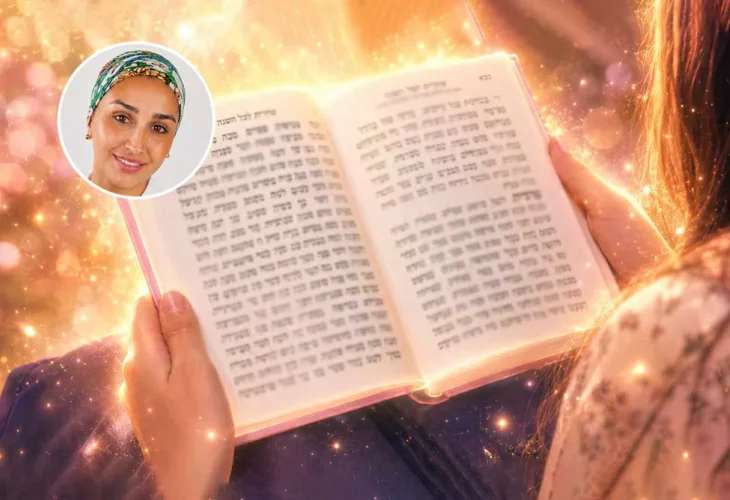
How does a young Israeli woman who grew up largely disconnected from Judaism find herself, years later, living as a Haredi wife and mother in Herzliya? For Muriel Hadar Gutgold, the journey began in one of the most unexpected places: an army intelligence base, where a simple visit to the synagogue introduced her to a world she had barely known existed.
"My story is very surprising," she says at the beginning of our conversation. "To this day, I run into friends who are shocked to see me with a head covering and modest clothing. It doesn't match the person I used to be, so far away and so disconnected. But baruch Hashem, I experienced a real change in my life, and it's the best thing I could ever have wished for myself."
A Discovery in the Base Synagogue
Muriel takes us back to her childhood. "I come from a home that would be defined as traditional, but very lukewarm when it came to tradition. We would make Kiddush on Shabbat, but right afterward we'd get in the car and go out. We fasted on Yom Kippur and avoided chametz on Pesach, but not much beyond that.
"At 18, I enlisted in the army and served in military intelligence. Back then, I had a friend who served with me, and we were even in the same room. For a long time, I noticed that she was consistently released early from the morning shift because 'she's going to pray.' I didn't know much about prayer, but I thought to myself, 'That doesn't sound so bad. Why shouldn't I go pray too?'"
That was how Muriel also became one of the "girls who pray."
"Every day, I would go to the synagogue on base, sit off to the side, and get myself together a little: put on makeup, do my hair, and enjoy the idea of the break I was being given."
But eventually, curiosity took over.
"I asked my friend, 'What do you do in the synagogue? What are you supposed to read?' She opened the siddur for me, and for the first time in my life I was exposed to the verses of Kriat Shema, the morning prayers, and the personal requests in the Shemoneh Esrei. It fascinated me, and really, through that first encounter with prayer, I began to grow stronger."
Within a short time, Muriel began studying in a women's seminary and immersed herself in Torah classes. Before long, she went from listening to classes to giving them herself. Gradually, more girls gathered around her, and she discovered how meaningful it was to strengthen others.
"I started to understand how much power there is in a good word that I say, in an encouraging idea that I share, and in the light that suddenly turns on in the eyes of someone listening to me. I was deeply moved when girls told me they were growing stronger because of me. I realized that part of my purpose in this world is to encourage and inspire the people around me, and to awaken in them excitement in serving Hashem and drawing closer to the Creator."
Muriel then began looking for a practical way to combine that sense of purpose with something already deeply connected to her family.
"Because I come from a family of jewelers, and my parents manufacture silver jewelry, I felt these things could come together in a remarkable way."
She began creating jewelry carrying messages of faith and spiritual growth. The idea came partly from conversations with people who had tattoos.
"They explained to me that it came from a desire to awaken something in the body and give it meaning. It hurt me to hear that. I decided to take that desire to a different place, a holier and purer one."
One of the pieces she created was engraved with the words, "Nothing is more beautiful than modesty," and was designed for women who had taken on a new commitment in modesty. Another woman, who had called off her wedding at the last minute, ordered a ring engraved with the words, "Everything is for the best."
"Women tell me that wearing these pieces brings them thoughts of teshuvah, strengthens them, and truly stirs their hearts. Hearing that fills me with joy."
Muriel also finds other ways to encourage women in their spiritual growth.
"If one of the girls takes on a spiritual commitment for 40 days and keeps it successfully, she writes to me about it, and I send her a beautiful gift to encourage and strengthen her. That's how I try to motivate and uplift."
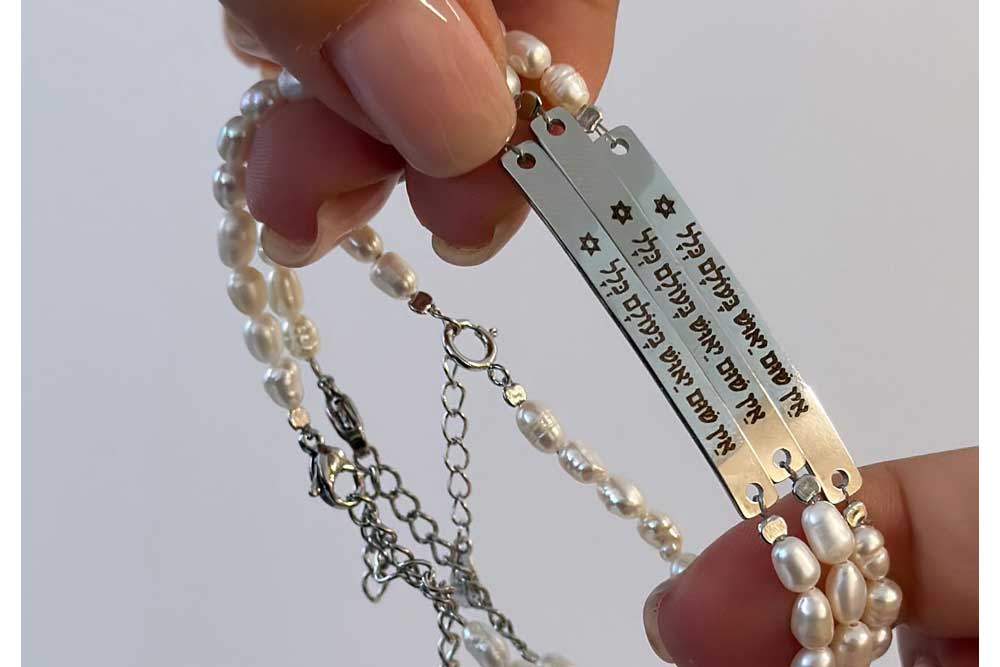 A bracelet created by Muriel, engraved with “There is no despair in the world at all.”
"I Didn't Burn Any Bridges"
As Muriel's religious observance grew, her surroundings naturally began to change.
"Of course, as I grew stronger, I started changing my social circle," she explains. "It wasn't because I wanted to leave people behind or disconnect, but my friends kept going to parties at the Tel Aviv port, while I had moved on to study in seminary.
"Even so, to this day I still have a few good friends from my past whom I'm in excellent contact with, even though they aren't religious. I didn't burn bridges with anyone. I simply kept moving forward, because I felt that a huge world had opened up before me, one I had never known at all until then."
How did her parents react?
"My mother is a very spiritual woman, and she didn't mind that I was taking that spirituality in a different direction from her own. My father, by contrast, liked it less at first. He was sure it was a temporary phase that would pass, and that in a few years I'd laugh about what I had gone through. He didn't believe it would last. But in the end, he adjusted to the situation."
And Muriel's influence eventually reached another member of the family.
"Today, he also has to adjust to the fact that my younger sister grew stronger because of me, and she keeps Shabbat and is careful about modesty."
Throughout her journey, however, Muriel was determined that becoming more observant would never mean becoming estranged from her family.
"I heard quite a few painful stories about children who grew stronger religiously and, as a result, became estranged from their parents. That hurt me deeply. My parents are the most important people in the world to me, and it was clear to me from the very beginning that there was a way to maintain a close relationship and honor them. There is no reason religion and family need to clash."
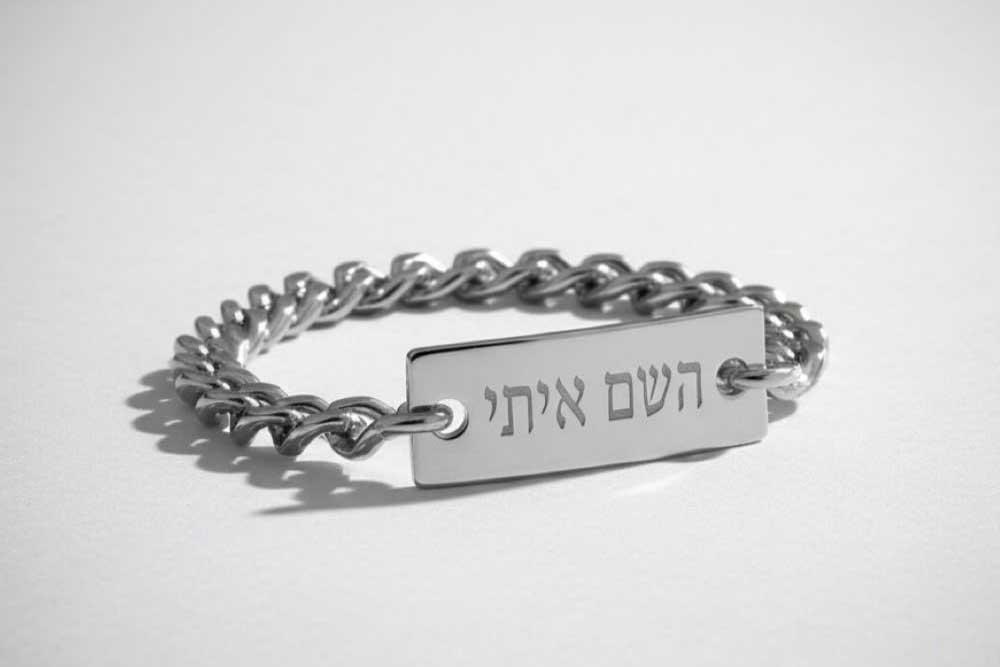 A bracelet engraved with "Hashed is with me"
From Teshuvah to Marriage and Family
Today, 10 years after beginning her journey of teshuvah, Muriel's life looks completely different. She lives with her husband and children in the young Haredi community in Herzliya, led by Rabbi Shmueli, and sees her life there as a mission.
"My husband also became religious," she reveals. "And our matchmaker was none other than Rebbetzin Lasri, wife of Rabbi Michael Lasri."
The connection began when Muriel met the Rebbetzin at a seminar for people growing stronger in their Judaism.
"I told her that I was connected with a lot of girls, and since then, with siyata dishmaya, we've made quite a few matches together. One day, the Rebbetzin surprised me and said she had a young man she thought might be right for me. That's how she introduced me to my husband."
Even after becoming religious, Muriel had never imagined that she herself would meet her future husband through a shidduch.
"At first, the whole idea scared me. Meeting a few times and immediately deciding you want to get married? After all, I didn't come from that world. But that is exactly what happened for me too. We met a few times, felt this was it, and decided to move forward."
A few months later, they married in a fully separate wedding with high standards of kashrut.
"To this day, I still can't believe I got to this place. All I thought was that I wanted to get a little stronger, and here I am, a Haredi woman in every sense, married to my dear husband and a mother of four wonderful children."
Strengthening Others and Growing Alongside Them
Muriel's desire to help others has only expanded over the years. Alongside her work in jewelry, she has become an active matchmaker herself.
"I've had the privilege of making quite a few matches, and we even have a couple in our own Herzliya community whom my husband and I matched. We see them up close, watch how they built their home, and they even have children in preschool together with our children. It brings us enormous satisfaction, joy, and happiness."
Muriel has also studied Jewish psychology and uses what she has learned to support women who come to her.
"I do it voluntarily. I meet women who come to me for Torah classes, and I try to help and support them. Women sometimes laugh with me and say that you can't go through a strengthening process without texting with me."
Yet Muriel insists that she receives just as much as she gives. A journey that began with taking a break from an army shift eventually introduced her to prayer, Torah, marriage, motherhood, and a life centered on strengthening others.
"In the end, first and foremost, I'm the main one who gains," she says. "To live inside a world of encouragement, giving, and holiness is something with only upsides. I have no doubt about that at all."

