

Wonders of Creation
The Ark That Occupied No Space: A Fascinating Connection Between Torah and Modern Physics
How the Talmud's mysterious description of the Ark of the Covenant echoes modern concepts of space-time curvature, black holes, and the idea that the Torah transcends the limits of the physical universe
- Yosef Yaavetz
- | Updated
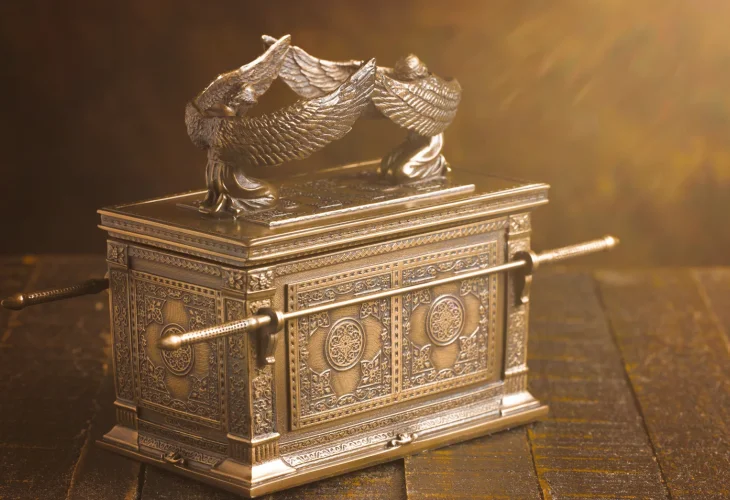 (Photo: shutterstock)
The Sages teach that the Ark of the Covenant, which stood in the Holy of Holies, "did not occupy any space" (Yoma 21a; Megillah 10b). How could such a thing be possible?
For many centuries, space was viewed as a fixed framework within which reality existed. However, since the work of Albert Einstein and the development of General Relativity, scientists have come to understand that space and time are not rigid and absolute. Instead, space-time is flexible and can be bent or curved.
According to General Relativity, every object with mass causes a curvature in the fabric of space-time around it. The greater the mass, the greater the curvature.
To illustrate this complex idea, physicists often use a simplified two-dimensional model. Imagine a large sheet stretched tightly in all directions. If you roll a small ball across it, the ball will travel in a straight line.
Now place a basketball in the center of the sheet. The weight of the basketball causes the sheet to sag and curve around it. The once-flat surface has become curved. If you now roll the small ball across the sheet, it will no longer travel in a straight line. Instead, its path will be altered by the curvature created by the basketball.
This analogy helps illustrate how massive objects influence the space around them.
The Mystery of Black Holes
Scientists eventually discovered regions in the universe where gravity is unimaginably strong.
The explanation is that these regions contain objects of extraordinary mass. Because they are so massive, they create extreme distortions in space-time. Any object that comes too close becomes trapped by their gravitational pull and effectively becomes part of their mass.
These objects cannot even be seen directly because their gravity is so powerful that even light cannot escape. Since they emit no visible light, they are known as black holes.
The Ark in the Holy of Holies
The Talmud describes an extraordinary phenomenon regarding the Ark of the Covenant.
The Holy of Holies measured twenty cubits in width. Yet when measurements were taken, there were ten cubits from the Ark to the wall on the right and ten cubits from the Ark to the wall on the left.
In other words, although the Ark physically stood in the room, it appeared not to occupy any measurable space at all.
From a purely mathematical perspective, this seems impossible.
Yet in light of the concept that space itself can be distorted, the idea may appear somewhat less strange than it once did.
One might suggest that the Ark represented a form of spatial distortion far beyond anything known in nature — even beyond the extreme curvature associated with a black hole.
If the Ark occupied no space whatsoever, one could describe the phenomenon as a complete collapse of spatial dimensions at that location, as though space itself had been folded, torn, or transcended.
Beyond Space and Time
General Relativity teaches that extreme curvature corresponds to extreme mass.
From a symbolic perspective, one could say that the Ark represented an infinite spiritual reality breaking into the finite world.
The Ark contained the Tablets of the Covenant and housed the Torah itself. The message may be that the Torah is not merely another object within creation. Rather, it transcends creation.
The Torah is eternal and infinite. It stands above the limitations of physical space and time.
Seen this way, the miracle of the Ark occupying no space expresses a profound spiritual truth: the Torah belongs to a dimension beyond the visible and measurable universe.
The Ark Carried Its Bearers
The Sages make another remarkable statement about the Ark. They teach that the Ark "carried those who carried it" (Yalkut Shimoni, II Samuel 5:142).
According to this tradition, those transporting the Ark through the wilderness were not truly supporting its weight. Instead, the Ark itself supported them.
This idea fits naturally with the miraculous nature attributed to the Ark. If its reality transcended ordinary physical laws, then its transportation would likewise transcend ordinary physical limitations.
The Torah's descriptions of the Ark suggest that it was extraordinarily heavy. The Tablets themselves were massive stone slabs. They were placed inside a wooden ark covered with gold, along with an additional outer covering and a golden lid known as the kaporet.
The total weight would have been immense. The simple physical carrying poles and rings described in the Torah appear insufficient to support such a load by ordinary means.
For the Sages, this was evidence that the Ark's transportation was supernatural.
A Deeper Lesson
Yet the physical miracle is only part of the story.
The deeper lesson is not merely that the Ark defied the laws of nature, but that we do not carry the Torah; the Torah carries us.
At first glance, it may seem that human beings sustain Torah through study, observance, and dedication. But the message of the Ark is the opposite.
The Torah is the source of our strength. It is the Torah that sustains us, uplifts us, and gives meaning and direction to our lives.
The Ark that occupied no space and carried its bearers teaches that divine wisdom belongs to a reality far greater than our physical world — and that when we attach ourselves to it, we discover that what we thought we were carrying is, in truth, carrying us.

