

Facts in Judaism
The Cave of the Patriarchs: 10 Fascinating Facts
Explore the traditions, mysteries, and history surrounding the Cave of the Patriarchs, one of the most sacred places in the Jewish world.
- Yonatan HaLevi
- | Updated
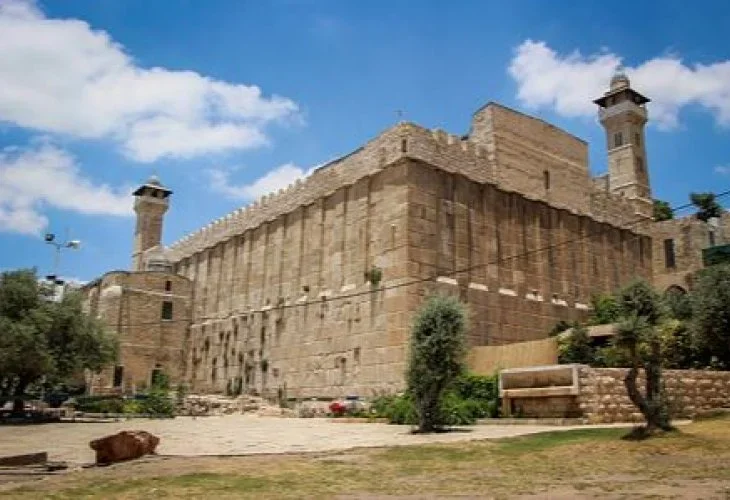 The Cave of the Patriarchs (Photo: Gershon Elinson/Flash90)
For centuries, Jews dreamed of reaching one of Judaism's holiest sites. Yet for more than 700 years, they were forbidden from entering the Cave of the Patriarchs, forced to stop at the famous "seventh step" outside its gates.
Today, the massive structure that dominates Hebron is recognized around the world. But behind its ancient stones lie remarkable traditions, mysteries, and stories that stretch back to the very beginning of humanity.
Here are 10 fascinating facts about the Cave of the Patriarchs.
1. One of Judaism's Holiest Places
The Cave of the Patriarchs, located in Hebron, is traditionally identified as the burial place of Adam and Eve, Abraham and Sarah, Isaac and Rebecca, and Jacob and Leah.
Above the cave stands an impressive stone structure that has remained largely intact for nearly 2,000 years. Together with the Western Wall and the Temple Mount, the Cave of the Patriarchs is considered one of Judaism's holiest sites.
2. Abraham Purchased It as a Family Burial Place
The Torah records in detail how Abraham purchased the Cave of Machpelah and the surrounding field from Ephron the Hittite following Sarah's passing.
Unlike many ancient burial sites whose ownership is uncertain, the Torah emphasizes that Abraham paid the full price, 400 silver shekels, for the property, securing it as an eternal possession for his family.
The transaction is described at length in Genesis chapter 23.
3. According to the Zohar, Adam Chose the Site
The Zohar teaches that Adam himself recognized the unique holiness of the cave.
According to this tradition, he saw a ray of spiritual light emerging from the area and understood that it was connected to the entrance of Gan Eden. Drawn by its sanctity, he chose the site as his burial place.
4. Abraham Is Said to Have Discovered the Cave While Chasing a Calf
A famous tradition recorded in Pirkei DeRabbi Eliezer describes how Abraham first discovered the cave.
While preparing a meal for his guests, a calf escaped and ran into the cave. Abraham followed it inside and found Adam and Eve resting there, surrounded by light and a heavenly fragrance.
Inspired by the holiness of the place, he later sought to purchase it as a burial site.
5. A Tradition Links the Purchase to Jerusalem
Another tradition in Pirkei DeRabbi Eliezer connects Abraham's purchase of the cave with an oath involving Jerusalem.
According to this account, local inhabitants agreed to the sale only after Abraham entered into a covenant with them. The tradition is later connected to the difficulty the Jewish people experienced in conquering Jerusalem during the period of the Judges.
While not part of the plain reading of the Torah, this tradition has been discussed by generations of commentators.
6. One of Three Places Purchased for Full Payment
The Cave of the Patriarchs is one of three places that the Torah explicitly records as being purchased for full payment.
The other two are the Temple Mount, purchased by King David, and Joseph's burial place in Shechem, purchased by Jacob.
The Midrash notes that these purchases serve as a powerful response to any claim that these locations were taken unlawfully.
7. Caleb Prayed There Before Entering the Land
The Talmud relates that when the spies were sent to scout the Land of Israel, Caleb separated himself from the group and traveled to Hebron.
There, he prayed at the graves of the patriarchs, asking for strength not to be influenced by the negative report of the other spies.
His prayer was answered, and he remained faithful to Hashem's promise.
8. Why Is It Called Machpelah?
The name "Machpelah" has inspired several explanations.
Some commentators explain that it was simply the name of the field where the cave was located.
Others suggest it refers to a double cave, with one chamber above another.
Another famous explanation is that it refers to the pairs buried there: Adam and Eve, Abraham and Sarah, Isaac and Rebecca, Jacob and Leah.
Each interpretation reflects a different dimension of the site's significance.
9. The Structure Above the Cave Is Nearly 2,000 Years Old
The enormous stone structure surrounding the cave is among the best-preserved monumental buildings from the Second Temple period.
Many historians attribute its construction to King Herod due to its architectural similarities to other Herodian projects.
Others believe the structure may predate Herod and was built by earlier rulers.
Regardless of its exact origin, it remains one of the most impressive ancient buildings in the Land of Israel.
10. Jews Were Barred From Entering for More Than 700 Years
During the Mamluk period, Jews were forbidden from entering the compound.
For centuries, they were allowed to approach only as far as the seventh step near the entrance.
Following the Six-Day War in 1967, Jews once again gained access to the site after more than seven centuries of exclusion.
The connection of the Jewish people to the Cave of the Patriarchs remained strong throughout those years. The Rambam famously visited the site and considered the day of his visit so significant that he established it as a personal day of celebration and gratitude.
Today, thousands of visitors and worshippers come to the Cave of the Patriarchs each year, continuing a connection that stretches back thousands of years to the very beginnings of Jewish history.

