

World News
Why Israel Can’t Destroy Every Iranian Missile Before Launch
After Iran published footage of a missile launch toward Haifa, the question is why hidden launchers and underground sites remain so difficult to stop
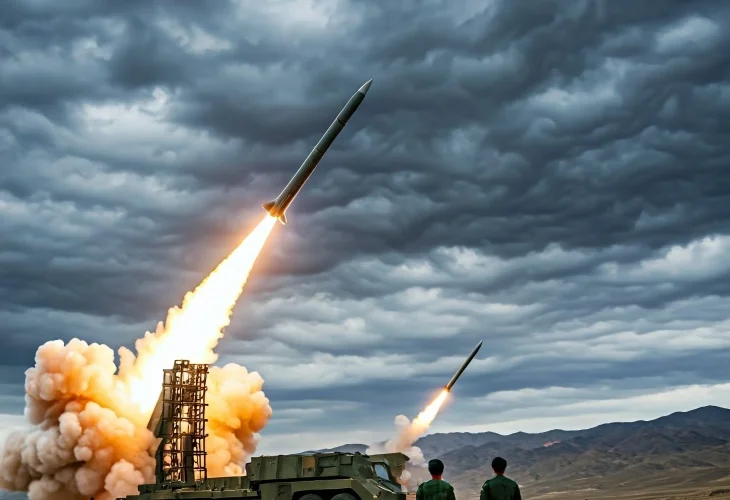 Shutterstock
Iran’s publication of footage showing a ballistic missile launch toward Haifa has renewed a common question in Israel: why can’t the IDF simply destroy all of Iran’s missiles before they are fired?
The answer is that the challenge is not just the missile itself. It is the entire launch system around it. Many Iranian ballistic missiles are hidden, mobile, or stored in underground facilities, giving Iran the ability to launch from multiple places while making it harder for Israel to strike every missile before takeoff.
Iran has spent years building what it calls “missile cities,” a network of tunnels, bunkers, mountain facilities, storage sites, and underground launch areas designed to protect its missile force. These sites allow missiles and launchers to be stored, moved, and prepared out of sight.
Even if Israel knows the location of many Iranian missile bases, that does not mean every missile inside can be destroyed. Some facilities are deep underground. Some entrances can be damaged while other parts of the complex remain usable. Missiles and launchers can also be moved between sites before or during a conflict.
A simplified launch process shows why timing is so critical. A launcher may be hidden inside a tunnel, cave, bunker, warehouse, military base, or mountain facility. Once launch orders are given, it can move into position, raise the missile, fire, and then relocate or hide again.
In some cases, the launcher may only be visible for a few minutes. For Israel to prevent the launch, it must detect the launcher, identify it as a missile launcher, track it, approve a strike, and hit it before the missile is already in the air.
That window can be extremely short, especially with modern ballistic missiles. Solid-fuel missiles do not need to be fueled immediately before launch. They can be stored in a ready-to-fire condition, allowing the launch process to move quickly once the launcher is in place.
This is why Israel does not only try to hit missiles at the moment of launch. Israeli air campaigns against Iran have targeted missile bases, tunnel entrances, storage sites, command centers, production facilities, and launch infrastructure. The goal is to weaken the entire missile network, not only individual missiles.
But the fact that Iran is still able to launch missiles does not necessarily mean Israel lacks intelligence. It can also mean Iran still has enough surviving launchers, missiles, underground facilities, and dispersed infrastructure to keep firing despite Israeli strikes.
Mobile launchers are another major challenge. They are essentially large military trucks that carry ballistic missiles. They can be parked in tunnels, military zones, warehouses, or concealed areas, then move out briefly to launch and disappear again.
Iran is also a large country, and no intelligence service has a live tracker on every missile or launcher. Even with advanced intelligence from Israel, the U.S., and other partners, the process of locating and striking mobile launchers in real time remains difficult.
After launch, Israel and the U.S. can intercept many incoming ballistic missiles. But no air-defense system can guarantee a perfect interception rate in every wave. Iran tries to fire from different locations and launch salvos designed to challenge defenses with speed, distance, and volume.
The bottom line is that Israel’s intelligence and air-defense systems are advanced, but they are not magic. Stopping every missile before launch means finding hidden, mobile launchers across Iran and destroying them within minutes. That is why Israel combines intelligence, pre-launch strikes, launcher hunting, attacks on missile infrastructure, and interception once missiles are already in the air.

