

Parashat Shelach
Why the Women Never Lost Faith in the Promised Land
What the Sin of the Spies teaches about hope, leadership, and continuity
Due to a quirk in the calendar, we in Israel are one Torah portion ahead of the rest of the Jewish world. On the holiday of Shavuot, while the Diaspora celebrated the second day on Shabbat, we in Israel had a regular Shabbat. As such, that week, we read from the weekly Torah portion while the Diaspora read the reading of the holiday, and now we are a week ahead.
All this to say that it was last week, here in Israel, that we read the fourth portion of the book of Numbers, which the Diaspora will be reading this week. As far as Torah portions go, it is utterly tragic. The Israelites were on the threshold of entering the land promised to their forefathers, the land flowing with milk and honey. Moses thought they were ready; he loved the land with every fiber of his being and he thought the same about his people. And so when they asked to send a group of scouts to check out the terrain, he agreed.
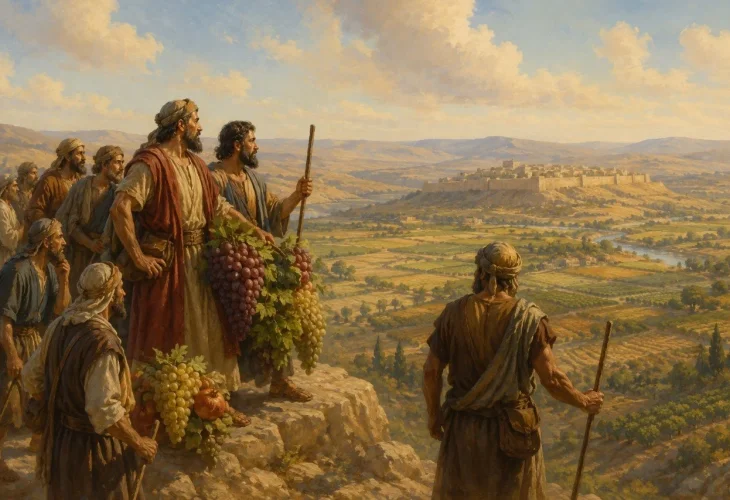
Forty days after the scouts set out, they returned with fruits so large they could have fed a family for a week, proof of the land’s bounty. But, they said, it is a land that consumes its inhabitants. The people are giants, the cities are fortified, and we cannot conquer the land because the nations there are too strong. And the people panicked.
The end of the story, of course, is that the people were punished with wandering in the desert for forty years, one year for each day that the scouts were in the land. Instead of a short stint in the desert, two full generations would go by from the Exodus until the Israelites would cross the Jordan River. And everyone who was counted in the census as they left Egypt would die in the desert, with the exception of Caleb and Joshua. They were the only two of their entire cohort who merited to see the land.
There were, interestingly, two groups who did not partake in the Sin of the Spies, and therefore were excluded from the punishment. One such group was the Levites, who had already set themselves apart by not being enslaved in Egypt and by not partaking in the Sin of the Golden Calf. They were the tribe of priests and holy men, living in their own encampment between the other tribes and the Tabernacle, giving them the space and strength to do what was right.
The other group that did not partake in the sin was the women. Rabbi Shlomo Ephraim of Luntschitz, a sixteenth century Polish scholar known for the name of his Biblical commentary, the Kli Yakar, comments on the second verse of the portion, when God tells Moses, “Send for yourself men who will scout out the land.” Kli Yakar picks up on the word men, and he says that if the women had been sent, the people would never have fallen because the women love this land and they would never have brought back a negative report.
I think this insight by Kli Yakar is the key to understanding what follows the sin. In the aftermath, the Jewish people were distraught. Understandably so. They had been strangers in a strange land for more than two hundred years, enslaved for a good portion of that time, and were on their way to being a sovereign people in their own homeland. Then the door was slammed shut and they were told that it would be years before that would happen and that most of them wouldn’t make it. And although the people brought it upon themselves, God, in His infinite mercy, immediately instructed Moses to teach the people two commandments that would go into effect only when they entered the land. It was His promise to them that although things look bad right now, there is a future. There is hope. Your children will enter the land and they will be the ones to begin keeping these mitzvot.
One of the two commandments given was that of hafrashat challah, separating a portion of dough. In the times of the Temple, that dough was given to priests; today, it is still separated but the portion is burned. Although not specified here in this week’s portion with the giving of the commandment, the Talmud lists hafrashat challah as one of the three commandments that are considered the domain of the woman, together with lighting candles for Shabbat and maintaining family purity. That’s not to say, of course, that a man is excluded from these commandments, but there’s a recognition that these are part of what it takes to build a home, where the woman is the mainstay and the backbone.
In light of Kli Yakar’s comment, it makes sense what this commandment is doing here, following the Sin of the Spies. The women never lost their faith in the land. They never lost their love of the land. And now, as the rest of the nation was in the depths of despair, God turned to them and charged them with keeping that hope—keeping that love—alive to sustain the people for the better part of the next forty years.
On Friday last week, as we prepared to enter the Shabbat in which we in Israel read of the Sin of the Spies, I made challah. I didn’t use enough flour to be able to take the priestly portion, but it was on my mind. And then my husband and I, together with my husband’s family, went cherry picking, going out into the land to enjoy its bounty. There were so many families, so many mothers with their children, maintaining the charge from three thousand years ago, doing their part in keeping that love alive and transmitting it to the next generation.
It was a small, but significant act, our way of continuing to rectify the Sin of the Spies, to remind God—and remind ourselves—that this is not a mistake we will ever again make.
Because this land of ours? She is very, very good (Num.14:7). And we know it.

