

Parashat Chukat
The Missing Piece of Teshuvah: An Ohr HaChaim Insight on Parashat Chukat
The Ohr HaChaim explains why Moshe's prayer brought healing, but not the complete removal of the fiery serpents.
- Amitai Hanya
- | Updated
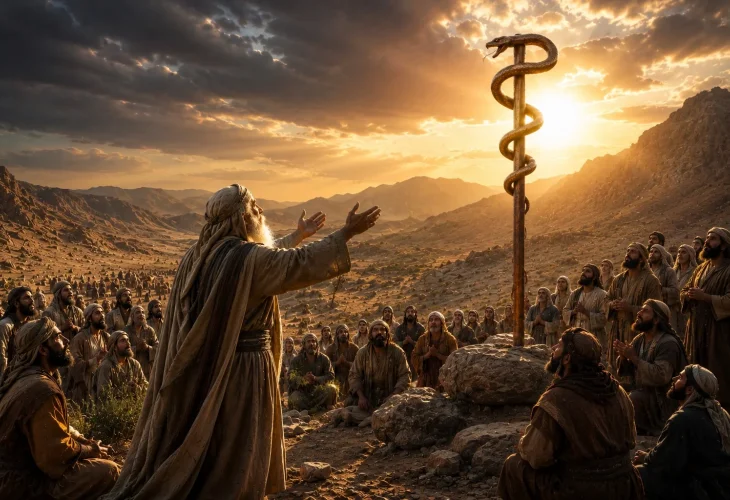
One of the most dramatic episodes in Parashat Chukat occurs when the Jewish people complain against Hashem and Moshe. As a result, poisonous snakes enter the camp, and many people are bitten.
Realizing their mistake, the people approach Moshe and confess:
"We have sinned, for we spoke against Hashem and against you."
Moshe prays on their behalf, and Hashem responds with a surprising instruction:
"And Hashem said to Moses: Make yourself a fiery serpent and place it on a pole, and it shall be that anyone who is bitten and sees it shall live" (Numbers 21:8).
The solution raises an obvious question.
If Moshe's prayer was accepted, why didn't Hashem simply remove the snakes altogether?
If there were no snakes, no one would be bitten, and no one would need healing.
Why leave the danger in place?
A Missing Element of Repentance
The Ohr HaChaim explains that Hashem, the ultimate Judge, examined the people's repentance and found that it was incomplete.
True, they confessed their wrongdoing.
True, they admitted their sin.
But one essential component of teshuvah was missing.
They regretted the past, but they never committed themselves to changing the future.
The people said, "We have sinned," but they did not say, "We will no longer speak this way."
They acknowledged their mistake, yet they did not clearly abandon the behavior that caused it.
According to the Ohr HaChaim, genuine teshuvah requires more than regret. It also requires a sincere commitment not to return to the same wrongdoing.
Because that element was lacking, the decree was not completely removed.
Why the Snakes Remained
The snakes remained for a purpose.
Hashem created a system that would help each person reach the level of repentance they still needed.
Someone who truly corrected his behavior and returned to Hashem wholeheartedly would be protected. The snakes would have no power over him.
But someone whose repentance was still incomplete might be bitten. The experience itself would serve as a wake-up call, pushing him toward deeper reflection and genuine change.
The punishment was no longer merely a punishment.
It became an opportunity for growth.
Looking Upward
Chazal famously explain that the copper serpent itself did not heal anyone.
Rather, when the people looked upward toward the serpent, their hearts were directed toward Heaven.
They were reminded that their salvation did not come from a piece of copper, but from Hashem.
The Ohr HaChaim explains that this process helped people complete what was still missing in their repentance. The encounter with the snake, followed by looking at the copper serpent, awakened them to examine their actions more deeply.
Through that reflection, they could fully return to Hashem and merit healing.
The Difference Between Regret and Change
This teaching highlights an important lesson about personal growth.
Many people regret mistakes.
Many people recognize when they have done something wrong.
But true change requires more than acknowledging the past.
It requires making a decision about the future.
The goal of teshuvah is not merely to say, "I shouldn't have done that."
It is to say, "With Hashem's help, I will strive not to repeat it."
A Path to Healing
The story of the fiery serpents teaches that Hashem's goal is not punishment for its own sake.
Even moments of difficulty can become opportunities for correction, growth, and return.
Sometimes a challenge remains in our lives because there is still something we need to learn from it.
When we use those moments to reflect honestly, strengthen our commitment, and draw closer to Hashem, they can become the very tools that lead us toward healing.
As the Ohr HaChaim teaches, the snakes remained not because Hashem wanted to harm the people, but because He wanted to help them complete the process of teshuvah and return to Him with their whole hearts.

