

Wonders of Creation
This Unusual Organism Can Predict Pollution and Survive Drought
Lichens are far more sophisticated than they appear, serving as both environmental indicators and survival specialists.
- Yehosef Yaavetz
- | Updated
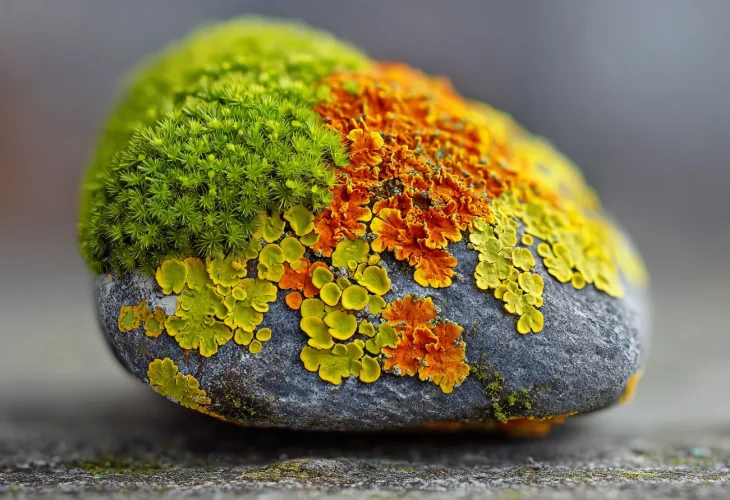
At first glance, lichen looks like little more than moss growing on a rock or tree trunk. But appearances can be deceiving. Lichen is not a plant at all. It is one of nature's most remarkable partnerships; a living collaboration between a fungus and either algae or cyanobacteria. Together, these very different organisms create a new biological system capable of surviving in some of the harshest environments on Earth.
What Exactly Is Lichen?
Lichen is a unique symbiotic partnership between a fungus and microscopic organisms that can produce energy from sunlight.
The fungus forms the outer structure, anchoring the lichen to rocks, trees, roofs, and other surfaces. It absorbs water and minerals from the environment while protecting its partners.
The algae or cyanobacteria, in turn, perform photosynthesis, converting sunlight into sugars that provide energy for the entire organism.
Together, they form a completely new biological unit that neither could create on its own.
A Master of Survival
Lichens are among the most resilient organisms on Earth.
They can be found growing on bare rock faces, tree bark, rooftops, desert landscapes, frozen tundra, mountain cliffs, and other places where few forms of life can survive.
Unlike plants, lichens have no roots and do not require soil. Instead, they absorb moisture directly from rain, fog, dew, and even humidity in the air.
When conditions become too dry, many lichens enter a dormant state. Their metabolism slows dramatically until water becomes available again. Once moisture returns, they quickly resume normal activity.
This ability allows them to withstand extreme cold, intense heat, and prolonged drought.
Built for Efficiency
Although lichens may appear simple, their internal structure is surprisingly sophisticated.
Many species contain several distinct layers:
A protective outer layer made of fungal threads
A photosynthetic layer containing algae or cyanobacteria
Internal layers that store water and provide support
Attachment structures that anchor the lichen to its surface
Each layer plays a specific role, helping the lichen collect sunlight, conserve moisture, and survive challenging environmental conditions.
Not All Lichens Look Alike
Lichens come in a variety of shapes and forms.
Crustose lichens cling tightly to rock or bark, appearing almost painted onto the surface.
Foliose lichens resemble small leaves or flattened lobes attached at the base.
Fruticose lichens grow outward like miniature shrubs or hanging strands.
There are also gelatinous lichens that appear dry and shriveled during drought but become soft and swollen when moisture returns.
Each form represents a different survival strategy adapted to specific environments.
Nature's Tiny Chemists
Lichens produce hundreds of unique chemical compounds.
Some protect them from intense ultraviolet radiation. Others discourage animals and microorganisms from feeding on them. Certain compounds help break down minerals in rock, while others create the striking orange, yellow, gray, red, and green colors seen in different species.
Historically, humans even used some lichens to produce dyes for textiles. Lichen-derived substances also played a role in the development of litmus paper, which is used to test acidity.
Growing at an Extraordinary Pace
One of the most remarkable things about lichen is how slowly it grows.
Some species expand by less than a millimeter per year. Yet this slow growth contributes to exceptional longevity. Certain lichens may survive for centuries or even thousands of years.
Because their growth rates are so predictable, scientists use lichens to estimate the age of exposed rock surfaces, landslides, monuments, and ancient structures.
This method is known as lichenometry.
The Organism That Helps Create Soil
Lichens are often among the first living organisms to colonize newly exposed rock.
Over time, they release natural acids that gradually break down minerals. Their fungal threads penetrate tiny cracks, widening them little by little.
As rock fragments accumulate and organic matter builds up, the process contributes to the formation of soil.
In many ecosystems, lichens help prepare the way for other plants and organisms to establish themselves.
Natural Air-Quality Monitors
Lichens are highly sensitive to environmental changes.
Because they absorb water and nutrients directly from the atmosphere, they are particularly vulnerable to air pollution.
Some species disappear entirely when pollution levels become too high. Others absorb and store pollutants such as heavy metals.
For this reason, scientists use lichens as biological indicators to monitor air quality, industrial pollution, climate change, and environmental health.
In a sense, lichens serve as living records of the environments in which they grow.
Tiny Contributors to the Nitrogen Cycle
Some lichens contain cyanobacteria capable of fixing nitrogen from the atmosphere.
This means they can convert atmospheric nitrogen into forms that other organisms can use.
In nutrient-poor environments, this ability can play an important role in supporting entire ecosystems.
A Unique Way of Reproducing
Because lichen is made up of multiple organisms living together, its reproduction is different from that of most plants.
Many species reproduce by releasing tiny fragments that already contain both the fungal and photosynthetic partners. Wind, water, or animals then carry these fragments to new locations, where they can establish new colonies.
More Important Than They Look
Lichens also provide food and shelter for countless living creatures.
In Arctic regions, they are a major food source for reindeer and other grazing animals, especially during winter months.
Lichens growing on tree branches provide nesting material for birds and create miniature habitats for insects and other small organisms.
Though they are often overlooked, lichens play a surprisingly important role in ecosystems around the world.
They may grow slowly and quietly, but their impact on the natural world is anything but small.

