

Evolution
From a Fly’s Compound Eye to Lizard Skin: The Infinite Beauty Woven Into Nature
A fascinating look at the intersection of biology, beauty, and purpose
- Yosef Yaavetz
- | Updated
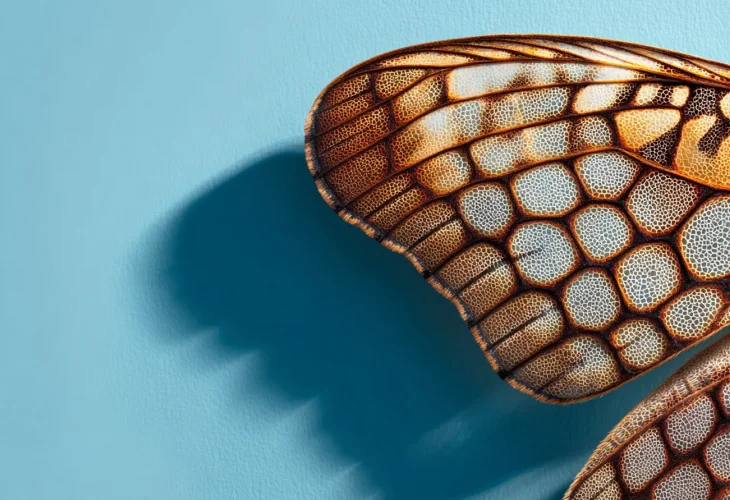
In recent years, scientists and philosophers have renewed their discussion of a fascinating question: does the beauty and order found throughout nature suggest that the universe is more than a product of random chance?
An article by David Coppedge on the Science and Culture website highlights a remarkable international study that explores this very issue. The research examines intricate patterns found throughout the natural world — patterns that are not only functional but strikingly beautiful.
Nature's Hidden Mosaics
The study's image database contains hundreds of examples from nature:
The compound eye of a fly
The shimmering scales of butterflies
Seashells
Turtle shells
Honeycomb structures
Sunflower seed arrangements
The skin of lizards and fish
At first glance, these structures resemble carefully designed mosaics, stained-glass windows, or finely crafted engineering projects. Tiny repeating units fit together with extraordinary precision, creating geometric patterns that seem almost too orderly to be accidental.
Researchers refer to these arrangements as tessellated patterns — repeating shapes that fit together like tiles in a mosaic.
The more closely one examines them, the more remarkable they appear. Not only do these structures function exceptionally well, but they also display symmetry, harmony, balance, and aesthetic beauty.
The Scientific Question
The study, published in PNAS Nexus by an international team of biologists, engineers, and designers, set out to answer a simple but profound question:
Why do living organisms create so many tessellated structures, and why do these structures appear beautiful rather than merely functional?
The researchers cataloged approximately 100 examples of biological tessellations, ranging from microscopic viruses to reptile scales and protective shells.
They classified them according to:
Shape of the "tile"
Material composition
Type of connections between units
Arrangement patterns
Biological function
Binding materials
Their findings revealed an almost universal pattern that appears repeatedly throughout the tree of life, spanning eight orders of magnitude in size.
The Functional Explanation
From a biological perspective, many of these patterns serve practical purposes.
For example:
Hexagonal honeycombs maximize storage while minimizing material usage.
Overlapping scales provide both flexibility and protection.
Butterfly scales create structural colors used for camouflage and signaling.
Compound eyes offer wide fields of vision.
The researchers emphasize that these designs are highly multifunctional, often providing strength, lightness, optical performance, protection, and sensory capabilities simultaneously.
Why Are They So Beautiful?
This is where the deeper question arises.
If Darwinian evolution operates through random mutations filtered by natural selection, why do the resulting structures so often resemble what humans perceive as beautiful?
Why do they exhibit:
Symmetry
Repetition
Harmony
Elegant proportions
Geometric sophistication
Why do nature's engineering solutions frequently resemble the work of architects, artists, and designers?
Competing Interpretations
Supporters of Intelligent Design argue that this observation points toward purposeful planning. They note that even modern biology often uses engineering language when describing living systems:
Optimized structures
Design trade-offs
Engineered solutions
Functional architecture
Such terminology reflects how biological systems often appear to balance multiple competing requirements with remarkable efficiency.
Traditional evolutionary explanations generally offer two responses:
Beauty as a Byproduct
Some scientists argue that beauty emerges incidentally from structures optimized for survival. In this view, a highly efficient design may simply happen to look beautiful.
Sexual Selection
Others suggest that aesthetic traits evolved because organisms prefer attractive mates, causing beautiful features to be preserved over time.
However, many examples discussed in the study — such as internal bone structures, shell formations, and certain scale arrangements, are difficult to explain solely through mate selection, since they are often hidden from potential partners.
A Different Perspective
From a faith-based perspective, these patterns may be viewed differently.
Rather than seeing beauty as an accidental consequence of physical processes, many believers see it as a signature of intelligence, purpose, and creativity.
In this view, beauty in nature is not merely decorative. It is a consistent and recurring feature woven into the fabric of life itself.
The same structures that perform precise biological functions also display elegance and harmony, as though efficiency and beauty were intended to coexist.
Science and the Bigger Question
The study does not reject biological mechanisms. On the contrary, modern science continues to uncover extraordinary details about the materials, forces, and processes that shape living organisms.
Yet a larger philosophical question remains:
Do these discoveries explain the ultimate origin of nature's patterns, or do they merely describe the rules through which those patterns emerge?
More Than Function
The result is a fascinating dual picture.
On one hand, science provides increasingly detailed maps of nature's extraordinary "tiles of beauty." On the other hand, these discoveries continue to fuel deeper questions about meaning, order, and design.
For those who see evidence of a Creator, the beauty of nature offers more than a challenge to purely material explanations. It serves as a quiet and enduring reminder that the world may be more than the product of blind processes — it may also be a work of artistry.

