

Evolution
The Koala Mystery: The Extraordinary Australian Animal That Continues to Fascinate Scientists
With human-like fingerprints, unique tree-climbing adaptations, and a lifestyle unlike any other creature on Earth, the koala remains one of nature’s most remarkable animals
- Yosef Yaavetz
- | Updated
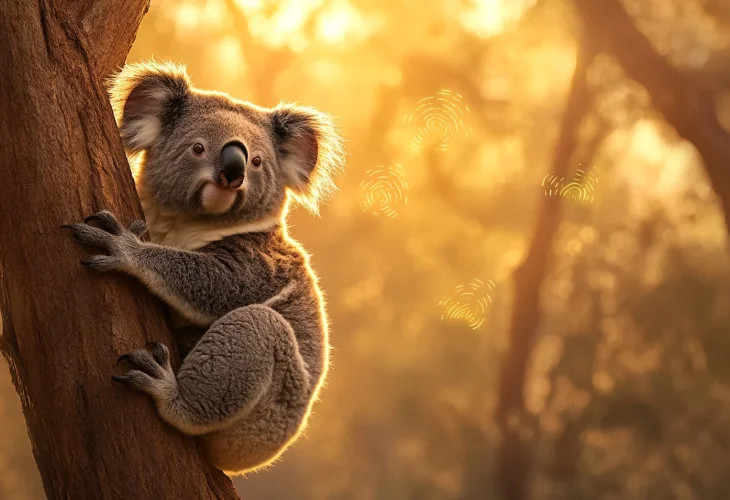
The koala is one of the world's most charming and recognizable animals. It is also remarkably rare. Koalas are found only in Australia, and only in the eastern regions of the continent.
Their diet is highly specialized — they feed almost exclusively on certain species of eucalyptus trees native to Australia. They spend around 18 hours a day sleeping, and much of their remaining time is devoted to eating eucalyptus leaves.
Not a Bear at All
Children often refer to the koala as a "koala bear" because of its soft fur and cuddly appearance. However, koalas are not bears and are not closely related to bears in either structure or genetics.
In fact, the koala is a unique animal with no close equivalent among living species.
One of its most fascinating features is that it possesses fingerprints. Unlike most animals, the skin on a koala's fingers forms patterns strikingly similar to human fingerprints. In theory, a koala's fingerprints could even be used to identify an individual animal.
Koalas are also marsupials, meaning they carry their young in a pouch attached to the mother's body, much like kangaroos and several other Australian species.
A Challenge for Materialist Explanations?
Some writers argue that the koala presents a challenge to materialist views of life's origins and development.
They point to its unusual combination of traits and ask how such a distinctive animal came to possess characteristics that appear so different from those of other species — including features such as human-like fingerprints.
Did these traits arise gradually from ancestral species, or do they point to something else?
The Debate Over the Koala's Origins
German researcher Wolf-Ekkehard Lönnig of the Max Planck Institute for Plant Breeding Research recently published an article challenging evolutionary explanations of the koala's development.
Lönnig discusses a claim made by evolutionary biologist Richard Dawkins, who suggested that the koala evolved from an animal similar to the wombat, partly because of similarities in their pouches.
According to Lönnig, however, the comparison is flawed. He notes that the koala's pouch opens upward, whereas the wombat's pouch opens downward. He argues that the upward-opening pouch is particularly well suited to an animal that spends its life climbing trees, helping to protect the joey while allowing it to observe its surroundings safely.
Built for Life in the Trees
Researchers have identified dozens of features uniquely adapted to the koala's lifestyle.
Among them:
Two opposable thumbs that provide a strong grip on tree branches.
An ability to obtain much of its water from eucalyptus leaves, reducing the need to seek out water sources.
Specialized digestive and detoxification systems that enable it to process the toxic compounds found in eucalyptus leaves.
A body structure optimized for climbing and resting in trees.
Supporters of intelligent design argue that these highly specialized features work together as an integrated system.
A Truly Unique Animal
Evolutionary biologist Danielle Clode, in her 2023 book about koalas, described them as uniquely distinctive creatures.
She notes that people often compare koalas to bears, wombats, sloths, or pandas because they share certain characteristics with those animals. Yet, she argues, such comparisons only go so far.
Koalas are ultimately unlike any other creature we know.
Complexity and Design
Lönnig also cites Austrian biologist Siegfried Scherer, who has written about the extraordinary complexity of living cells.
Scherer argues that compared to the sophistication of biological systems, even humanity's most advanced technologies remain relatively primitive.
From this perspective, proponents of intelligent design see features such as the koala's fingerprints, specialized digestive systems, and tree-climbing adaptations as evidence of purposeful design rather than undirected processes.
A Species in Need of Protection
Whatever one's views on origins, there is broad agreement on one point: the koala is a remarkable animal worthy of protection.
Today, koalas face significant threats, including habitat loss, disease, drought, and climate-related challenges.
The devastating Australian bushfires of 2019 had a particularly severe impact, destroying vast areas of habitat and killing large numbers of koalas across the country.
Despite these challenges, the koala remains one of Australia's most beloved animals — a gentle, fascinating creature whose uniqueness continues to capture the imagination of people around the world.

