

Evolution
Was One of Evolution's Most Famous Examples Flawed?
The story of the peppered moth appeared in science textbooks worldwide, but not everyone agrees on what it really proves.
- Yehosef Yaavetz
- | Updated
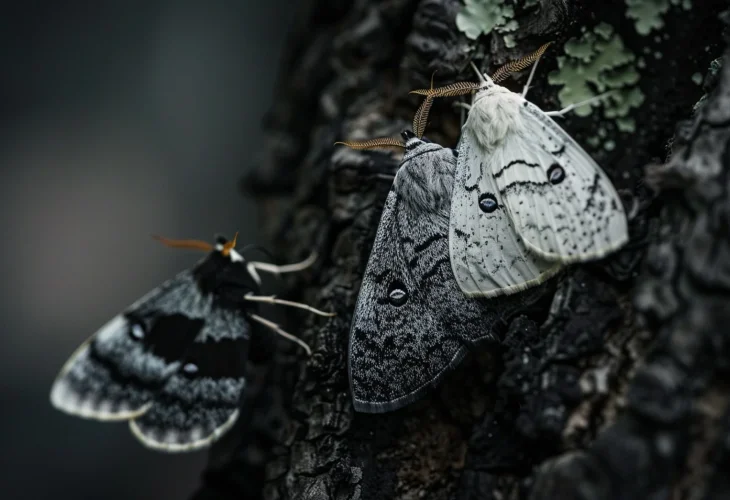
For decades, one of the most frequently cited examples of evolution in action has been the story of the peppered moth. The case appeared in countless textbooks, documentaries, and classroom lessons, often presented as a clear demonstration of natural selection at work. Yet over the years, questions have emerged about how the original experiments were conducted and whether the story is as straightforward as many people were led to believe.
The Famous Peppered Moth
The peppered moth is a species found in Britain. Its traditional appearance is light-colored with black speckles, giving it a peppered look and earning it its name.
In the 1950s, British biologist Bernard Kettlewell conducted a series of studies involving these moths. He argued that the Industrial Revolution had altered their environment in a dramatic way.
According to Kettlewell, soot from factories darkened many tree trunks throughout England. As a result, the lighter moths became more visible to predators, while darker moths were better camouflaged. Over time, the dark-colored form became more common.
The findings were widely celebrated and quickly became one of the most famous illustrations of natural selection. Photographs of light and dark moths resting on tree trunks appeared in textbooks around the world and were often presented as evidence of evolutionary change.
Questions Begin to Surface
Years later, however, researchers began taking a closer look at the experiments and the assumptions behind them.
One of the most vocal critics was molecular biologist Jonathan Wells, who examined Kettlewell's original research and the studies that followed.
Critics pointed out that the peppered moth story does not involve the appearance of a new species, a new organ, or a new biological structure. Instead, both the light and dark varieties already existed within the population. The change involved the relative frequency of existing traits rather than the emergence of entirely new ones.
For this reason, some argue that the example demonstrates natural selection within a species rather than large-scale evolutionary change.
Did the Moths Really Rest on Tree Trunks?
Another criticism focused on the moths' natural behavior.
Subsequent studies suggested that peppered moths do not normally spend much of their time resting on exposed tree trunks. Instead, they are more often found beneath branches or among leaves.
If this is correct, critics argue that the experimental setup may not have accurately reflected the moths' natural environment.
Some researchers concluded that Kettlewell's experiments placed moths in locations where they would not ordinarily be found, potentially affecting the results.
The Controversy Over the Photographs
Perhaps the most widely discussed criticism involves the famous photographs that appeared in textbooks for decades.
Because peppered moths are difficult to photograph in their natural resting locations, some of the iconic images were reportedly staged using specimens placed on tree trunks for demonstration purposes.
Critics argue that these photographs created a misleading impression about how and where the moths typically behave in the wild.
Supporters of Kettlewell's work counter that the photographs were intended as illustrations rather than direct documentation of natural behavior and that they do not invalidate the broader findings.
An Ongoing Debate
The peppered moth remains one of the most discussed examples in the history of evolutionary biology.
While many scientists continue to view the case as an important illustration of natural selection, critics argue that the story has often been presented in an oversimplified manner and that significant questions remain regarding the original experiments and their interpretation.
The controversy serves as a reminder that scientific ideas are constantly examined, challenged, and reevaluated. Even some of the most famous examples in science can become the subject of intense debate as new evidence and perspectives emerge.
Whether one sees the peppered moth as a strong example of natural selection or as a cautionary tale about scientific interpretation, its story continues to spark discussion more than half a century after it first captured the world's attention.

