

Evolution
Human and Chimpanzee DNA: Does Genetic Similarity Really Prove Evolution?
A thought-provoking exploration of the 96% genetic overlap between humans and chimpanzees, examining scientific claims, traditional Jewish perspectives, and the ongoing debate about human origins
- Rabbi Zamir Cohen
- | Updated
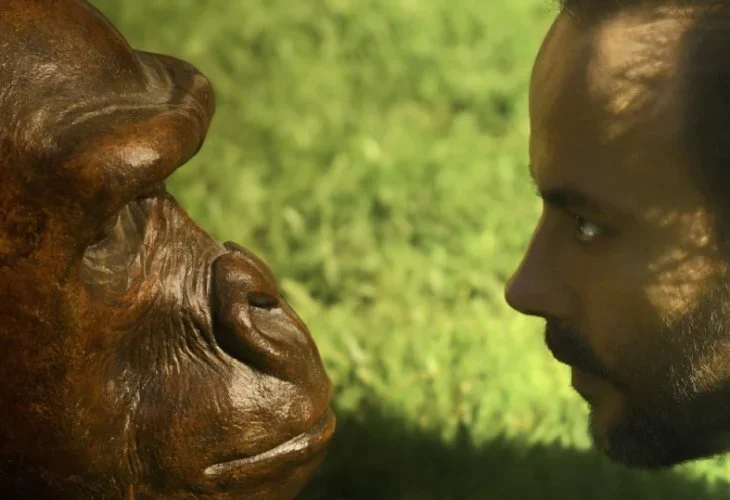
In 2005, a study conducted on chimpanzees by researchers from the Massachusetts Institute of Technology (MIT), Harvard University, and several international institutions found that approximately 96% of chimpanzee genes are identical to human genes.
Many critics of the Bible celebrated this discovery, believing it disproved the Torah's account that humanity was created from the dust of the earth and endowed with the breath of life, rather than descending from an ape-like ancestor.
However, according to traditional Jewish thought, this genetic similarity is not necessarily viewed as a contradiction to the Torah's account of creation. Some argue that it may even be interpreted differently altogether.
A Parable About Two Statues
Imagine a group of researchers making first contact with a remote indigenous tribe.
In the center of the village stands an ancient stone statue of a man. It is weathered, damaged, and clearly very old.
A few days later, the tribal chief leads the researchers into a magnificent building where they discover an identical statue — except this one is made of gold and is perfectly preserved.
After conducting their investigations, the researchers conclude:
"The stone statue must be the original. The golden statue was clearly copied from it. Over many generations, the tribe accumulated enough gold to recreate the ancient stone figure."
The next day, however, the chief tells them a different story.
According to tribal tradition, passed down through generations, the golden statue was actually the original. Hundreds of years ago, when Spanish conquerors arrived and sought gold, the tribe hid the precious golden statue and created a stone replica to display publicly.
The damage to the stone statue, he explains, came much later from unusual storms and environmental conditions.
In this scenario, the researchers have a theory based on observation and inference. The chief, on the other hand, presents a historical tradition that claims to preserve direct knowledge of past events.
The parable is intended to illustrate the distinction between interpreting evidence and relying on inherited testimony.
Two Different Explanations
Proponents of evolution see similarities between humans and chimpanzees as evidence of common ancestry.
Those who reject human evolution interpret the same similarities differently.
From this perspective, genetic resemblance does not necessarily establish ancestry. Similar structures may simply reflect similarities in design or origin.
The argument is that resemblance alone does not automatically reveal which organism came first.
The Torah's Account
According to the Torah, humanity was created directly by God: "And the Lord God formed man from the dust of the ground and breathed into his nostrils the breath of life, and man became a living soul" (Genesis 2:7).
Traditional Jewish belief maintains that this account was transmitted from generation to generation, beginning with Adam himself.
For those who accept this tradition as authoritative, it takes precedence over scientific theories regarding human origins.
Questions Raised About Human Evolution
Critics of human evolution often point to features they believe are difficult to explain through evolutionary processes alone.
Among the questions commonly raised are:
How did human language originate?
What evolutionary advantage first led to speech?
How did complex systems for language production and comprehension arise?
How did major anatomical changes occur, such as differences in skull structure and posture between humans and apes?
These questions continue to be debated among scientists, philosophers, and theologians.
An Ancient Jewish Tradition About Apes
Interestingly, some writers point to a passage in the Talmud concerning the generation that built the Tower of Babel.
The Talmud (Sanhedrin 109a) states that among those who rebelled against God, some were transformed into apes and other creatures.
According to this interpretation, certain ape-like beings originated from humans rather than humans originating from apes.
Supporters of this view argue that the Talmudic tradition anticipated a connection between humans and apes long before modern genetics discovered significant similarities between their DNA.
Different Ways of Interpreting the Evidence
The debate ultimately comes down to how one interprets the available evidence.
Evolutionary biology explains genetic similarities through common ancestry and gradual biological change over millions of years.
Traditional religious interpretations may view those same similarities through the lens of creation, inherited tradition, and divine design.
Regardless of one's position, the discovery of strong genetic similarities between humans and chimpanzees remains one of the most fascinating findings in modern biology — and continues to inspire discussion about human origins, identity, and the relationship between science and faith.

