

Evolution
Half Ape, Half Human: What Do the Fossils Actually Prove?
Researchers continue to debate how ancient human-like fossils should be interpreted and where they fit into the story of human origins.
- Yehosef Yaavetz
- | Updated
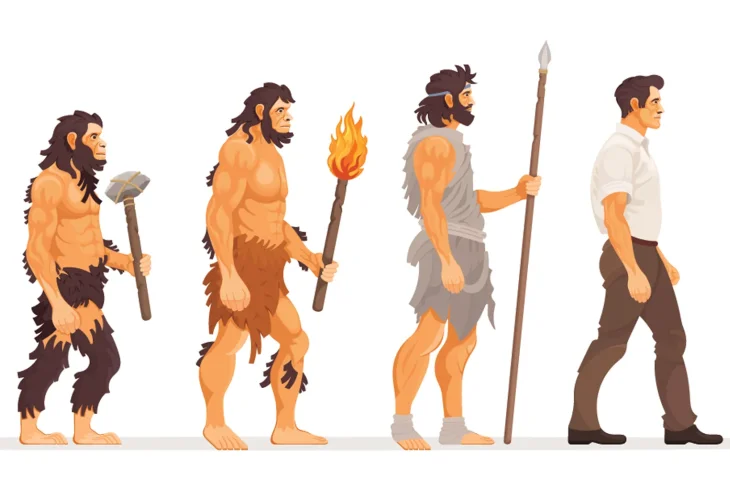 (Photo: shutterstock)
One of the most common claims made in discussions about human evolution is that scientists have discovered creatures that were "half ape and half human" and that these fossils prove humans evolved from ape-like ancestors.
But how much can fossils really tell us? And how certain are scientists about the ages assigned to these discoveries?
A reader recently asked:
"Rabbi, I saw that you wrote that creatures that appear half ape and half human do not necessarily prove that humans developed from them, but may simply be creatures with a mixture of physical characteristics. But aren't these fossils dated to hundreds of thousands or even millions of years ago?"
The answer touches on one of the most debated topics in paleoanthropology: fossil dating.
How Are Ancient Fossils Dated?
Many people assume that scientists can directly determine the age of a fossil by examining the bones themselves. In reality, the process is often more complicated.
The well-known radiocarbon dating method, commonly called carbon dating, can only be used on relatively recent organic remains and cannot date fossils that are hundreds of thousands or millions of years old.
As a result, researchers frequently rely on indirect methods. In many cases, they date the surrounding rock layers, volcanic deposits, or geological formations and then estimate the fossil's age based on its location within those layers.
Critics point out that this process can involve assumptions about the geological history of the site and that determining the precise age of a fossil is not always straightforward.
The Case of Homo Naledi
A fascinating example is Homo naledi, a species announced in 2015 following the discovery of more than 1,500 bone fragments in a cave system in South Africa.
The discovery attracted worldwide attention because of the unusually large number of fossils recovered from a single site. Yet despite the abundance of remains, one major question initially remained unanswered: How old were they?
According to researchers studying the find, the fossils provided extensive information about the anatomy of the creatures but offered little immediate evidence regarding their age. Without reliable dating, it was difficult to determine where Homo naledi fit within existing theories about human origins.
The challenge highlighted a broader issue that has accompanied paleoanthropology since its earliest days.
A Long History of Dating Challenges
The first recognized Neanderthal skeleton was discovered in Germany's Neander Valley in 1856. Unfortunately, before scientists realized the significance of the find, quarry workers had already disturbed the site and removed the bones from their original location.
As a result, valuable information that might have helped determine the fossil's age was lost.
At the time, scientists had few reliable methods for dating ancient remains. Some of the techniques used during the nineteenth century seem almost unbelievable today.
One surprisingly common method involved placing a bone against the tongue. Researchers believed that very old bones would stick to the tongue while newer bones would not. Although this approach was once taken seriously, scientists eventually abandoned it as unreliable.
Even after more sophisticated methods emerged, accurately dating ancient fossils continued to present challenges.
The Role of Interpretation
Critics of evolutionary theory argue that fossil ages are often influenced by broader assumptions about human origins and prehistory.
According to this view, fossils are frequently assigned ages and positions within an evolutionary framework based on theoretical expectations, and those same fossils are later presented as evidence supporting the framework itself.
Supporters of evolutionary theory disagree, pointing to multiple dating techniques and decades of accumulated evidence that they believe support the standard timeline.
Regardless of where one stands in the debate, it is important to recognize that dating ancient fossils is often more complex than popular presentations suggest.
Questions That Remain
Fossil discoveries continue to generate excitement because they offer rare glimpses into the distant past. At the same time, they also raise difficult questions.
How accurately can ancient remains be dated?
How much can scientists determine from incomplete skeletons?
And to what extent do existing theories influence the interpretation of new discoveries?
These questions remain at the center of ongoing discussions about human origins. Whatever conclusions one ultimately reaches, it is wise to approach such claims carefully, examine the evidence critically, and recognize that scientific interpretation is often more nuanced than a headline may suggest.

