

Evolution
Dinosaurs, the Flood, and the Asteroid Theory: A Torah Perspective on Extinction
Explore the debate between modern scientific theories and traditional Jewish teachings about fossils, giant creatures, and Earth's ancient past
- Dr. N. Vidal
- | Updated
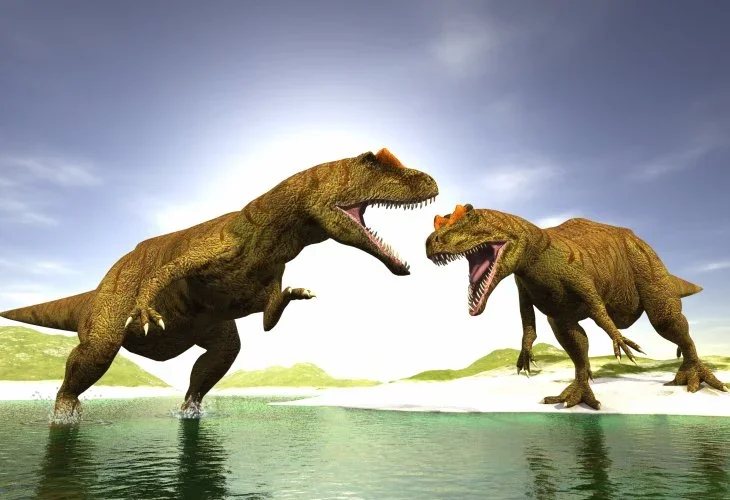
Various theories have been proposed to explain the disappearance of the dinosaurs. Among them, one of the most widely known is the asteroid-impact theory, which suggests that a massive asteroid struck Earth, devastated much of the planet's vegetation, and ultimately caused the extinction of the dinosaurs through starvation.
Around the world, scientists have discovered the fossilized remains of enormous creatures whose skeletons measure over 30 meters (100 feet) in length and reach heights of approximately 10 meters (33 feet). According to scientific estimates, some of these animals weighed dozens of tons. These creatures became known as dinosaurs, and many are believed to have resembled modern reptiles, though on a vastly larger scale.
The Scientific Explanation
According to conventional scientific understanding, many dinosaurs were herbivores that depended on abundant plant life for survival.
Their bones, buried underground for long periods, gradually underwent fossilization — a process in which minerals replaced the original organic material while preserving the shape of the bones.
Researchers generally conclude that dinosaurs disappeared from Earth approximately 65 million years ago. Various explanations have been suggested for this sudden extinction, but the asteroid-impact hypothesis has become one of the most influential.
According to this theory, a giant asteroid collided with Earth, triggering catastrophic environmental changes, widespread destruction, and a collapse of plant life. Without sufficient vegetation, many herbivorous dinosaurs would have died, followed by the extinction of predators that depended on them.
Scientists have even identified what they believe to be the impact site: the Chicxulub crater in the region of the Gulf of Mexico, which spans roughly 200 kilometers (125 miles) in diameter.
A Torah-Based View of Giant Creatures
Traditional Jewish sources do not necessarily dispute the existence of enormous animals in the past.
The Zohar and other rabbinic texts describe ancient generations that included giants of extraordinary size. One passage relates that Rabbi Chiya and Rabbi Yehuda encountered enormous human bones attributed to the generation of the Flood, and that a single bone measured hundreds of paces in length.
These descriptions are often cited as evidence that Jewish tradition acknowledges the existence of creatures far larger than those familiar today.
Why Look for an Asteroid?
From this perspective, some ask why scientists seek extraordinary explanations such as asteroid impacts when the Bible already records a global catastrophe — the Flood described in the story of Noah.
According to Genesis, the Flood destroyed nearly all life on Earth approximately four thousand years ago. Traditional commentators describe this event as involving not only massive rainfall but also upheavals from deep within the earth, including earthquakes, volcanic activity, and dramatic geological changes.
Supporters of this view argue that such an event could account for the burial of enormous creatures and the formation of fossil deposits without requiring a timeline of tens of millions of years.
The Malbim's Explanation
The nineteenth-century commentator Malbim addressed discoveries of giant fossilized bones long before modern paleontology reached its current form.
He suggested that the Flood dramatically altered the earth's surface, burying the remains of animals and giants deep underground. According to his explanation, geological layers were rearranged by the catastrophic forces unleashed during the Flood, making later attempts to reconstruct ancient history difficult and potentially misleading.
The Malbim argued that the immense pressures and conditions present during the Flood could have accelerated processes that would ordinarily take far longer under normal circumstances.
Fossils and Rapid Geological Change
Advocates of a Flood-based model propose that the extraordinary conditions during the Flood — including massive water pressure, geological upheaval, and sediment movement, could have rapidly fossilized animal remains.
According to this view, fossils that scientists interpret as evidence of vast ages may instead be the result of catastrophic events occurring over a much shorter timescale.
Evidence from Ancient Trees
Some proponents of this perspective also point to studies of ancient tree rings. They note that certain tree-ring records indicate unusually wet conditions roughly four thousand years ago, which they interpret as potentially consistent with memories of a large-scale flood event.
Two Different Interpretations
Ultimately, the disagreement is not necessarily about whether giant creatures once lived on Earth. Both perspectives acknowledge that such creatures existed.
The primary debate concerns:
When these creatures lived.
How old the fossils are.
What caused their extinction.
Whether geological evidence should be interpreted through the lens of gradual processes over millions of years or through catastrophic events such as the biblical Flood.
For those who approach the question from a Torah perspective, dinosaurs may be viewed as part of the ancient world that existed before or during the Flood. For mainstream science, they remain creatures that lived and disappeared millions of years before human history began. The discussion therefore centers not on the existence of dinosaurs, but on the interpretation of the evidence surrounding them.

