

The Month of Elul
The Month of Elul: Meaning, Customs & Preparation for the High Holidays
Elul is Judaism's month of return — 29 days of shofar blasts, Psalm 27, Selichot, and quiet soul-accounting that turn the summer's end into the doorway of the Days of Awe.
- Hidabroot
- | Updated
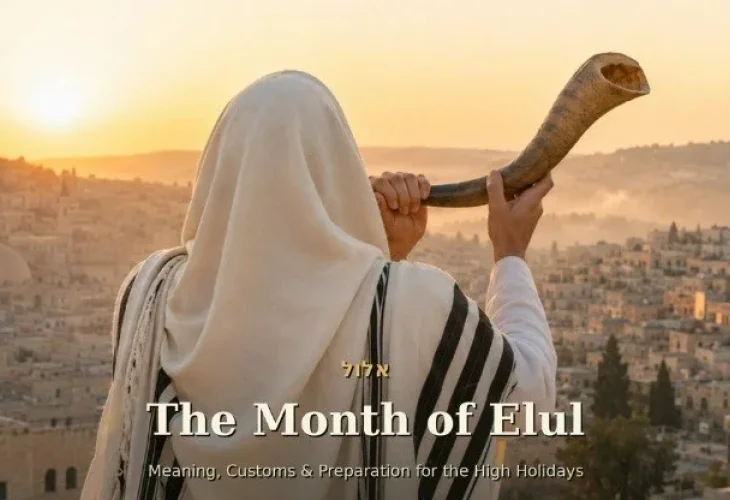 Shofar blowing in the morning during the Month of Elul
Elul is the sixth month of the Hebrew biblical year (the twelfth of the civil year), a 29-day month that immediately precedes Rosh Hashanah. It serves as the month of preparation for the High Holidays — a time of teshuvah (repentance), introspection, and heightened prayer. The name Elul is understood as an acronym for "Ani L'Dodi V'Dodi Li" — "I am my Beloved's and my Beloved is mine" (Song of Songs 6:3). During Elul the shofar is blown every weekday morning, Psalm 27 is added to daily prayers, and Selichot (penitential prayers) are recited. In 2026, Rosh Chodesh Elul begins at sundown on Wednesday, August 12, and Elul ends at sundown on Friday, September 11 (Erev Rosh Hashanah).
Every journey needs a runway, and the Jewish calendar builds one into the year itself. The Month of Elul — the final month before Rosh Hashanah — is Judaism's designated season of preparation for the Days of Awe: a full month in which the shofar sounds every weekday morning, Psalm 27 is recited daily, Selichot prayers fill the early mornings, and every Jew is invited to an honest accounting of the year gone by. The Sages describe Elul as a time when God is uniquely close — "the King is in the field" — and its very name is read as a love note: Ani L'Dodi V'Dodi Li, "I am my Beloved's and my Beloved is mine." This complete guide covers everything about the Month of Elul: what it is, the 2026 dates, the meaning of the name, the customs of shofar and Psalm 27, Selichot, the Torah readings, and how to use these 29 days to arrive at Rosh Hashanah ready.
What is the Month of Elul?
Elul is the month of spiritual preparation that leads directly into Rosh Hashanah and Yom Kippur. It has no biblical festivals and no commanded observances of its own — and that is precisely its character: Elul is not a destination but a preparation, a month whose entire content is supplied by what stands at its end. From Rosh Chodesh Elul, Jewish practice shifts into pre-High-Holiday mode: the shofar is sounded after weekday morning prayers, Psalm 27 enters the liturgy, charity increases, and the work of teshuvah — returning to God — begins in earnest, a full forty days before Yom Kippur.
Elul in the Hebrew Calendar (Sixth or Twelfth Month?)
Both, depending on how you count. The Torah counts months from Nisan, the month of the Exodus — by that count Elul is the sixth month. The civil year, however, begins with Tishrei and Rosh Hashanah — by that count Elul is the twelfth and final month, the closing chapter of the outgoing year. Elul is always 29 days long, and it always falls in late summer, spanning August–September on the Gregorian calendar. The name itself, like all the Hebrew month names, came back with the Jewish people from the Babylonian exile; it appears in the Bible in Nehemiah 6:15, where the wall of Jerusalem is completed "on the twenty-fifth of Elul."
Elul as the "Month of Mercy"
Jewish tradition calls Elul the month of mercy and forgiveness (chodesh harachamim vehaselichot). The reason reaches back to Sinai: according to tradition, Moses ascended the mountain for his final forty days on Rosh Chodesh Elul and descended on Yom Kippur with the second Tablets and God's full pardon for the sin of the Golden Calf. Those forty days were stamped forever as days in which repentance is welcomed and mercy flows more freely — which is why the entire month functions as the opening act of the season of forgiveness that culminates in the Days of Awe.
When is Elul 2026?
In 2026, Rosh Chodesh Elul begins at sundown on Wednesday, August 12. The month of Elul ends at sundown on Friday, September 11 — Erev Rosh Hashanah — when the year 5787 begins. Ashkenazi Selichot begin on Saturday night, September 5, 2026.
Elul Dates for the Coming Years
Year | Rosh Chodesh Elul (2 days) | Elul Ends | Ashkenazi Selichot |
|---|---|---|---|
2026 | Aug 13–14 | Sundown, Fri., Sep 11 | Sat. night, Sep 5 |
2027 | Sep 2–3 | Sundown, Fri., Oct 1 | Sat. night, Sep 25 |
2028 | Aug 22–23 | Sundown, Wed., Sep 20 | Sat. night, Sep 16 |
2029 | Aug 12–13 | Sundown, Sun., Sep 9 | Sat. night, Sep 1 |
2030 | Aug 30–31 | Sundown, Fri., Sep 27 | Sat. night, Sep 21 |
Dates verified against the Hebcal Jewish calendar. Sephardic communities begin Selichot from the 2nd of Elul. All Jewish days begin at sundown on the previous evening.
Rosh Chodesh Elul
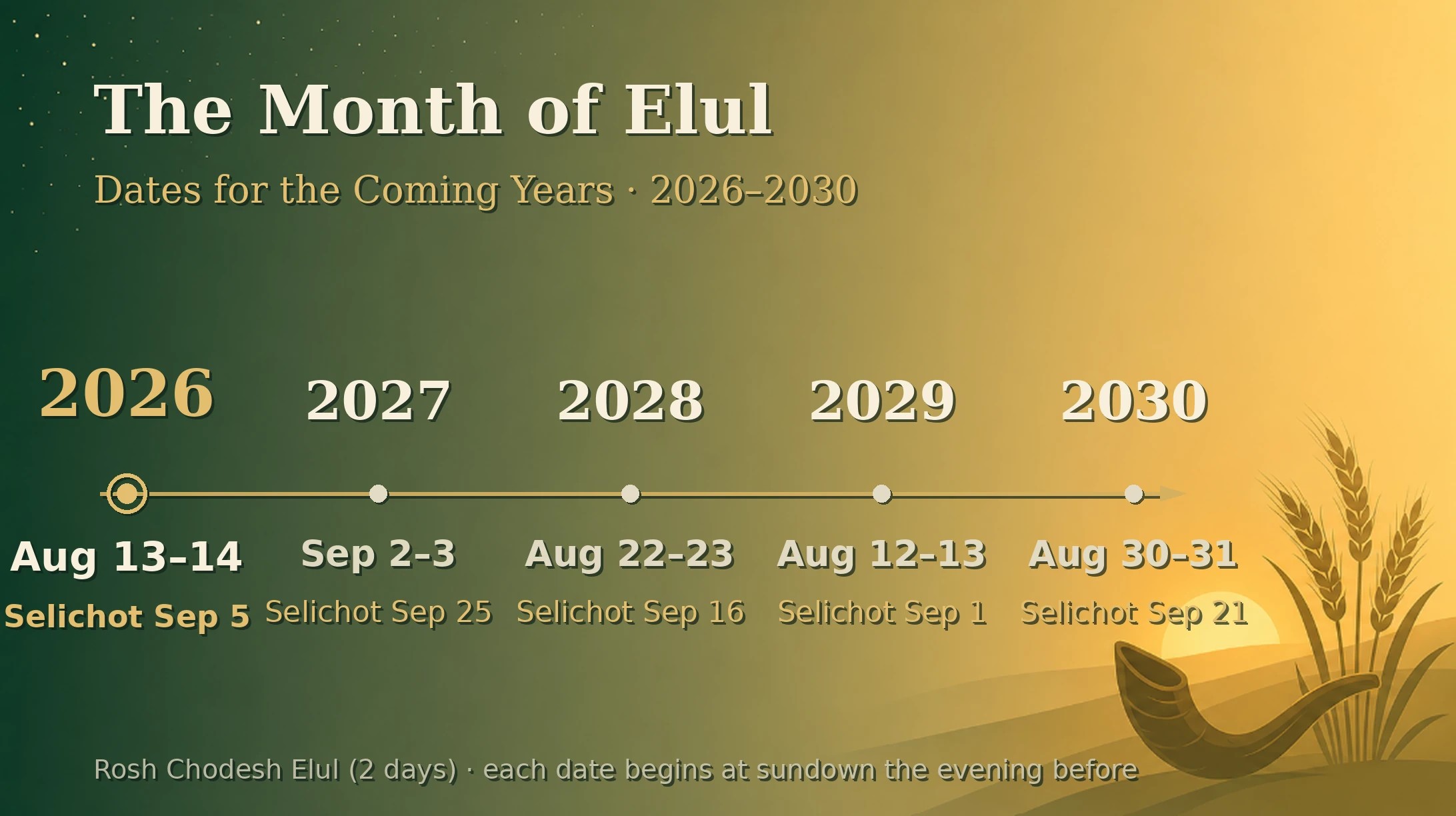 Month of Elul dates for upcoming years
Rosh Chodesh Elul — the "head of the month" — is always observed for two days: the 30th of Av and the 1st of Elul. This is a fixed feature of the calendar, because the preceding month of Av always has 30 days. Rosh Chodesh is marked with Hallel, the Musaf prayer, and Ya'aleh V'yavo — and in Elul it carries extra weight, because tradition places Moses' final ascent of Sinai on this day, and the shofar begins sounding from the first morning of the month. It is also customary to begin wishing friends a good new year from Rosh Chodesh Elul onward.
How Long is Elul? (29 Days)
Elul is always exactly 29 days — a chodesh chaser, a "short month," and this never varies. The Sages saw meaning in the number: twenty-nine days, followed immediately by Rosh Hashanah, form a countdown that cannot be paused or extended. Together with the Ten Days of Repentance that follow, Elul gives the Jew a forty-day arc of return — from the first shofar blast of Rosh Chodesh Elul to the closing Ne'ilah service of Yom Kippur.
The Meaning of the Name "Elul"
Ani L'Dodi V'Dodi Li — I Am My Beloved's and My Beloved Is Mine
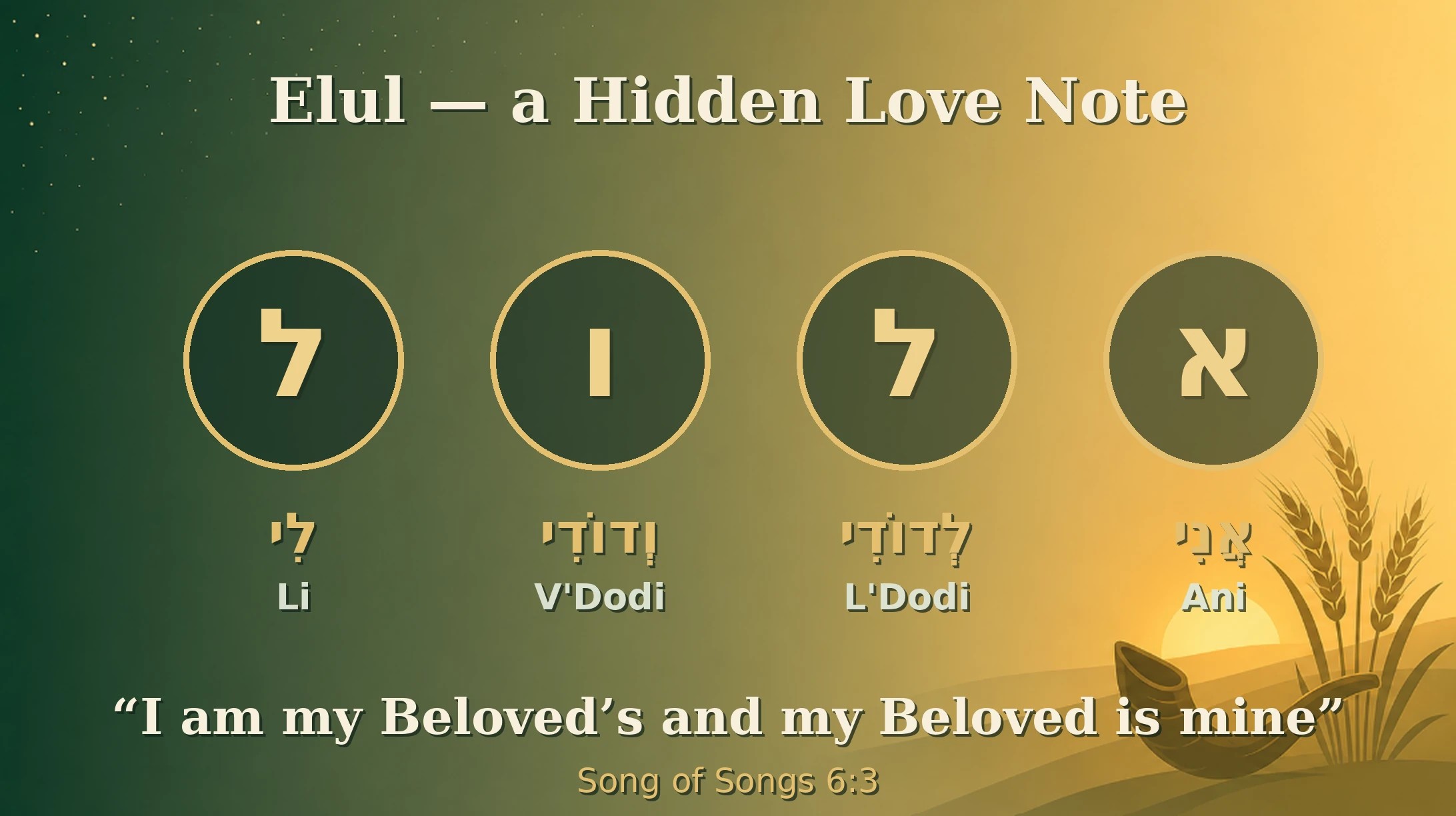 Hebrew letters spelling Elul as acronym for Ani L'Dodi V'Dodi Li
The most beloved interpretation of the name is that the four Hebrew letters of Elul — Alef, Lamed, Vav, Lamed — form an acronym of the verse "Ani L'Dodi V'Dodi Li" — "I am my Beloved's and my Beloved is mine" (Song of Songs 6:3), the love song between God and Israel. This teaching, cited in the classic halachic literature on Elul (Mishnah Berurah 581), defines the month's spirit: Elul's repentance is not driven by fear of the approaching judgment but by longing — a month of drawing close to a Beloved who is drawing close to us. The commentators add that the final letters of each word in the verse are all Yud, together hinting at the forty days from Rosh Chodesh Elul to Yom Kippur.
The Aramaic Meaning — "Search"
In Aramaic, the root of "Elul" means to search. The Targum (the ancient Aramaic translation of the Torah) uses this very root for the spies who "searched" the Land of Israel (Numbers 13). The name of the month is thus a job description: Elul is the month a Jew searches — not a foreign land, but his own deeds, his habits, and his heart, in the personal accounting the tradition calls cheshbon hanefesh.
Additional Acronyms and Interpretations
The commentators found Elul's letters hidden in other verses as well, each pointing to one of the month's labors. "Et Levavcha V'et Levav" — "God will circumcise your heart and the heart of your children" (Deuteronomy 30:6) — points to teshuvah. "Ish L'rei'ehu U'matanot L'evyonim" — "each man to his fellow, and gifts to the poor" (Esther 9:22) — points to charity and repairing relationships. Together with prayer ("I am my Beloved's" — the language of closeness), the acronyms map onto the three pillars of the season: teshuvah, tefillah, tzedakah — repentance, prayer, and charity.
Elul Customs and Practices
Elul has no festival meals and no commanded rituals — instead it has a toolkit of customs, codified around Shulchan Aruch, Orach Chayim 581, each designed to wake the heart a little more each day.
Blowing the Shofar Every Weekday
From the first day of Rosh Chodesh Elul, Ashkenazi communities sound the shofar every weekday morning at the end of Shacharit — a single set of blasts: Tekiah, Shevarim, Teruah, Tekiah. The custom traces back to the shofar sounded in the camp when Moses ascended Sinai on Rosh Chodesh Elul (Pirkei DeRabbi Eliezer 46), and its purpose is stated plainly by the codifiers: to stir the people to repentance, as the prophet says, "Shall a shofar be sounded in the city and the people not tremble?" (Amos 3:6). The shofar is deliberately silenced on Erev Rosh Hashanah, creating a break between the customary blasts of Elul and the Torah-commanded blasts of Rosh Hashanah itself.
Reciting Psalm 27 (L'David Hashem Ori)
From Rosh Chodesh Elul, Psalm 27 — "L'David, Hashem Ori V'Yishi" ("The Lord is my light and my salvation") — is added to the morning and evening prayers, and in most Ashkenazi communities it continues through the festival season until Shemini Atzeret. The psalm receives its own full section below.
Increased Charity (Tzedakah)
Giving tzedakah intensifies throughout Elul, in the spirit of the acronym from Esther — "each man to his fellow, and gifts to the poor" — and of the Rambam's ruling that charity is amplified in the season of judgment (Hilchot Teshuvah 3:4). Many use Elul to settle outstanding pledges, take on a new regular commitment, or give in memory of loved ones ahead of the new year.
Special Focus on Teshuvah (Repentance)
Elul is the classic season of teshuvah — return. The Rambam's four steps — abandoning the sin, regret, confession before God, and resolve for the future (Hilchot Teshuvah 2:2) — become the month's daily homework. The great masters of Mussar and Chassidut alike, from the Arizal to the Maharal of Prague, treated Elul as the year's dedicated workshop of self-repair, when repentance is most readily received ahead of the judgment of Rosh Hashanah.
Asking Forgiveness from Others
Since even Yom Kippur does not atone for wrongs between people until the injured party is appeased (Mishnah Yoma 8:9), the wise begin in Elul: apologizing for the sharp word, returning what was borrowed, repairing the strained friendship — without waiting for the crowded final days before Yom Kippur. Elul's month-long runway exists precisely so that this most delicate work is not left to the last minute.
Personal Introspection (Cheshbon HaNefesh)
Cheshbon hanefesh — literally "an accounting of the soul" — is Elul's quiet core: a regular, honest review of one's deeds, character, and direction. Many set aside a few minutes daily, some keep a written record, and others learn a Mussar text through the month. The Maharal of Prague and the masters of the Mussar movement taught that without this deliberate accounting, the year's mistakes simply renew themselves — and that Elul is the annual audit that prevents it.
Checking Tefillin and Mezuzot
A beloved Elul custom, recorded by the halachic authorities (Mateh Ephraim 581), is to have one's tefillin and mezuzot examined by a qualified scribe (sofer) during this month, ensuring the parchments remain kosher — letters can crack and fade with time. The custom is Elul in miniature: before the new year, a Jew checks not only his deeds but even his sacred objects, making sure everything that connects him to God is in working order.
Psalm 27 — The Elul Psalm
"L'David Hashem Ori V'Yishi"
![Open siddur showing Psalm 27 (L'David Hashem Ori) recited during Elul]() Open siddur showing Psalm 27 (L'David Hashem Ori) recited during Elul
Open siddur showing Psalm 27 (L'David Hashem Ori) recited during Elul
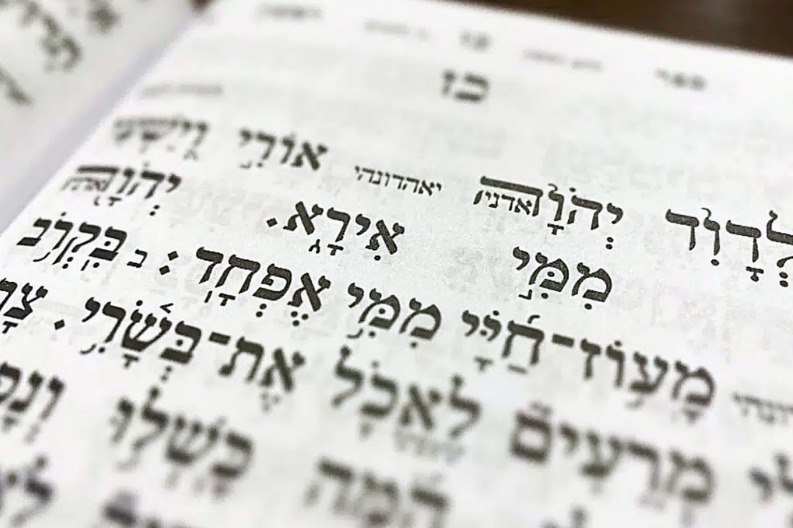 Open siddur showing Psalm 27 (L'David Hashem Ori) recited during Elul
Open siddur showing Psalm 27 (L'David Hashem Ori) recited during Elul
Psalm 27 opens with the words that gave it its Elul identity: "Of David: the Lord is my light and my salvation — whom shall I fear?" It is a psalm of fearless trust: one thing I ask, to dwell in the house of the Lord all the days of my life; though my father and mother abandon me, the Lord will gather me in; hope to the Lord, be strong, and let your heart take courage. In the season of judgment, the psalm insists that the Judge is also the loving Father — light, salvation, and shelter.
When to Recite Psalm 27
The widespread Ashkenazi custom, recorded in the halachic literature (Mateh Ephraim 581), is to recite Psalm 27 twice daily — at Shacharit and at Ma'ariv (some say it at Minchah) — from Rosh Chodesh Elul through Shemini Atzeret, spanning the entire season of judgment and its festivals. The practice was especially cherished in the school of the Baal Shem Tov, and it spread until it became a fixture of the Ashkenazi siddur; customs vary among Sephardic communities. Recite it with the rest of Tehillim all year round.
The Meaning of Psalm 27 for Elul
The Midrash on Psalms reads the psalm's opening as a map of the season itself: "my light" — on Rosh Hashanah; "my salvation" — on Yom Kippur; and "He will hide me in His shelter (sukkah)" — an allusion to Sukkot. The one psalm thus carries a Jew through every station of the coming weeks. Its recitation in Elul frames the Days of Awe before they arrive: judgment is coming, but the Judge is my light; the verdict matters, but "the Lord is the strength of my life — of whom shall I be afraid?"
Selichot — The Penitential Prayers of Elul
![Thousands reciting Selichot at the Western Wall during Elul]() Thousands reciting Selichot at the Western Wall during Elul
Thousands reciting Selichot at the Western Wall during Elul
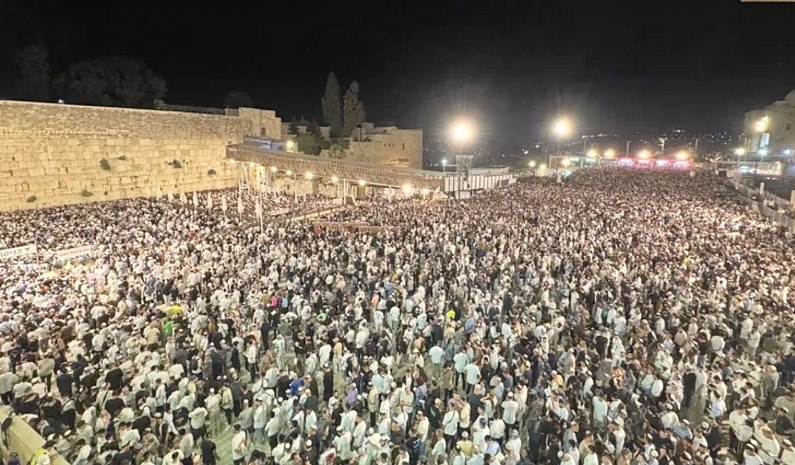 Thousands reciting Selichot at the Western Wall during Elul
Selichot are the special penitential prayers of the season — ancient poems of confession and pleading built around the Thirteen Attributes of Mercy, recited before dawn or late at night.
Sephardic Custom — From the 1st of Elul
Sephardic and Eastern communities recite Selichot for the entire month: beginning on the 2nd of Elul (the day after Rosh Chodesh) and continuing every weekday through Erev Yom Kippur — some forty days of pre-dawn prayer, mirroring Moses' forty days on Sinai (Shulchan Aruch, Orach Chayim 581:1). In Jerusalem and in Sephardic synagogues worldwide, the month of Elul is defined by these stirring nightly gatherings, with their beloved melodies and communal recitation.
Ashkenazi Custom — Starting the Saturday Before Rosh Hashanah
Ashkenazi communities begin Selichot on Motzaei Shabbat (Saturday night) shortly before Rosh Hashanah, at or after midnight — famously the best-attended Selichot of the year. The rule (Rema, Orach Chayim 581:1): there must be at least four days of Selichot before Rosh Hashanah, so when the holiday falls early in the week, Selichot begin from the Motzaei Shabbat of the previous week. From then on, Selichot are recited each weekday morning before Shacharit through Yom Kippur eve.
The Thirteen Attributes of Mercy
The beating heart of every Selichot service is the Thirteen Attributes of Mercy — "Hashem, Hashem, Kel Rachum V'chanun…" — the formula of divine compassion that God Himself taught Moses on Sinai after the sin of the Golden Calf (Exodus 34:6–7). The Talmud teaches that God pledged: whenever Israel recites this order of prayer, they will not return empty-handed (Rosh Hashanah 17b). Selichot returns to this refrain again and again — the same words that won forgiveness at Sinai, deployed each year in the same season.
When Selichot Begin in 2026
In 2026, Sephardic communities begin Selichot on Sunday, August 16: the 2nd of Elul falls on Shabbat (August 15), when Selichot are not recited, so the first recitation moves to the following morning. Ashkenazi communities begin on Saturday night, September 5, 2026, after midnight — with Rosh Hashanah beginning the following Friday evening, September 11.
The King is in the Field — The Spiritual Concept
![Illustration of the Chassidic teaching "The King is in the Field" during Elul]() Illustration of the Chassidic teaching "The King is in the Field" during Elul
Illustration of the Chassidic teaching "The King is in the Field" during Elul
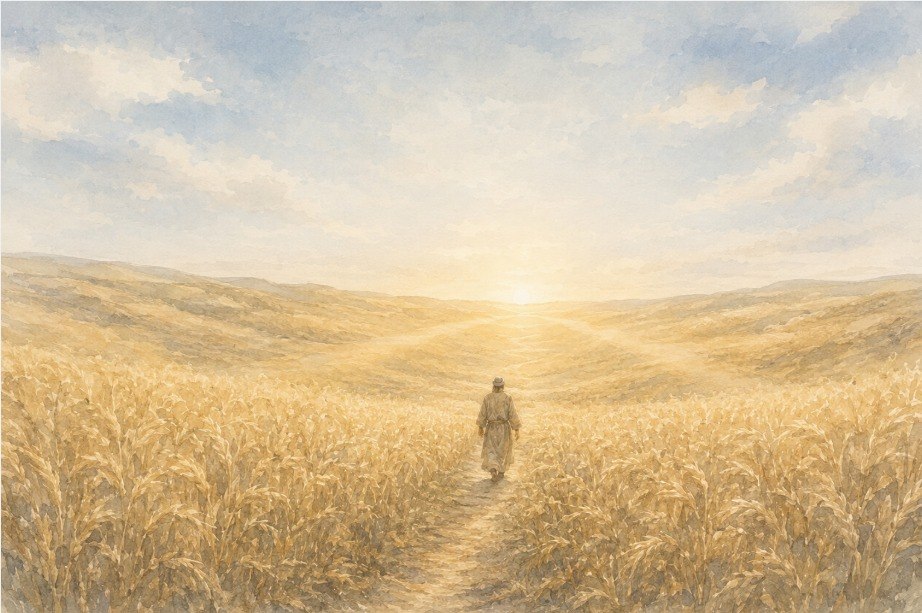 Illustration of the Chassidic teaching "The King is in the Field" during Elul
Rabbi Schneur Zalman's Teaching
The most famous metaphor for Elul comes from Rabbi Schneur Zalman of Liadi, founder of Chabad, in his work Likkutei Torah. All year, he taught, approaching the King means traveling to the palace — passing gates, guards, and protocols, with no guarantee of an audience. But in Elul, "the King is in the field" (HaMelech BaSadeh): before the King returns to His palace for the coronation of Rosh Hashanah, He goes out to meet His people where they are — in the field, in work clothes. In Elul, anyone can approach, "and He receives them all with a pleasant countenance and shows a smiling face to them all."
What This Metaphor Means for Us Today
The teaching answers the paradox every Jew feels in Elul: if judgment is coming, shouldn't we be terrified? The answer: the Judge has left the courtroom and is walking toward you. In practical terms, Elul is the month when spiritual growth is most accessible — a small commitment made in Elul, the masters taught, accomplishes what great efforts accomplish the rest of the year, because God is already reaching out. It is the month to speak to God in your own words, in your own "field" — the car, the kitchen, the commute — without waiting for the palace and the machzor of the Days of Awe.
The Historical Origin of Elul
Moses' Third Ascent to Mount Sinai
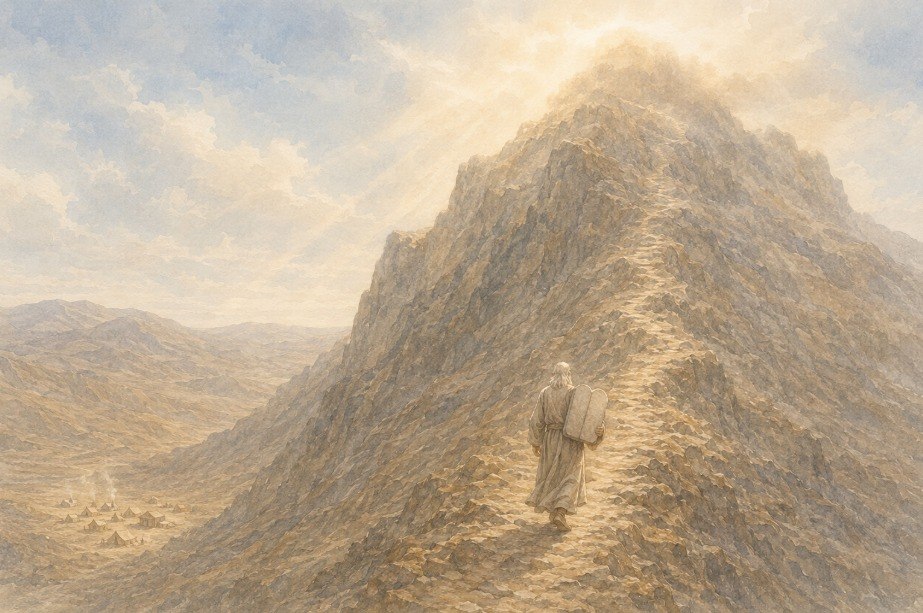 Moses ascending Mount Sinai for the third time on Rosh Chodesh Elul
Elul's identity was forged at Sinai. After the sin of the Golden Calf and the shattering of the first Tablets, and after a second forty days of pleading, Moses ascended the mountain a third and final time — according to tradition, on Rosh Chodesh Elul (Rashi on Exodus 33:11; Pirkei DeRabbi Eliezer 46). A shofar sounded through the camp as he went up — the origin of the Elul shofar — so that the people would not stray again.
The 40 Days from Elul 1 to Yom Kippur
Those final forty days on the mountain — from Rosh Chodesh Elul through the 10th of Tishrei — were days of pure mercy, in which Moses secured complete forgiveness for Israel. The calendar preserves them exactly: the forty days from the start of Elul to Yom Kippur remain the year's season of favor, when the Sephardic custom recites Selichot daily and every Jew is called to the work of return. What began as Moses' forty days became the Jewish people's annual forty days.
The Second Set of Tablets
Moses descended on the 10th of Tishrei — Yom Kippur — carrying the second Tablets, the eternal sign that God had forgiven His people completely (Exodus 34:27–28; Rashi on Deuteronomy 9:18). The second Tablets are Elul's promise in stone: what was shattered can be rebuilt, and the rebuilt version endures. Every Elul re-enacts that arc — ascent, labor, and descent into a new year with a renewed covenant.
Elul and the High Holidays
Preparing for Rosh Hashanah
Elul is Rosh Hashanah's runway. Practically, preparation includes: hearing the shofar each morning so its sound is familiar when it becomes a mitzvah; learning the machzor and the meaning of Malchuyot, Zichronot, and Shofarot; settling debts and disputes; arranging holiday meals and synagogue seats; and above all, arriving at the Day of Judgment already in motion — the Sages taught that one who prepares before the judgment is not the same as one who is startled by it.
Preparing for Yom Kippur
The deeper work of Elul aims past Rosh Hashanah at Yom Kippur. Asking forgiveness from friends and family, the nightly cheshbon hanefesh, and the daily Selichot (in Sephardic communities) are all Yom Kippur work begun early — because atonement between man and his fellow cannot be manufactured in a single Erev Yom Kippur, and character does not change in a day. Elul gives the Ten Days of Repentance something to build on.
The Ten Days of Repentance Connection
Elul flows directly into the Aseret Yemei Teshuvah — the Ten Days of Repentance from Rosh Hashanah through Yom Kippur — completing a continuous forty-day season of return. The classic image: Elul is when the verdict is still fully open and the King is in the field; the Ten Days are the final court recess, "Seek God when He may be found" (Isaiah 55:6); Yom Kippur is the sealing. A Jew who uses Elul enters that endgame with momentum instead of panic.
Elul Torah Readings
The Shabbat Torah portions of Elul read like a curriculum for the season — the Sages arranged the calendar so that Deuteronomy's great speeches of covenant and return accompany the month of return.
Parashat Re'eh
Read at the very start of Elul (often on the Shabbat of Rosh Chodesh), Re'eh opens: "See, I set before you today a blessing and a curse." Free choice is the foundation of teshuvah — Elul begins with the reminder that the coming year is genuinely in our hands.
Parashat Shoftim
"Judges and officers shall you appoint in all your gates" (Shoftim). The Chassidic masters read the verse inward: appoint judges at your own gates — eyes, ears, mouth — exactly the self-supervision of cheshbon hanefesh.
Parashat Ki Teitzei
"When you go out to war against your enemies" (Ki Teitzei) — read in Elul as the manual for the inner war against habit and impulse, with its seventy-plus mitzvot covering the details of daily decency.
Parashat Ki Tavo
Ki Tavo brings the first fruits and their declaration of gratitude, followed by the covenant's stern warnings — gratitude and accountability, Elul's two lenses for reviewing a year.
Parashat Nitzavim
Always read on the final Shabbat before Rosh Hashanah, Nitzavim contains the Torah's great teshuvah passage: "You will return to the Lord your God… For this commandment is not in heaven… it is very near to you, in your mouth and in your heart, to do it" (Deuteronomy 30). The calendar's message is explicit: no one enters Rosh Hashanah without first hearing that return is within reach.
Elul Greetings and Practices
Wishing "Shanah Tovah" Starting in Elul
From Rosh Chodesh Elul, Jews begin greeting one another with "Shanah Tovah" — "a good year" — and the fuller "Shanah Tovah U'metukah," a good and sweet year. The custom of blessing one another early flows from the teaching that the month itself is a time of favor: every good wish is a small prayer, and Elul is when the ledgers of the new year are still wide open.
Ketivah V'Chatimah Tovah
The classic Elul letter-signature and greeting is "Ketivah V'Chatimah Tovah" — "may you be written and sealed for good" — anticipating the imagery of the Book of Life: written on Rosh Hashanah, sealed on Yom Kippur. From Rosh Hashanah onward the greeting shifts with the calendar ("L'Shanah Tovah Tikatevu," then "Gmar Chatimah Tovah" as Yom Kippur nears) — but in Elul, "Ketivah V'Chatimah Tovah" carries the full span of the season's hope.
Elul in American Jewish Communities
In American Jewish life, Elul is the great turning of the communal year. Synagogues open High Holiday seat reservations and launch adult-education series on the machzor and teshuvah; day schools begin the year with the shofar sounding each morning; and the Motzaei Shabbat Selichot service — often held at midnight with a program beforehand — draws crowds far beyond the regular minyan, serving for many families as the true opening of the High Holiday season. Jewish media and community centers fill the weeks before Rosh Hashanah with Elul classes and campaigns, and the month's themes — new beginnings, self-audit, reconciliation — resonate with the American back-to-school season in which it falls. For millions of American Jews, Elul is when the calendar quietly reasserts itself: the year is ending, the Days of Awe are near, and it is time to come home.
Watch: Elul full Library
Sources
Tanach (Bible)
- Song of Songs 6:3 — "Ani L'Dodi V'Dodi Li," the acronym and spirit of Elul.
- Exodus 32; 34:27–28 — the Golden Calf, Moses' ascents, and the second Tablets.
- Exodus 34:6–7 — the Thirteen Attributes of Mercy, core of Selichot.
- Deuteronomy 30 — the teshuvah passage of Parashat Nitzavim ("it is very near to you"); 30:6 ("Et Levavcha…" acronym).
- Nehemiah 6:15 — the first biblical mention of the month name "Elul."
- Psalm 27 — "L'David Hashem Ori V'Yishi," recited throughout the season.
- Amos 3:6 — "Shall a shofar be sounded in the city and the people not tremble?"
- Isaiah 55:6 — "Seek God when He may be found."
- Esther 9:22 — "Ish L'rei'ehu U'matanot L'evyonim," acronym for Elul charity.
Talmud and Midrash
- Babylonian Talmud, Rosh Hashanah 17b — the covenant of the Thirteen Attributes of Mercy.
- Mishnah Yoma 8:9 — atonement between man and his fellow requires appeasement.
- Pirkei DeRabbi Eliezer 46 — Moses' ascent on Rosh Chodesh Elul and the shofar in the camp.
- Midrash Tehillim on Psalm 27 — "my light" (Rosh Hashanah), "my salvation" (Yom Kippur), "His sukkah" (Sukkot).
- Rashi on Exodus 33:11 and Deuteronomy 9:18 — the chronology of Moses' forty-day ascents.
Halachic Codes and Later Authorities (Poskim)
- Rambam (Maimonides), Mishneh Torah, Hilchot Teshuvah — 2:2 (the elements of repentance); 3:4 (increased charity and the shofar's call to awaken).
- Shulchan Aruch, Orach Chayim 581, with Rema — the customs of Elul: shofar, Selichot dates (Sephardic and Ashkenazi), and early rising for penitential prayer.
- Mishnah Berurah 581 — the "Ani L'Dodi V'Dodi Li" acronym and the reasons for the Elul customs.
- Mateh Ephraim 581 — Psalm 27 recitation and checking tefillin and mezuzot in Elul.
- Rabbi Schneur Zalman of Liadi, Likkutei Torah (Parashat Re'eh) — "The King is in the Field."
- Teachings of the Arizal (Rabbi Isaac Luria) and the Maharal of Prague — Elul as the season of repentance and cheshbon hanefesh.
- Rulings of Rabbi Ovadia Yosef zt"l (Chazon Ovadia — Yamim Noraim) — contemporary Sephardic practice for Elul and Selichot.
Liturgy and Calendar
- The Selichot liturgy (Sephardic and Ashkenazi rites) — the Thirteen Attributes and the penitential poems of Elul.
- Hebcal Jewish Calendar (hebcal.com) — verified Gregorian anchor dates for Rosh Hashanah and Yom Kippur 2026–2030, from which the Elul and Rosh Chodesh dates are derived (Av is always 30 days; Elul is always 29).
Questions & Answers
+What is the Month of Elul?
+When does Elul begin in 2026?
+How long is the Month of Elul?
+What does the name "Elul" mean?
+Why is the shofar blown during Elul?
+Why is Psalm 27 recited during Elul?
+What is Rosh Chodesh Elul?
+What is the meaning of "Ani L'Dodi V'Dodi Li"?
+What does "The King is in the Field" mean?
+When do Selichot begin in 2026?
+What is the difference between Sephardic and Ashkenazi Selichot customs?
+Can you say "Shanah Tovah" during Elul?
+What Torah portions are read during Elul?

