

Evolution
Yale Professor on Evolution: It's Time to Rethink Darwin's Theory
What led a respected Yale professor to publicly question one of the most influential scientific theories of modern times?
- Yehosef Yaavetz
- | Updated
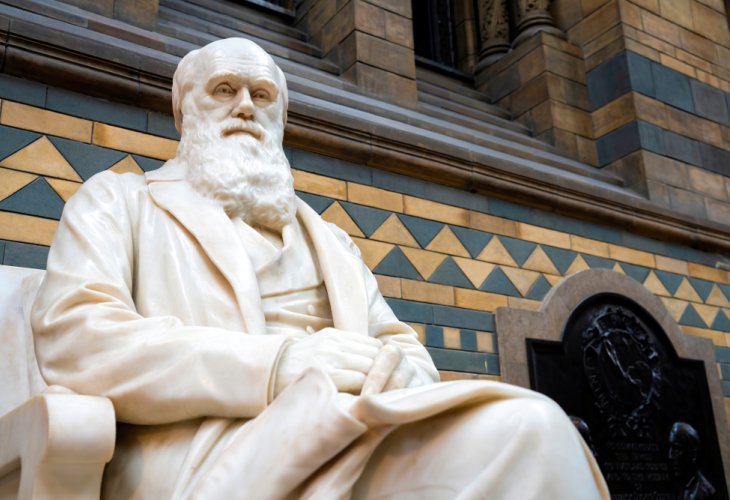 (Photo: shutterstock)
For generations, Charles Darwin's theory of evolution has been one of the most influential scientific ideas in the modern world. It is taught in schools, discussed in universities, and often presented as the accepted explanation for the diversity of life on Earth.
Yet not all critics of Darwinian evolution come from religious backgrounds. In recent years, one of the theory's most surprising critics has been David Gelernter, a professor of computer science at Yale University and a well-known public intellectual.
A Surprising Critic of Darwinism
David Gelernter spent much of his life accepting evolutionary theory as fact.
Like many educated people, he grew up assuming that Darwin's explanation of life's development had been firmly established by science. But after years of reading and examining the arguments surrounding the subject, he eventually reached a different conclusion.
Writing in Claremont Review of Books, Gelernter described evolution as a beautiful and historically important scientific idea. Yet he argued that admiration for a theory is not the same as proving it true.
According to Gelernter, Darwin's theory does a reasonable job explaining small changes within existing species, such as variations in fur thickness, body size, or beak shape. The larger question, however, is whether those small changes can adequately explain the origin of entirely new species and complex biological systems.
The Question of New Species
At the heart of Gelernter's criticism is a question that has occupied scientists since Darwin's time: How do entirely new forms of life arise?
Gelernter argues that while minor adaptations are easy to observe, the emergence of fundamentally new biological structures remains much more difficult to explain.
He points to arguments made by several contemporary critics of Darwinian evolution, particularly those who question whether random genetic mutations and natural selection alone can account for the complexity found in living organisms.
According to these critics, the problem is not merely biological but mathematical as well.
A Computer Scientist's Perspective
As a computer scientist, Gelernter approaches the issue differently from most biologists.
In the world of computing, complex systems typically require highly organized information. For that reason, he finds it difficult to accept that vast amounts of biological information could arise solely through a long series of undirected genetic changes.
Gelernter argues that many proposed explanations fail to address what he sees as the central challenge: the origin of the information needed to build new biological features and species.
Whether one agrees with his conclusions or not, his criticism reflects a growing discussion among some scholars about the limits of traditional Darwinian explanations.
Beyond Science Alone
One of Gelernter's most controversial claims is that Darwinism has, for some people, become more than a scientific theory.
He suggests that evolutionary theory often functions as a broader worldview, shaping how people think about humanity, purpose, and existence itself.
Because of that, he argues, criticism of evolution is sometimes treated differently from criticism of other scientific theories. Instead of being viewed as a normal part of scientific debate, it can be seen as a challenge to a larger philosophical framework.
Supporters of evolution strongly disagree with this assessment and maintain that evolutionary theory remains the best explanation for the evidence currently available.
What Comes Next?
Interestingly, Gelernter does not present himself as a religious advocate offering an alternative explanation for life's origins.
Instead, he argues that if a theory cannot adequately explain the evidence, intellectual honesty requires acknowledging its limitations.
In his view, the goal of science is not to defend a particular theory indefinitely, but to follow the evidence wherever it leads.
Whether one agrees with Gelernter or not, his comments have drawn attention because they come from an accomplished scholar outside the fields of theology and religion. His criticism serves as a reminder that debates about origins, complexity, and the nature of life remain active topics of discussion.
The larger question he raises is one that continues to fascinate scientists, philosophers, and ordinary readers alike: If current explanations are incomplete, what explanation best accounts for the remarkable complexity and diversity of life?

