

Evolution
Are Humans Really 98% Chimpanzee? A New Debate Emerges
A recent ape genome study has sparked new discussion about the true genetic gap between humans and chimpanzees. Discover the debate.
- Yehosef Yaavetz
- | Updated
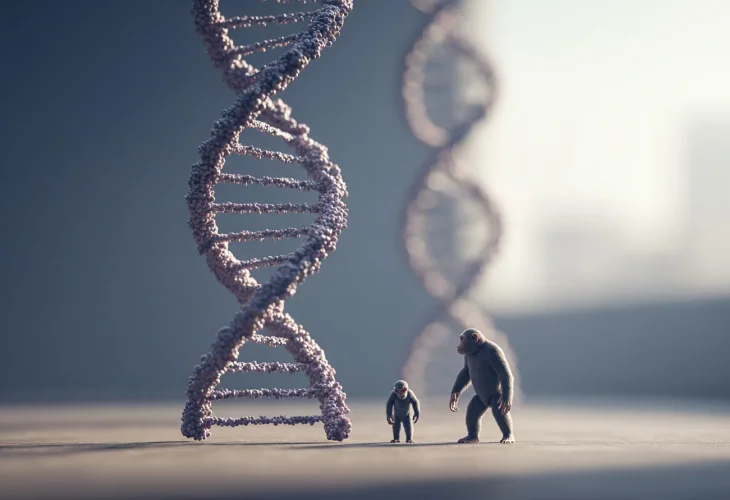
One of the most widely repeated claims about human origins is that humans and chimpanzees are almost genetically identical. According to this popular figure, the difference between the two is only about 1.5 to 2 percent. Many people cite this statistic as evidence that there is little separating human beings from animals.
But is that really the full story?
According to geologist and science writer Casey Luskin, the answer is no. He argues that the commonly quoted figure is outdated and that the actual genetic difference between humans and chimpanzees is much larger, closer to 15 percent.
Where Did the 98 Percent Figure Come From?
For decades, the public was told that humans and chimpanzees share roughly 98 to 99 percent of their DNA. This number was based primarily on DNA sequences that could be directly compared between the two species.
In those comparable regions, the genetic differences are indeed relatively small. Researchers found differences of about 1.5 to 1.6 percent when comparing individual DNA "letters" and other small genetic changes.
However, Luskin argues that a significant assumption was made. The calculation focused mainly on the portions of the genome that were easy to compare. It did not fully account for large sections of DNA that differ so dramatically that they cannot be matched side by side.
A New Look at Ape Genomes
Luskin points to a major study published in Nature in April 2025 titled Complete Sequencing of Ape Genomes.
Using more complete and accurate genome assemblies than were previously available, researchers were able to examine the genomes of great apes in greater detail. According to Luskin's interpretation, the study revealed that substantial portions of the human and chimpanzee genomes cannot be directly compared because they differ too greatly in structure and content.
This raises an important question: if those regions are excluded from the comparison, does the commonly cited 1.5 percent figure tell the whole story?
What About So Called "Junk DNA"?
For many years, some of these difficult to compare regions were grouped under the label "junk DNA." The term was often used for repetitive DNA sequences or regions whose function was not fully understood.
Luskin argues that this label is misleading. Just because scientists do not yet fully understand the purpose of certain DNA sequences does not mean they serve no purpose at all.
In fact, he points out that many of the differences between humans and chimpanzees appear in these very regions. Some contain repeated DNA sequences, while others involve large structural rearrangements or inversions in the genetic code.
According to Luskin, these features may play important biological roles. He cites research suggesting that repetitive sequences and structural changes can influence how DNA folds within the cell nucleus and how genes are regulated during development.
A Helpful Illustration
To understand the issue more easily, imagine two books in a library.
Suppose the main chapters contain almost identical wording. At first glance, the books might appear nearly the same.
But what if one book contains additional chapters, missing sections, or chapters arranged in a completely different order?
Even though many of the words match, they are clearly not identical books.
Luskin argues that something similar may be true when comparing genomes. Looking only at the matching sections can create the impression of near identity while overlooking larger structural differences.
The Debate Continues
Luskin discusses several theories regarding the function of these poorly understood DNA regions. One idea comes from biologist Bruce Lipton, who has suggested that such regions may play a major role in regulating genetic activity and influencing development.
Whether or not researchers agree with that conclusion, Luskin's central argument is straightforward: the public should be given the fullest picture possible.
In his view, if large portions of the genome differ significantly and are excluded from the comparison, then citing only the 1.5 percent figure can be misleading. While scientists may continue to debate the meaning and importance of those differences, Luskin argues that the discussion should begin with an accurate presentation of the data.
The debate over human and chimpanzee genetics remains ongoing, but one thing is clear: understanding the full complexity of the genome is far more challenging than a single percentage might suggest.

