

History and Archaeology
The Jewish Boy Who Survived the Holocaust in a Hitler Youth Uniform
Shlomo Perel survived the Holocaust by concealing his Jewish identity and living among the Nazis. His extraordinary true story continues to inspire generations.
- Yehosef Yaavetz
- | Updated
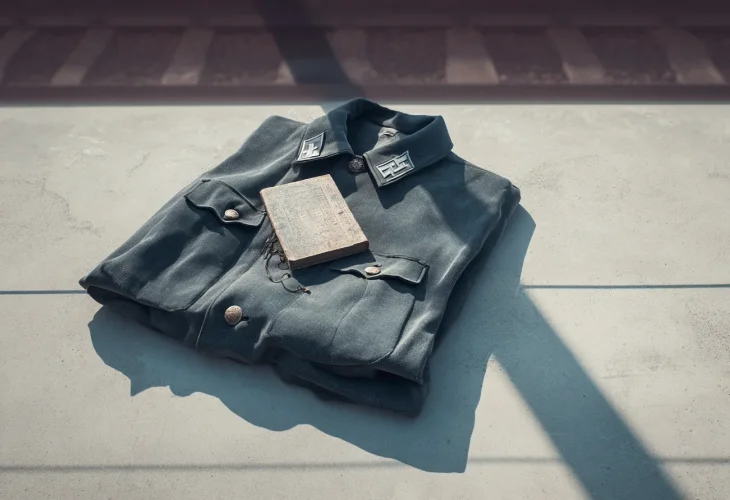
In December 1943, a teenage boy wearing a Hitler Youth uniform walked down Polnoczna Street in Lodz, Poland.
On the insignia of his neatly pressed uniform was the name "Jupp Perjell."
He approached the wooden gates surrounded by thick barbed wire, the gates of the Lodz Ghetto. Looking around carefully, he waited for the tram that passed through the ghetto. When it arrived, he stepped aboard and stood silently behind the driver.
One by one, a Jewish policeman locked the tram doors to prevent ghetto residents from escaping. As the tram slowly rolled through the streets, the young man pressed his face against the glass and stared at the people below.
The next day, he returned and did the same thing.
At one point, the tram paused on Zgierska Street while several Jews slowly pushed a wagon across the tracks. The wagon was filled with bodies. As it rolled over a bump, thin lifeless hands bounced into view.
Starving men and women with gray faces wandered through the streets, yellow Stars of David sewn onto their clothing.
By then, most of the ghetto's residents had already been murdered.
More than 200,000 Jews had been forced into the Lodz Ghetto, an area of just 2.5 square kilometers. By the end of the war, only 877 remained alive.
What no one around him knew was that just two and a half years earlier, the boy in the Hitler Youth uniform had been one of them.
From Shlomo Perel to "Jupp"
The teenager's real name was Shlomo Perel.
He was born into a Jewish family in the German city of Peine. When World War II broke out, he fled east with his brother in hopes of escaping the advancing Nazis.
During the chaos of war, the brothers became separated. Alone and terrified, Shlomo continued fleeing with waves of refugees heading eastward.
After crossing the Bug River, the group was captured by German forces.
Faced with a life or death decision, Shlomo claimed that he was German.
His flawless German convinced the soldiers, and before long he was taken into the German military system. Because he spoke both German and Russian fluently, he was assigned as an interpreter for the Wehrmacht's 12th Panzer Division.
His duties included translating during the interrogation of Soviet prisoners.
At one point, he was even present during the questioning of Yakov Stalin, the son of Soviet leader Joseph Stalin.
The Germans hoped Stalin would make concessions to secure his son's release. According to the account, Stalin responded coldly: "I have no son."
Living With a Secret
Under his new identity as "Jupp," Shlomo quickly gained the trust of German officers.
He told them that he was an orphan whose parents had been killed in a bombing raid. One officer became particularly attached to him and even considered adopting him. The officer's wife regularly sent food packages to the young boy at the front.
Yet every day was a dangerous balancing act.
Shlomo had to carefully monitor every conversation, every answer, and every detail of his invented life story.
The greatest danger was discovery.
As a circumcised Jew, he constantly feared being subjected to a medical examination that would expose his identity and almost certainly lead to his death.
While those around him saw a loyal German youth, Shlomo carried a secret that could cost him everything: he was a Jewish teenager who had learned Torah in cheder and was now living among the very people determined to destroy his nation.
A Return to the Lodz Ghetto
Eventually, one of his superiors decided that "Jupp" should attend a Hitler Youth school in order to complete the ideological education he had supposedly missed while growing up as an orphan.
When given an opportunity for leave, Shlomo immediately traveled to Lodz.
He desperately wanted to discover whether any members of his family were still alive.
Unknown to him, his parents had already perished.
Terrified that entering the ghetto would expose him as a Jew, he stayed outside its walls and repeatedly rode the tram that passed through it.
Each journey offered another glimpse into the suffering taking place inside.
The people he saw through the tram windows were his own people.
Yet he could do nothing to help them.
Revealing the Truth
After the war ended, Shlomo embarked on a remarkable journey.
He revisited many of the places where he had lived under his false identity and sought out people who had once shared with him their hatred of Jews, unaware that he was Jewish himself.
For years, he had been forced to nod silently while listening to their antisemitic views.
Now he could finally tell them the truth.
Some expressed regret and admitted they had been wrong.
Others remained unchanged.
One of the most moving encounters was with the tram driver from Lodz.
Shlomo eventually discovered that the driver had also been Jewish.
Because of his expertise operating the tram line, the German authorities had allowed him to remain in his position.
The driver later recalled:
"Every day, when I saw a boy standing behind me in a Hitler Youth uniform, I trembled with fear. I thought they were going to remove me from the tram and send me away to be destroyed. But I did not dare say a word."
Neither of them knew the secret the other was carrying.
A Life Dedicated to Remembrance
In 1948, Shlomo Perel immigrated to Israel.
For decades, he shared his extraordinary story with audiences around the world, preserving the memory of the Holocaust and teaching future generations about courage, survival, and identity.
His life inspired books, lectures, and the internationally acclaimed film Europa Europa, which told the unbelievable story of the Jewish teenager who survived by hiding in plain sight.
Shlomo Perel passed away at the age of 97.
His story remains one of the most remarkable survival accounts of the Holocaust, a testament to courage, resilience, and the determination to remain connected to one's identity even under the most unimaginable circumstances.

