

Evolution
Do Ancient Stalactites Disprove the Torah's Timeline?
Can cave stalactites really prove the world is hundreds of thousands of years old? Explore Rabbi Mordechai Neugroschel's response to this common question.
- Eran Ben Yishai
- | Updated
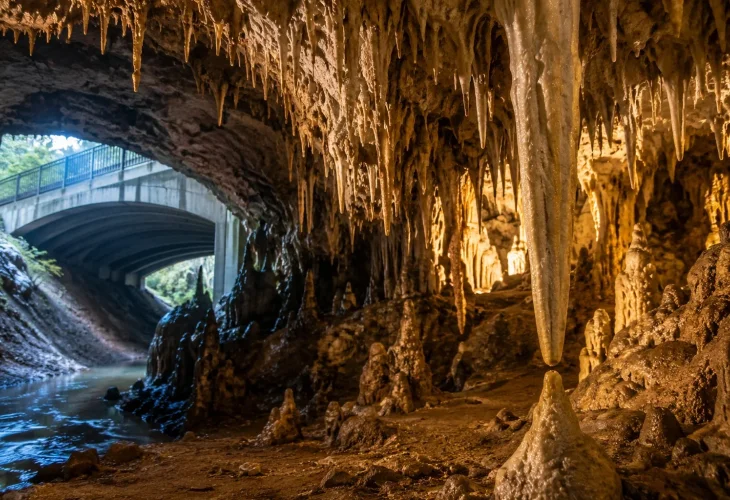
A reader once asked: If scientists claim that some cave stalactites took hundreds of thousands of years to form, how does that fit with the age of the world according to the Torah?
A response to this question appears in the writings of Rabbi Mordechai Neugroschel, who addressed the assumptions behind such age estimates.
How Are Stalactites Dated?
When people visit a stalactite cave, they are often told that the formations around them are incredibly ancient.
A guide may point to a stalactite several meters long and explain that it formed over hundreds of thousands of years. The calculation appears straightforward: if a stalactite grows at a certain measured rate, then its current size can be used to estimate how long it took to form.
For example, if a stalactite grows at a rate of one centimeter every thousand years, a ten centimeter stalactite would be estimated at ten thousand years old. A one meter stalactite would be estimated at one hundred thousand years old. According to this reasoning, a three meter stalactite would be approximately three hundred thousand years old.
At first glance, the mathematics seem undeniable.
A Surprising Discovery
Rabbi Neugroschel points to an interesting example that challenges the assumption behind such calculations.
A stalactite measuring approximately one and a half meters was discovered beneath a bridge in San Francisco. The bridge itself had been built only a few decades earlier, and the engineers who constructed it were still alive.
Yet the stalactite was composed of the same types of minerals found in natural cave formations.
If one were to apply the same growth rate calculations used in ancient caves, the conclusion would be absurd: the bridge would have to be tens of thousands of years old.
Clearly, that was not the case.
The Importance of Environmental Conditions
The explanation offered for the bridge formation was simple: mineral concentrations and environmental conditions in that location allowed the stalactite to develop much more rapidly than expected.
This raises an important question.
If unique conditions can dramatically accelerate stalactite growth in one location, how can we be certain that similar conditions did not exist in caves at various points in the past?
It is possible that periods of unusually high mineral concentration could have allowed stalactites to form far more quickly than current growth rates would suggest.
In such a scenario, the existence of the stalactite would be evidence of those conditions rather than proof of an extremely ancient age.
Another Consideration: The Aftermath of the Flood
Rabbi Neugroschel further notes that, according to the Torah perspective, the world experienced extraordinary geological and environmental changes following the Flood.
If massive amounts of water and minerals once moved across the earth on a global scale, this could have created conditions very different from those observed today.
As a result, assumptions based solely on present day growth rates may not necessarily reflect what occurred in the distant past.
Looking Beyond the Numbers
The central point of Rabbi Neugroschel's argument is not that stalactites did not form over time, but that age estimates depend heavily on assumptions about growth rates and environmental conditions.
When those assumptions cannot be verified with certainty, the conclusions drawn from them become less absolute than they may initially appear.
The debate over the age of stalactites ultimately comes down to a broader question: whether present day processes can always be used to accurately reconstruct the conditions of the distant past.
As Rabbi Neugroschel suggests, that question remains open to discussion.

