

Evolution
What Does the Torah Say About Dinosaurs? Exploring Fossils, Science, and Biblical Creation
Discover the fascinating intersection of paleontology, biblical interpretation, and the enduring mystery of Earth's prehistoric giants
- Daniel Blass
- | Updated
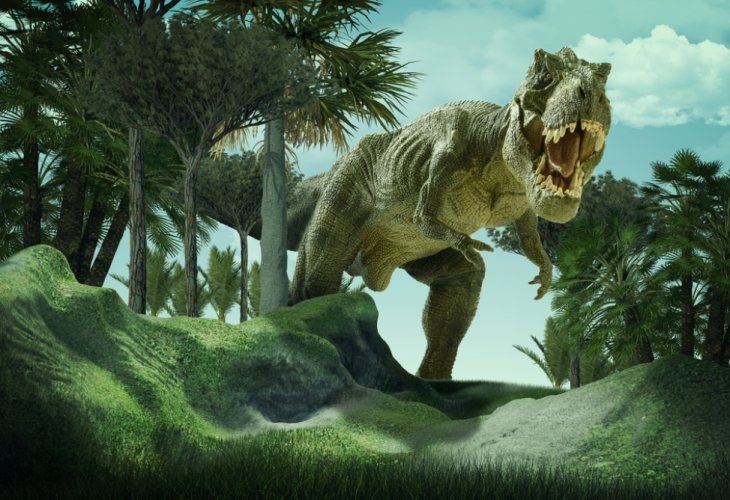 (Photo: shutterstock)
In the distant past, the world was home to many giant creatures, including mammoths and enormous birds. Among the most remarkable, however, were the giant reptiles known as dinosaurs, which reached extraordinary sizes and inhabited the ancient world.
Contrary to what many people assume, scientists have not discovered “millions” of dinosaur skeletons around the globe. The reality is much more modest: fewer than 2,000 dinosaur skeletons have been found to date.
It is also important to note that not every dinosaur species depicted in books and museums is considered an established scientific fact. When I researched the subject in depth, I was surprised to learn that many of the dinosaur skeletons displayed in famous museums are actually plastic reconstructions based on original fossil bones that are stored away in restricted-access collections.
There have been cases in which entire dinosaur models were reconstructed from a single shoulder bone or a few vertebrae, allowing considerable room for interpretation and imagination. Some fossil fragments may eventually be reclassified as belonging to different reptiles or even entirely different kinds of prehistoric creatures. As a result, each fossil must be evaluated on its own merits.
At the same time, there are dinosaur species for which scientists have discovered relatively complete skeletons, including well-preserved skulls. One famous example is the Tyrannosaurus rex specimen known as “Sue,” discovered in 1990. Fossils of juvenile dinosaurs have also been found, providing additional evidence about their mature form and development.
Their geographical distribution is also noteworthy. Although dinosaur fossils are relatively rare, they have been discovered on nearly every continent. Therefore, the existence of dinosaurs themselves is widely accepted as a scientific fact.
Is the Age of Dinosaurs a Scientific Fact?
According to this perspective, the age assigned to dinosaur fossils is not an empirical fact in the same way that the fossils themselves are.
Many people are unaware that dating methods do not always produce identical results, and researchers generally estimate ages using individual dating techniques rather than multiple methods that consistently agree with one another.
It is also argued that dating methods do not directly determine the age of the fossil itself, since fossils are largely composed of mineralized material. Instead, scientists estimate the age of dinosaur fossils based on theories regarding the geological layers in which they are found and by dating other materials associated with those layers.
Advocates of this view further point out that geological processes can disturb and overturn rock layers over time. As a result, many dinosaur fossils have been discovered close to the surface rather than deep underground, contrary to the simplified depictions often found in popular books. According to this argument, the arrangement of fossils into chronological sequences depends significantly on broader geological theories.
Does the Torah Mention Dinosaurs?
Some interpreters suggest that the Torah alludes to dinosaurs in the verse: “And God created the great sea creatures…” (Genesis 1:21)
In Hebrew, the word taninim is often translated as “great sea creatures,” “great reptiles,” or “great monsters.” According to this interpretation, the phrase “great taninim” refers to enormous reptilian creatures that existed in the ancient world and may be understood as including dinosaurs.
In rabbinic literature, some giant prehistoric animals are referred to as re’emim (often translated as “wild oxen” or “great beasts”). Various Midrashic and Talmudic passages describe extraordinarily large creatures and discuss their fate during the Flood.
According to this interpretation, not all dinosaurs were gigantic. The dinosaur family included reptiles of many different sizes. Some modern reptiles, such as crocodiles and monitor lizards, are viewed by certain writers as descendants or relatives of ancient reptilian groups that survived through history.
Could Giant Dinosaurs Still Exist Today?
Stories and reports occasionally emerge from remote parts of the world describing large, unidentified creatures.
One well-known example comes from the Congo Basin in Central Africa, where local traditions speak of a creature called Mokele-Mbembe, described as a large, dinosaur-like animal living in swamps and rivers.
There have also been occasional reports from sailors, explorers, and military personnel claiming encounters with large marine creatures that some have compared to prehistoric reptiles. One frequently cited account involves the German submarine SM U-28, whose crew reportedly described seeing an enormous unidentified sea creature during World War I.
Another often-mentioned case occurred in 1977, when a Japanese fishing vessel near New Zealand recovered the decomposing remains of a large marine animal. Some speculated that it resembled a long-necked marine reptile, though many scientists later suggested it was likely a decomposing basking shark.
Conclusion
According to this perspective, the Torah describes the creation of enormous creatures in the ancient world and preserves traditions about giant animals that existed in early history.
While the existence of dinosaurs is generally accepted based on fossil evidence, questions regarding their age, their relationship to biblical descriptions, and the possibility of surviving prehistoric creatures remain subjects of debate among various writers and researchers.
Whether one approaches the topic from a scientific, historical, or religious perspective, dinosaurs continue to capture the imagination and inspire ongoing discussion about the history of life on Earth.

