

Evolution
Former NASA Scientist Questions How Flight Could Have Evolved
Former NASA scientist David Coppedge argues that the origin of flight remains one of the most challenging questions for evolutionary theory.
- Yehosef Yaavetz
- | Updated
David Coppedge spent years working in the world of advanced aerospace engineering. Trained in physics, he worked for 14 years in NASA laboratories and was involved in planning the Cassini mission, the spacecraft that journeyed to Saturn and transformed our understanding of the ringed planet.
Today, Coppedge works as an independent science consultant and writer. One of the subjects he frequently discusses is the origin of complex biological systems, particularly those that, in his view, are not adequately explained by conventional evolutionary theories.
In a recent article, he turned his attention to one of nature's most remarkable abilities: flight.
How Does Flight "Develop"?
Coppedge argues that people often use phrases such as "the ability to fly evolved" without stopping to consider what such a statement actually means.
Drawing on his aerospace background, he notes that even relatively small engineering challenges can require years of work by large teams of highly trained specialists.
"When people talk about the development of flight," he writes, "what exactly are they describing?"
For Coppedge, the question is not whether animals fly today, but how a complete flight system could emerge in the first place.
Lessons From Aerospace Engineering
Having worked on complex spacecraft systems, Coppedge is familiar with the enormous number of components required for successful flight.
A flying system requires far more than wings. It depends on balance, steering, navigation, structural support, muscle coordination, energy management, and precise aerodynamic performance.
According to Coppedge, all of these elements must function together in order for true powered flight to occur.
That leads him to ask: How could a creature benefit from only part of a flight system?
The Case of the Pterosaurs
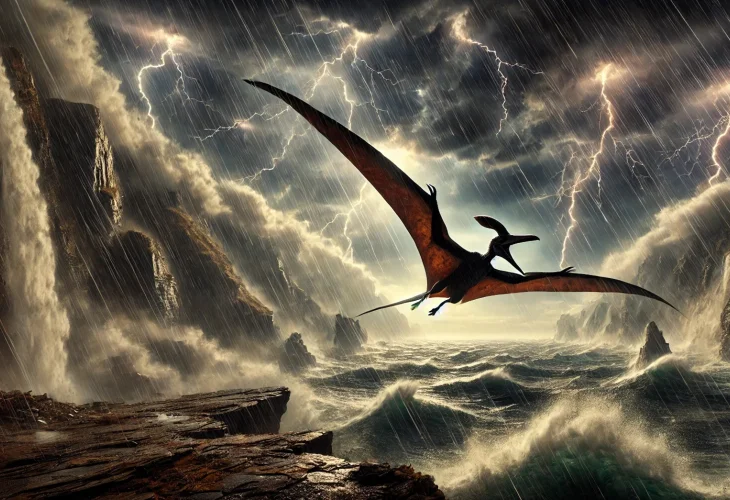
Coppedge focuses much of his discussion on pterosaurs, the extinct flying reptiles often described as the first vertebrates to achieve powered flight.
He argues that fossil evidence shows pterosaurs appearing with sophisticated flight capabilities already in place.
According to his interpretation, the fossil record does not reveal a long series of intermediate forms gradually acquiring flight.
Instead, he contends that pterosaurs appear as fully functional flying creatures.
A Question of Biological Information
The central issue, Coppedge argues, is not simply the presence of wings.
A successful flight system requires numerous interconnected features working together simultaneously.
A creature capable of flying even a short distance needs functioning wings, muscles, skeletal structures, sensory systems, and mechanisms for maintaining stability in the air.
According to Coppedge, explaining how these systems arose remains a significant challenge.
Günter Bechly's Criticism
Coppedge points to the work of German paleontologist Günter Bechly, who has also questioned conventional explanations for the origin of certain complex biological traits.
Bechly has argued that some evolutionary accounts rely heavily on storytelling rather than demonstrating step by step mechanisms supported by direct evidence.
According to Coppedge, Bechly's criticism extends beyond flight and applies to many complex features found throughout the fossil record.
Are the Explanations Sufficient?
Coppedge reviews several scientific proposals regarding the origin of flight and argues that many focus on isolated features rather than the complete system.
For example, some theories suggest that changes in limb structure or movement patterns may have contributed to the development of flight.
Coppedge responds that such changes alone do not explain how a fully integrated flight system emerged.
In his view, describing a feature as having "developed" is not the same as demonstrating how it actually arose.
An Ongoing Debate
The origin of flight remains a fascinating topic in biology, paleontology, and evolutionary research.
Supporters of evolutionary theory continue to investigate possible pathways through which flight could have emerged over time.
Critics such as Coppedge argue that current explanations leave important questions unanswered.
Whatever position one takes, the debate highlights the extraordinary complexity of living organisms and the continuing effort to understand how some of nature's most remarkable abilities came to exist.

