

Parashat Balak
The Hidden Lesson Behind Balaam and the Talking Donkey
What was Balaam's donkey really trying to tell him? A fascinating insight from Parashat Balak with a timeless message.
- Yisrael Keinig
- | Updated
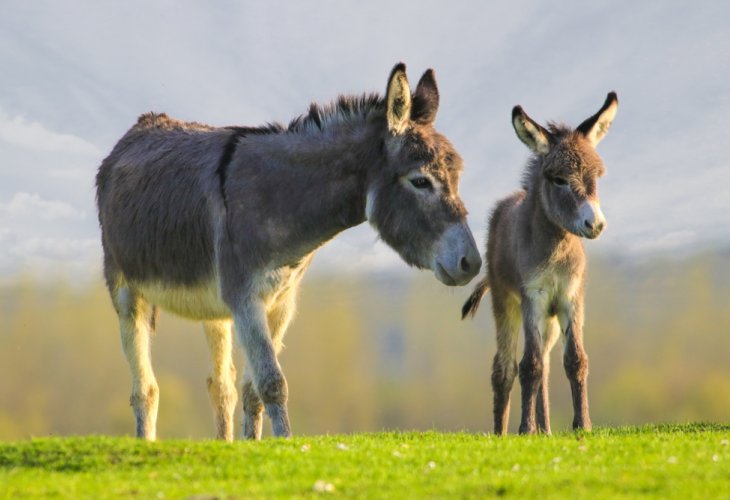 (Photo: shutterstock)
"How many jars did I ask you to buy?" Mom asked Meir.
"Two," Meir replied, holding only one jar.
"And where is the second one?" Mom asked.
"It broke," the boy shrugged.
"How did it break?" Mom asked in surprise.
"Like this," Meir demonstrated, smashing the jar in his hand onto the floor.
The Strange Conversation Between Balaam and His Donkey
After the donkey turned off the road, pressed Balaam’s foot against a wall, and then crouched beneath him, Balaam struck her each time with his staff.
Then Hashem performed a miracle and opened the donkey’s mouth.
To everyone’s surprise, she spoke:
"What have I done to you, that you have struck me these three times?"
At first glance, the conversation seems puzzling.
Once Heaven had granted the donkey the ability to speak, shouldn't she have apologized for changing course? Shouldn't she have explained that something was preventing her from moving forward?
Instead, she simply asked why Balaam was hitting her.
And Balaam, supposedly a great wise man, responded on the same level:
"Because you made a mockery of me."
In other words: "You started it."
The donkey then asked:
"Have I ever been accustomed to do this to you?"
And Balaam answered:
"No."
The Bear Who Became a Monkey
A hungry bear wandered through the forest, tormented by hunger. With no other choice, he decided to surrender himself to the zoo, where at least he would receive food every day.
"We don't need a bear right now," the zoo director told him. "But we're missing a monkey of a certain species. Interested?"
"A monkey?" the bear shuddered. "Not for me. I have no idea how to be a monkey."
"We'll teach you," the director promised. "You'll make an excellent monkey."
After several days of training and after preparing a costume large enough for him, the bear entered the monkey enclosure and began entertaining visitors.
But the food that had attracted him to the zoo in the first place turned out to be disappointing. A bear needs a lot of food. Bananas and peanuts were nowhere near enough.
One night, after the zoo had closed, the bear wandered over to the bears' enclosure. There he discovered enormous amounts of food.
Turning to one of the bears, he asked, "Why aren't you eating all this?"
"I'll tell you the truth," the bear replied. "I'm not really a bear. I'm a monkey. I was starving in the forest, so I came to the zoo looking for food. The director told me the monkey position was already taken, but if I wanted, I could be a bear. My body is small, and I can't possibly eat all this food."
"What a strange world," the bear said in amazement. "I'm a bear in a monkey cage, and you're a monkey in a bear cage. Tomorrow morning we'll ask the director to switch us. That only makes sense."
The next morning, the two stood before the director and proposed exchanging places.
The director cut them off immediately.
"There's nothing to discuss. Each one stays exactly where he is."
"Director," the bear said politely, "forgive me, but you're talking like a donkey."
"That's true," the director replied. "When I was starving in the forest, I came to the zoo and asked for a place in the donkey enclosure. The secretary told me it was already full. But if I wanted, the position of zoo director was available..."
What the Donkey Was Really Trying to Say
Rabbi Azariah Figo, in his work Bina La'Itim, explains the unusual conversation between Balaam and the donkey through the question we raised earlier.
The donkey was not avoiding responsibility. She was actually trying to teach Balaam something.
"What have I done to you that you struck me?" she asked.
Why are you hitting me? Because I'm suddenly acting differently?
Until now, everything has been fine.
For the first time ever, I am behaving strangely, and this has now happened three times in a row. Yet instead of stopping to consider that something unusual may be going on, you simply hit me again.
Why doesn't it occur to you that there might be a reason?
Looking Beyond the Behavior
"This isn't like you."
"Maybe I would expect it from someone else, but not from you."
Most of us have either heard these words or said them ourselves.
Perhaps the miracle of the donkey's speech was not meant only for Balaam. Perhaps it was meant for every generation.
When a person generally behaves well and suddenly undergoes a dramatic change, it is easy to focus only on the behavior itself.
"How did he drop the jar?"
The answer may simply be:
"Like this."
But maybe there is a deeper question that needs to be asked.
Instead of striking with a stick, instead of lecturing someone about how unlike them this behavior is, perhaps we should pause and find out what is really happening beneath the surface.
Perhaps the person is lacking the nourishment he truly needs.
Perhaps someone has been feeding him monkey food, when all along he was really a bear.

