

Parashat Balak
Parashat Balak: What Are You Doing With Your Greatest Strength?
Balaam's greatest gifts were his powers of speech and vision. But when he misused them, Hashem taught him a powerful lesson through a talking donkey.
- Rabbi Moshe Shainfeld
- | Updated
As the Israelites draw closer to the Land of Israel, they must pass through territories controlled by powerful nations and kingdoms. Some of those nations are deeply alarmed by their arrival.
One of them is Moab. Balak, king of Moab, hears about the victories and miracles that have accompanied the Jewish people since the Exodus from Egypt. He realizes that there is no conventional way to fight a nation protected by Hashem. If their strength is spiritual, then the battle against them must be spiritual as well.
That realization leads him to Balaam son of Beor, a prophet from Midian who is believed to possess the power to bless and curse through his words. Balak hopes that Balaam's spiritual abilities will succeed where armies cannot.
Balaam's Journey
When Balak's messengers arrive, Balaam asks Hashem whether he should join them. Hashem's answer is clear: he must not go and he must not curse the Jewish people.
Balak, however, refuses to give up. He sends a second delegation, more prestigious than the first, and Balaam struggles to resist the temptation. Although he already knows Hashem's will, he continues pressing for permission.
Eventually, Hashem allows him to go.
The sages teach a powerful principle from this episode: "On the path a person wishes to go, he is led." Hashem grants every person free choice. If someone insists on following a certain path, even an unhealthy one, Hashem will not necessarily stop him.
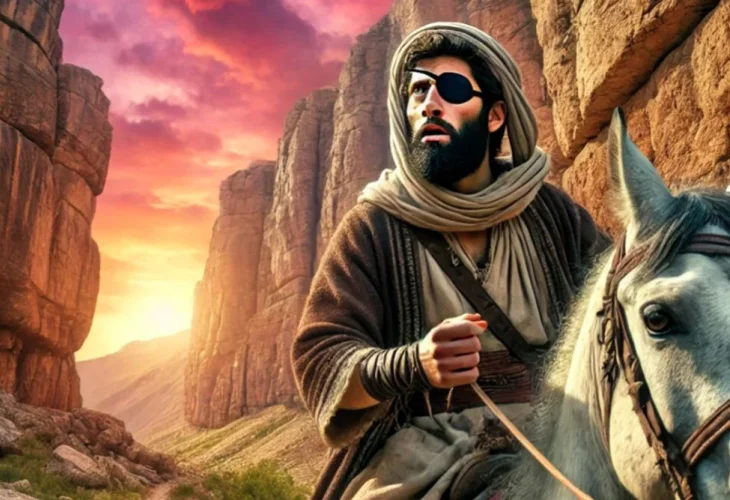
Balaam sets out on his donkey toward the Israelite camp. Along the way, one of the Torah's most famous and surprising episodes unfolds.
The Donkey Refuses to Move
The donkey is traveling along a narrow path when it suddenly veers off course. Balaam strikes it to force it back onto the road.
A short while later, the donkey presses itself against a wall and crushes Balaam's leg. Again, he strikes it.
Then the donkey simply stops moving. It crouches down beneath him and refuses to continue. Furious, Balaam strikes it for a third time.
At that moment, something astonishing happens.
"Hashem opened the mouth of the donkey, and it said to Balaam: What have I done to you, that you have struck me these three times?"
The donkey continues: "Am I not your donkey, upon which you have ridden all your life until this day? Have I ever been accustomed to do this to you?"
Balaam is forced to admit the truth.
"No."
Only then does the Torah tell us: "Hashem uncovered Balaam's eyes, and he saw the angel of Hashem standing in the road, with his sword drawn in his hand."
Suddenly everything becomes clear. The donkey had seen what Balaam could not.
Why a Talking Donkey?
What was the purpose of this extraordinary miracle?
Why did Hashem open the donkey's mouth? Why not simply reveal the angel immediately?
The answer may lie in Balaam's greatest strengths.
Every person derives confidence from the unique abilities Hashem has given him. A person's talents often become part of his identity. They are the qualities that make him feel valuable and distinct.
Balaam possessed two extraordinary gifts.
The first was speech. Balak himself says, "For I know that whom you bless is blessed, and whom you curse is cursed."
The second was vision. Balaam later describes himself as "the man with the open eye" (Numbers 24:3). Onkelos explains this as referring to his exceptional ability to perceive what others could not. According to the commentators, Balaam possessed unusually powerful spiritual vision.
These gifts became the source of his pride.
The Message Balaam Needed to Hear
The Or HaChaim explains that Balaam's eyes possessed destructive power. Wherever he directed his gaze, harm could follow. His unique abilities set him apart from ordinary people, and he knew it.
So what does Hashem do?
He transfers Balaam's two greatest strengths to the donkey.
Suddenly the donkey sees what Balaam cannot see. The donkey recognizes the angel while Balaam remains blind to what is standing directly in front of him.
And then the donkey speaks.
The very gifts on which Balaam built his sense of superiority are suddenly found in the animal beneath him.
The message could not be clearer.
You think your greatness comes from your ability to see and speak. But if those gifts are used improperly, they mean nothing. Even a donkey can speak if Hashem wants it to speak. Even a donkey can see if Hashem wants it to see.
Talent Is a Responsibility
A talking donkey is still a donkey.
A donkey that sees angels is still a donkey.
Special abilities do not automatically make a person great. Greatness depends on how those abilities are used.
This was the lesson Balaam needed to learn. Hashem had entrusted him with remarkable gifts, but instead of using them to help others and bring people closer to truth, he was willing to use them to harm an entire nation.
The donkey's rebuke was not merely about that particular journey. It was a lesson about responsibility. Talent is not only a gift; it is also an obligation. The more a person has been given, the more he is expected to accomplish with it.
A Lesson for All of Us
The story of Balaam's donkey speaks to every one of us.
Each person has been given unique strengths, talents, and opportunities. No two people are exactly alike, and no one else's mission is identical to our own. Hashem equips every person with the tools needed to fulfill the purpose for which they were created.
But talents can be used in two very different ways. They can elevate a person, or they can become the source of his downfall.
Balaam chose to use his gifts in a destructive way, and those very gifts became the means through which he was humbled.
The question the story leaves us with is simple: What am I doing with the abilities Hashem gave me? Am I using them to become the best version of myself and contribute goodness to the world, or am I allowing those same gifts to pull me in the opposite direction?
That is the challenge hidden within one of the Torah's most famous miracles.

