

Tu Bishvat
The Almond Tree’s Secret: Why It Blooms First and What It Teaches Us About Life
Discover the deeper meaning of the almond tree in Jewish tradition, the biblical significance of its name, and the powerful lessons it teaches about diligence, spiritual growth, and becoming the first to blossom
- Rabbi Eitan Ziner
- | Updated
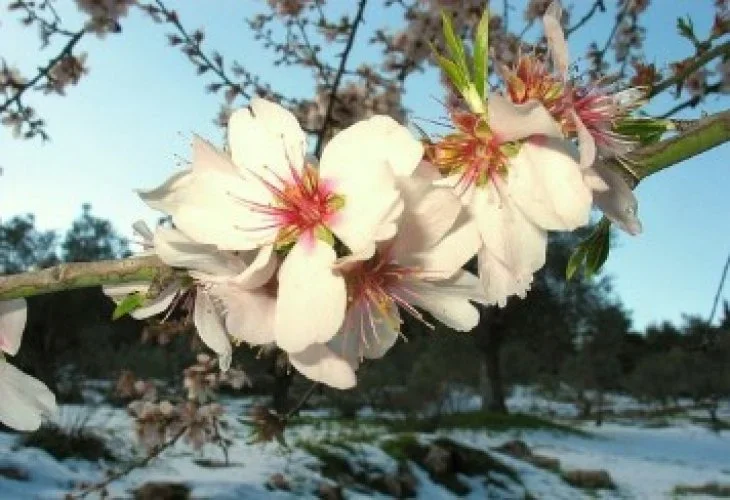
The almond tree is celebrated as the symbol of Tu B'Shevat. The tree’s fruit is well-known and beloved, and provides almonds that are available throughout the year. They are sold roasted, raw, shelled, unshelled, sliced, and ground, and are used in countless recipes and products.
To understand the significance of the almond tree, however, we must first understand the meaning of the Hebrew root shaked (שקד).
The Meaning of "Shaked"
The root shaked appears in the Book of Jeremiah: "The word of the Lord came to me, saying, 'What do you see, Jeremiah?' And I said, 'I see a branch of an almond tree.' Then the Lord said to me, 'You have seen well, for I am watching over My word to perform it.'" (Jeremiah 1:11–12)
The commentator Metzudat Zion explains that the word shoked ("watching over") implies speed, diligence, and eagerness.
In other words, when God says, "I am watching over My word to perform it," He means, "I am hastening and diligently bringing My word to fulfillment."
This insight reveals the deeper meaning behind the almond tree's name.
The First Tree to Awaken
Unlike evergreen trees, which remain green throughout the year, the almond tree belongs to the family of deciduous fruit trees. During autumn, its leaves fall, leaving the tree bare and dormant throughout the winter months.
Most fruit trees wait patiently for spring before awakening and blossoming. Each one blooms in its own season and according to its own natural rhythm.
The almond tree does not.
It is the pioneer. The first to awaken, the first to bloom, and the first to adorn the world with flowers after the long winter.
Its remarkable eagerness and speed are what earned it the name shaked — the diligent, watchful tree.
For this reason, it is praised and celebrated.
Man Is Like a Tree
The Torah often compares a person to a tree.
In the Book of Deuteronomy we read: "For man is like the tree of the field."
Rabbeinu Bachya explains that just as a fruit tree sustains people through its produce, so too does a person provide benefit and nourishment to the world around him.
The Sages take this comparison even further.
In Tractate Taanit, they teach that the verse refers particularly to Torah scholars. Just as fruit trees nourish people with their fruit, Torah scholars nourish the world through their wisdom and teachings.
Their words sustain us, their guidance enriches us, and their wisdom shapes generations.
Throughout Jewish history, Torah scholars were respected not only by their own communities but often even by their greatest opponents. Their wisdom, integrity, and insight earned them positions of influence and responsibility under many rulers and governments.
A Tree with Sweet Fruit
The Talmud records a beautiful encounter between two Torah scholars.
One scholar asked the other for a blessing. In response, his friend offered the following parable:
A man was traveling through the desert. Hungry, thirsty, and exhausted, he came upon a tree with sweet fruit, pleasant shade, and a stream flowing beneath it.
He ate from its fruit, drank from its water, and rested in its shade.
When the time came to leave, he said: "Tree, tree, how can I bless you?
If I bless you that your fruit should be sweet — your fruit is already sweet.
If I bless you that your shade should be pleasant — your shade is already pleasant.
If I bless you that a stream should flow beneath you — a stream already flows beneath you.
Therefore, may it be God's will that all the trees planted from you be just like you."
The scholar then applied the parable to his friend: "How can I bless you?
If I bless you with Torah — you already possess Torah.
If I bless you with wealth — you already possess wealth.
If I bless you with children — you already have children.
Therefore, may it be God's will that all your descendants be like you."
The message speaks for itself.
The Lesson of the Almond Tree
Perhaps this is why the almond tree occupies such a special place in Jewish tradition.
It reminds us not only of the changing seasons, but also of the virtues of diligence, initiative, and spiritual growth.
While other trees remain dormant, the almond tree is already preparing to bloom. While others wait, it moves forward.
Its message to us is simple: Do not wait for perfect conditions, and do not wait for everyone else.
Be the first to awaken, be the first to grow, be the first to blossom. Like the almond tree, we are called to approach our spiritual lives with enthusiasm, readiness, and determination.
May we all merit to emulate the almond tree's diligence in our service of God, our Torah study, and our personal growth.
And may the blessing spoken in the Talmud be fulfilled in each and every one of us — that our children and future generations continue to grow in wisdom, goodness, and faith.

