

Israel News
The Lebanon Plan Taking Shape: Israel Pulls Back, Hezbollah Stays Armed
Several diplomatic tracks now focus on Israeli withdrawal, Lebanese Army deployment, monitoring mechanisms and a possible Syrian role, while leaving Hezbollah’s weapons unresolved
Several proposals for Lebanon are now being floated after the U.S.-Iran talks in Switzerland, but they appear to share one major feature: none begins with the immediate disarmament of Hezbollah.
The different tracks differ over who monitors the front, how quickly the IDF withdraws and what role the Lebanese Army will play. But they all focus first on stopping the fighting and arranging a new security formula, while Hezbollah’s weapons remain unresolved.
The Switzerland track produced a Lebanon-related mechanism, including a “de-confliction cell” meant to help monitor a halt in military activity. That mechanism would not be a final political settlement. It would be a tool to manage the front and prevent renewed clashes while the wider U.S.-Iran process continues.
A separate plan reported by the Lebanese newspaper Al-Akhbar, which is close to Hezbollah, gives a clearer picture of what some Arab states want the arrangement to look like. According to the report, Egypt and Saudi Arabia are pushing a formula that includes an immediate ceasefire, a full Israeli withdrawal from southern Lebanon, expanded Lebanese Army deployment, stronger monitoring mechanisms for the ceasefire arrangements and Saudi support for reconstruction.
The key part is what the plan does not include. According to the report, the Egyptian approach does not focus on collecting Hezbollah’s weapons or dismantling its military infrastructure. Instead, it would rely on “freezing” the use of Hezbollah’s weapons, meaning Hezbollah would keep its arsenal but pledge not to use it.
The reported Arab formula also seeks to avoid an internal Lebanese confrontation over Hezbollah’s weapons. According to Al-Akhbar, Cairo believes there is no real chance of progress under U.S. sponsorship as long as the main demand remains Hezbollah’s disarmament.
U.S. President Donald Trump has sent pressure in several directions. In a post on Sunday, he warned Iran over Hezbollah, writing: “Iran must immediately stop their highly paid PROXIES in Lebanon from causing trouble. If they don’t, we’ll hit Iran very hard again, just like we did last week, only harder!”
At the same time, Trump has criticized Israel’s conduct in Lebanon. On Sunday, Trump told Fox News: “I am disappointed Israel cannot put Hezbollah away. They can’t do anything without knocking buildings down. I am close to giving this to Syria because he would do a more precise job.”
Syria has rejected the idea of entering Lebanon militarily. Syrian President Ahmed al-Sharaa told the Emirati channel Al-Mashhad: “We only wish good for the people of Lebanon. The role Syria will play is a completely positive one. Syria may help disarm Hezbollah, but not through war and not through Syrian sponsorship over Lebanon, as existed under the previous regime.”
Lebanon’s government is also pushing the idea that Israeli withdrawal must come first. Lebanese President Joseph Aoun said Israel’s withdrawal would allow Lebanon “to extend its authority, end armed manifestations and remove any justification for the existence of weapons other than those of the state.”
Hezbollah and Iran are trying to make Israeli withdrawal the central demand. Hezbollah chief Naim Qassem said: “A ceasefire with freedom of action for Israel is a continuation of the aggression, and we will not accept it.” Reuters reported that Hezbollah believes Iran will not sign a final nuclear deal with Washington unless Israel withdraws from Lebanon.
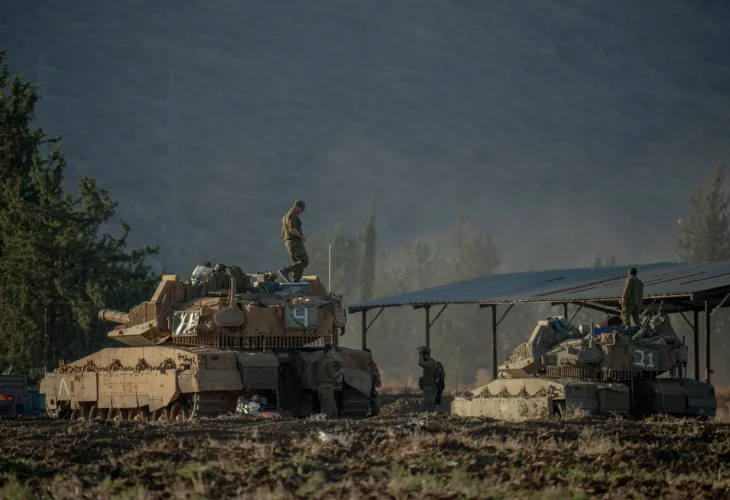
The pressure is also being felt on Israel. Kan reported that the Trump administration wants Israel to move IDF forces back toward the so-called yellow line, about eight kilometers from the border, a line meant to protect northern Israeli communities from anti-tank fire. Israel expanded its deployment beyond that line in recent months, and an Israeli official familiar with the matter said the IDF will not withdraw from the yellow line, though it may withdraw from areas captured recently, depending on negotiations.
On the ground, Israeli reports said no unusual incidents were recorded in the past day after the political echelon instructed the IDF to hold fire. One key area is the Ali Taher ridge, south of Nabatieh, where Hezbollah built a fortified underground command center over 20 years and where Israeli security officials say the terrorists inside do not currently pose an immediate threat because they are trapped.
The plans now being discussed may reduce the fighting. They may expand the Lebanese Army’s role and create new monitoring mechanisms. But for Israel, the unanswered question remains the same: who will actually take Hezbollah’s weapons away?

