

Evolution
The Biological Mystery That Darwin Never Fully Solved
Darwin acknowledged that certain discoveries could challenge his theory. Some researchers believe modern biology has uncovered exactly those kinds of examples.
- Yehosef Yaavetz
- | Updated
One famous joke asks: What is the ultimate speed record?
The answer: standing calmly at your third floor window, then suddenly sprinting down the stairs, racing outside, and arriving just in time to see your own face disappear from the window.
The joke works because it describes something impossible. A person cannot be in two places at the same time. There must be a sequence of events, with one stage leading naturally to the next.
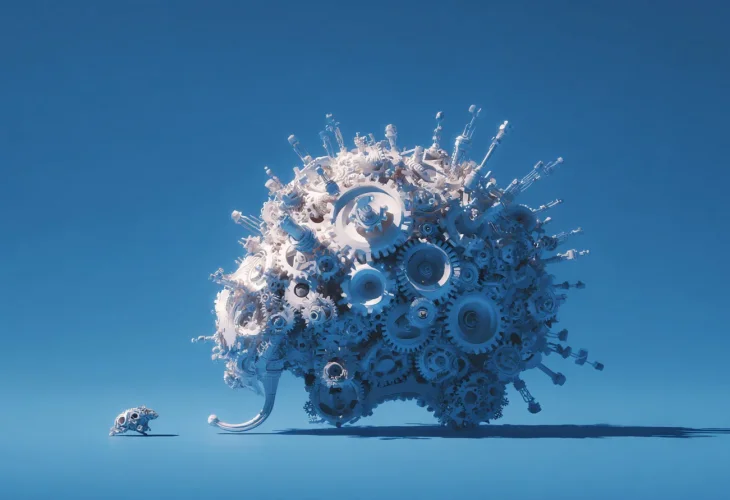
This simple idea lies at the heart of a fascinating scientific debate that has been gaining attention in recent years. The question is whether some of the most complex systems found in living organisms can truly be explained by a long series of small, gradual changes, or whether their very structure points to intentional design.
At the center of the discussion are two concepts: irreducible complexity and emergence.
Darwin's Challenge
Even Charles Darwin acknowledged that his theory would face a serious problem under certain conditions.
In On the Origin of Species, he wrote that if it could be demonstrated that a complex organ existed which could not possibly have been formed through numerous, successive, slight modifications, his theory would break down.
More than 150 years later, some scientists and proponents of intelligent design argue that modern biochemistry has uncovered examples that fit precisely that description.
Their argument centers on what is known as irreducible complexity.
What Is Irreducible Complexity?
The term was popularized by biochemist Michael Behe and refers to a system composed of multiple interacting parts, all of which are necessary for the system to function.
Remove one essential component, and the entire system stops working.
The claim is that such systems could not have developed gradually through a series of small, beneficial steps because the intermediate stages would not have provided any useful function.
One frequently cited example is the bacterial flagellum, a microscopic motor that allows certain bacteria to move through their environment.
The structure includes roughly 40 different proteins arranged in a highly organized system consisting of a rotor, stator, shaft, hook, rings, and filament. Supporters of intelligent design argue that if key components are missing, the motor cannot function, raising the question of how a partially formed version could have provided any evolutionary advantage.
Another commonly discussed example is the blood clotting system. This process depends on a complex chain of biochemical reactions in which one protein activates the next. If a critical stage is missing, blood may fail to clot properly or clot excessively, either of which can be life threatening.
The Idea of Emergence
Alongside irreducible complexity, some researchers point to the concept of emergence.
In simple terms, emergence refers to situations in which complex behavior arises from the interaction of many individual components, producing results that cannot easily be predicted by examining the parts alone.
Some theorists argue that biological systems may develop as integrated wholes rather than as simple collections of independently evolving pieces. According to this view, the organization of living systems involves levels of coordination that remain difficult to explain through purely step by step processes.
For advocates of intelligent design, the concept strengthens the argument that complex biological systems appear to require extensive coordination from the very beginning.
Design or Chance?
Supporters of intelligent design argue that systems such as the bacterial flagellum and blood clotting cascade require numerous components to work together in precise ways.
For the flagellum to function, its various parts must interact correctly and connect to the cell's energy system. For blood clotting to work, multiple proteins must activate in the proper sequence and in the correct amounts.
From this perspective, it becomes difficult to imagine how such systems could arise through a long series of random mutations if the intermediate stages provided little or no functional advantage.
Critics of intelligent design disagree and argue that evolutionary mechanisms can account for these systems through processes that may not yet be fully understood. They point to ongoing research into how complex biological structures evolve and caution against assuming that current gaps in scientific knowledge prove design.
Nevertheless, the debate continues because the underlying questions remain profound.
When Science and Faith Meet
For many believers, discoveries in molecular biology have strengthened rather than weakened their faith.
The deeper scientists look into the microscopic world of DNA, proteins, and cellular machinery, the more astonishing its complexity appears. To those who see evidence of a Creator in nature, these discoveries are not threats to faith but confirmations of it.
From this perspective, the intricate coordination found throughout living systems reflects wisdom, purpose, and intentional design.
Whether one ultimately views these systems as the product of evolutionary processes, intelligent design, or some combination of factors, the discussion highlights a remarkable reality: life is far more complex, sophisticated, and awe inspiring than anyone could have imagined only a few generations ago.
And for many people, that complexity naturally raises one of humanity's oldest questions: does such extraordinary design point to a Designer?

