

Interesting
Switzerland Unveils the World’s Tallest 3D-Printed Building
Standing nearly 100 feet tall, Switzerland's new White Tower is the tallest 3D printed structure ever built and may offer a glimpse into the future of construction.
- Shira Dabush
- | Updated
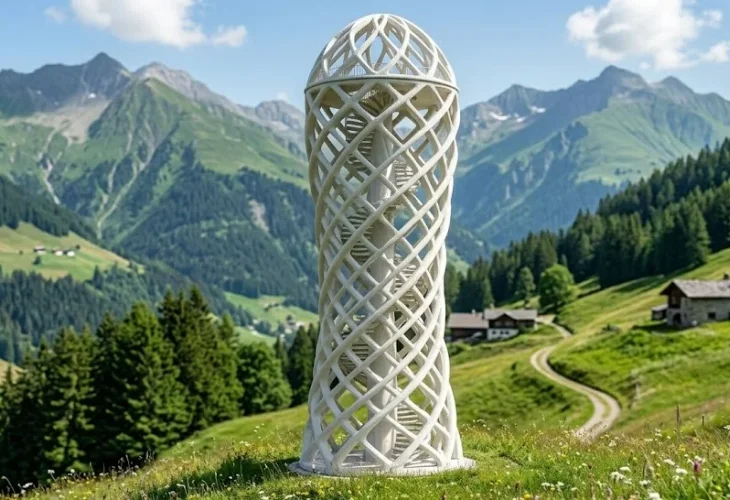
A remarkable new chapter in construction technology has opened in Switzerland, where the world's tallest 3D printed tower has officially welcomed its first visitors.
The project, known as Tor Alva, or "The White Tower," was developed by researchers and architects from the University of Zurich. Rather than relying on traditional construction methods, industrial robots printed the structure layer by layer using a specially developed building material. This innovative approach made it possible to create intricate architectural details that would be difficult, and in some cases impossible, to achieve through conventional construction.
The World's Tallest 3D Printed Tower
Located in the small Swiss village of Mulegns, Tor Alva rises approximately 100 feet (30 meters) into the air and currently holds the title of the world's tallest structure created through 3D printing technology.
Its striking appearance immediately sets it apart. Built from precisely printed components, the tower combines elegant geometric forms with flowing curves and decorative details that give it the appearance of a giant sculpture. Many visitors have compared the structure to a modern work of art rather than a conventional building.
Even before its official opening, the tower attracted widespread international attention and became one of the most talked-about projects in contemporary architecture.
Why Was It Built in a Tiny Village?
The choice of location was far from accidental.
Mulegns is home to only a few dozen residents, and the project's creators hope the tower will help bring new life to the area by attracting tourists, architecture enthusiasts, and technology lovers from around the world.
The structure has already become a landmark and a symbol of how cutting-edge innovation can help revitalize small communities.
More Than an Architectural Experiment
While the tower's appearance has captured headlines, the project's goals extend far beyond aesthetics.
Researchers view Tor Alva as a real-world laboratory for exploring the future of construction.
According to the development team, 3D printing technology allows builders to use materials more efficiently, reduce waste, and create highly complex structures with less manual labor. The process also offers architects greater creative freedom, opening the door to designs that would be difficult to produce using traditional building techniques.
Is This the Future of Construction?
Many experts believe 3D printing is still in the early stages of its development, but its potential is enormous.
In the years ahead, the technology could help reduce construction costs, shorten building timelines, and lower resource consumption. Around the world, 3D printing is already being used to create homes, bridges, and public buildings, although researchers continue to study its long-term practicality and economic viability.
Whether or not future cities will be filled with 3D printed towers remains to be seen. What is clear, however, is that projects like Tor Alva are pushing the boundaries of what architecture can achieve.
For now, the White Tower stands as both a world record holder and a glimpse into a future where buildings may be printed rather than built.

