

Evolution
The Geological Discoveries That Challenge Evolution
Do fossils always support the evolutionary timeline? Rabbi Zamir Cohen reviews several discoveries that some researchers argue challenge conventional explanations.
- Rabbi Zamir Cohen
- | Updated
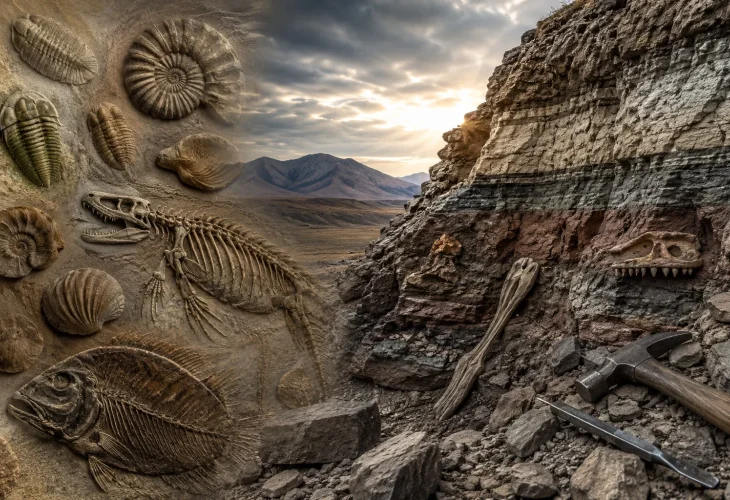
For many years, geological layers were considered one of the strongest pieces of evidence supporting evolutionary theory. Scientists studied the different layers of rock found throughout the world and used them to construct a timeline of Earth's history, arguing that changes in climate and environment led to the appearance of new species and the extinction of others.
According to this model, deeper geological layers are generally older than those above them, and the fossils found within those layers are assumed to belong to earlier periods in history. Based on these assumptions, researchers attempted to reconstruct the development of life over hundreds of millions of years.
Yet some critics of evolution argue that the geological record is not as straightforward as it is often presented.
Fossils in Unexpected Places
According to Rabbi Zamir Cohen, certain fossil discoveries appear to challenge the expected evolutionary timeline.
In some cases, creatures that evolutionary theory claims appeared later have reportedly been found in lower geological layers, while species believed to have existed earlier have been discovered in higher layers. Critics argue that such findings raise questions about the reliability of the evolutionary sequence traditionally presented in textbooks.
In addition, researchers have reported discovering artifacts and human-made objects in geological contexts that, according to conventional dating methods, predate the appearance of human beings. These findings remain controversial, and interpretations vary widely within the scientific community.
One of the most well-known books discussing such claims is Forbidden Archeology by Michael Cremo and Richard Thompson. The authors compiled numerous examples of discoveries they believe do not fit accepted historical timelines and argue that these findings deserve greater attention. Supporters view the book as an important challenge to mainstream assumptions, while critics dispute many of its conclusions.
A Critique From Within Science
Rabbi Cohen notes that some scientists have openly questioned aspects of evolutionary theory based on geological evidence.
Among those cited is Professor Kenneth Hsü, a prominent geologist known for his work in stratigraphy, the branch of geology that studies rock layers and their formation. Critics of evolution point to statements such as his as evidence that debates about the interpretation of geological data continue even within scientific circles.
The Discovery That Sparked Controversy
One of the most famous episodes in paleontology involves the fossil beds of the Canadian Rocky Mountains.
In 1909, paleontologist Charles Doolittle Walcott, then secretary of the Smithsonian Institution, made a remarkable discovery in what would later become known as the Burgess Shale. The site contained exceptionally preserved fossils estimated to be more than 500 million years old.
What made the discovery so significant was the extraordinary variety of life forms found there. Rather than revealing a simple progression of increasingly complex organisms, the fossils included a wide range of complex body structures already in existence.
Critics of evolution argue that the Burgess Shale raises difficult questions about gradual evolutionary development. They point to the appearance of numerous complex organisms in ancient rock layers as evidence that major forms of life appeared suddenly rather than through a long series of transitional stages.
Mainstream evolutionary biologists, however, view the Burgess Shale differently. They see it as an important window into what is known as the Cambrian Explosion, a period of rapid diversification in which many major groups of animals appeared in the fossil record.
The Ongoing Debate
According to Rabbi Cohen, discoveries such as these highlight what he sees as significant challenges to evolutionary theory.
He argues that the fossil record often reveals complex organisms appearing abruptly rather than through the gradual process Darwin envisioned. From his perspective, this pattern is more consistent with purposeful creation than with a purely random evolutionary process.
Supporters of evolutionary theory respond that the fossil record remains incomplete and that new discoveries continue to fill gaps in our understanding of life's history. They maintain that evolutionary biology remains the best scientific explanation currently available for the diversity of life.
The discussion continues to generate debate because it touches on some of humanity's deepest questions: How did life begin? How should we interpret the evidence found in nature? And what is the relationship between scientific inquiry and belief in a Creator?
For believers, discoveries in geology and paleontology do not weaken faith. Rather, they provide another opportunity to reflect on the complexity, order, and wonder found throughout creation.

