

Personality Development
What If We Could Be Everywhere at Once? Possibilities, Risks, and the Jewish Perspective
What life would be like if humans could be present everywhere at the same time, and what Judaism teaches about this extraordinary concept
- Moriah Chen
- | Updated
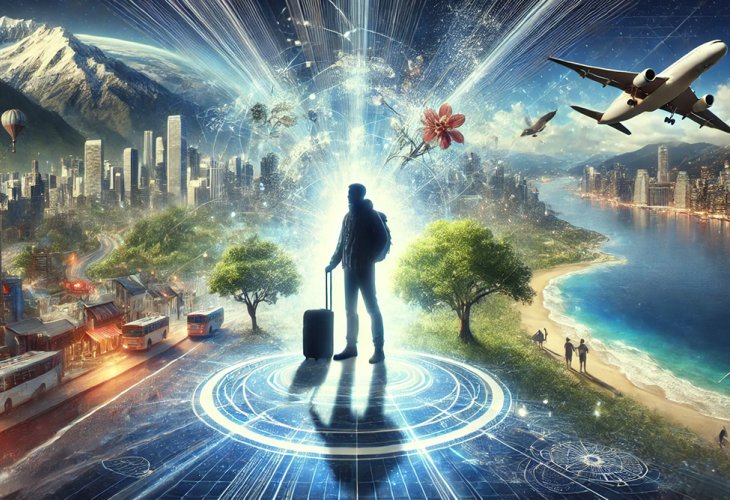
What would happen if we could be everywhere in the world at the same moment? There is no doubt that such an extraordinary ability would fundamentally transform the way we live, communicate, and experience the world.
This question invites us to imagine a reality in which physical boundaries become blurred. What would be the advantages and disadvantages of such a capability? And, of course, what does Judaism have to say about it?
Global Communication and Collaboration
The ability to be everywhere at once would dramatically improve international communication and cooperation. People could attend important meetings, conferences, and events anywhere in the world without the need to travel. This could accelerate scientific, medical, and technological breakthroughs.
Furthermore, enhanced global connectivity would foster relationships across continents and cultures, inspiring innovation and groundbreaking collaborations that would not have been possible before.
Education and Learning
Students and teachers could connect to classrooms and educational institutions around the world. High-quality education would become accessible to everyone, regardless of geographic location. People could learn and develop without limitations.
Students would benefit from guidance provided by experts from every corner of the globe, while educators could extend their influence to learners worldwide. These new opportunities could raise global educational standards and help reduce social and economic disparities.
Healthcare and Medicine
Doctors and specialists could provide medical services and perform complex procedures in distant locations. This would make advanced healthcare accessible even in remote regions and reduce dependence on the physical presence of doctors and medical facilities.
In addition, obtaining second opinions from world-renowned experts would become faster and more efficient. The ability to be everywhere could also drive medical progress by enabling higher-quality remote care and consultation.
Cultural Experiences
Being present anywhere in the world simultaneously would allow us to experience different cultures in real time. We could attend festivals, exhibitions, and events from across the globe, broadening our understanding and appreciation of other societies.
We could also learn about local traditions, cuisines, and languages through direct and interactive experiences. Such cultural exposure would deepen our understanding of the world and enrich our lives on both a personal and social level.
Family and Friends
People would be able to attend important family events and spend time with friends and loved ones, even when separated by great distances. This would help maintain strong and meaningful relationships.
We would no longer have to miss significant occasions such as weddings, birthdays, or holiday gatherings simply because we live far away. We could support one another during difficult times and preserve a sense of family and unity despite physical separation.
The Potential Downsides
While the benefits are impressive, there are also serious drawbacks that cannot be ignored.
Loss of Privacy
The ability to be everywhere at once could severely undermine personal privacy. If anyone could be anywhere at any moment, maintaining private spaces and personal secrets would become increasingly difficult.
The fear of constant observation could erode feelings of security and personal freedom. Continuous exposure might also cause people to alter their behavior and suppress authentic self-expression due to concerns about unwanted monitoring or scrutiny.
Mental and Physical Stress
Being everywhere simultaneously could create significant psychological and physical strain. People might feel obligated to be present everywhere and at all times, leading to overwhelming demands and increased pressure.
The drive to maximize productivity every moment could result in burnout and emotional exhaustion. Moreover, experiencing multiple events and situations simultaneously could impair concentration and create a constant sense of restlessness.
Loss of Place and Presence
The value of local experiences — face-to-face interactions, community events, and quality time with family and friends, could diminish.
Instead of fully experiencing the moment and appreciating the people around us, we might find ourselves scattered across numerous locations and activities. The meaning of quality time could fade, as we would be physically present in many places while not truly engaged emotionally or mentally in any of them.
Technological and Security Risks
Any advanced technology capable of enabling such a phenomenon would inevitably carry technological and security risks.
As technology becomes more sophisticated, so does the potential for misuse and unforeseen consequences. Security breaches, cyberattacks, and malicious exploitation could threaten both privacy and personal safety.
Social and Cultural Implications
Changes in Social Structures
The ability to be everywhere simultaneously could reshape the structure of society and communities. People might gradually lose their local and communal connections while forming new relationships with individuals around the world.
Economic Impact
The global economy would be profoundly affected. Businesses could operate on an unprecedented international scale, but competition for markets and resources would also become far more intense.
The Rise of a Global Culture
Such an ability could contribute to the emergence of a shared global culture. While people would be exposed to diverse traditions and perspectives, there is also the risk that local cultures and unique identities could gradually fade.
What Does Judaism Say About This?
As science and technology continue to advance and provide new possibilities, Judaism reminds us that the ability to be present everywhere and at all times belongs exclusively to God.
This principle is reflected in the third of the Rambam’s Thirteen Principles of Faith: “I believe with complete faith that the Creator, blessed be His Name, is not a body, and that the properties of a physical body do not apply to Him, and that there is no comparison whatsoever between Him and anything physical.”
God is non-physical, without bodily form or limitation. Only God can exist everywhere and at every moment. He is not confined by space, nor is He subject to the laws of time as human beings are.
Omnipresence is a uniquely Divine attribute that cannot be replicated by human beings. It is a fundamental distinction between the Creator and creation, establishing God as the eternal and all-powerful source of existence, unrestricted by nature or time.
King David expresses this idea in Psalms: “Where can I go from Your spirit? Where can I flee from Your presence? If I ascend to heaven, You are there; if I make my bed in the depths, You are there. If I rise on the wings of the dawn, if I settle at the farthest side of the sea, even there Your hand will guide me, Your right hand will hold me fast.” (Psalms 139:7–10)
These verses describe God's presence everywhere — from the heavens to the depths of the earth, and affirm the belief that there is no place where He is absent.
Similarly, the Torah declares: “Know this day and take it to heart that the Lord is God in heaven above and on the earth below; there is none else.” (Deuteronomy 4:39)
This verse emphasizes God's absolute sovereignty over all dimensions of existence, both in space and in time.
The idea of being everywhere in the world at the same moment raises profound philosophical, technological, social, and spiritual questions. While such an ability could offer remarkable benefits, including enhanced global communication, expanded educational opportunities, advanced healthcare, and richer cultural experiences, it also introduces significant challenges, such as threats to privacy, increased psychological pressure, and the erosion of meaningful human presence.
Judaism offers a unique perspective on this concept. It teaches that true omnipresence belongs to God alone. While human beings may continue to push the boundaries of technology and connectivity, the ability to transcend all limits of time and space remains a uniquely Divine attribute, reminding us of the distinction between human achievement and the infinite nature of the Creator.

