

History and Archaeology
The Mediterranean That Filled Overnight: A Tale of Catastrophic Flooding
Researchers uncover dramatic evidence that the Mediterranean may have been rapidly flooded by one of the largest megafloods in Earth's history, challenging long-held assumptions about slow geological processes and reigniting interest in ancient historical traditions
- Yosef Yaavetz
- | Updated
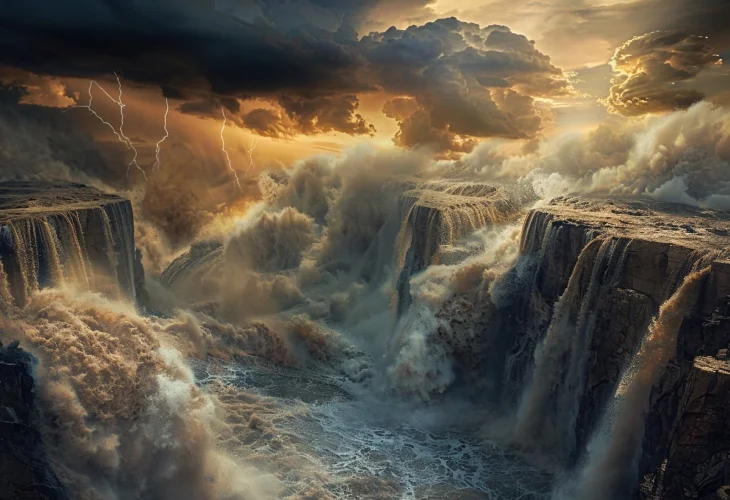
Ancient traditions preserved by our Sages tell us that parts of the Mediterranean Sea were once dry land. In recent years, scientific discoveries have lent support to this idea, but a study makes the case far more strongly.
The study was conducted by a team of American oceanographers and was published in the respected journal Earth and Environment. Scientists have long believed that, at some point in the distant past, the Mediterranean basin became largely isolated from the Atlantic Ocean due to a geological blockage. As a result, much of its water evaporated, leaving behind a much smaller, enclosed sea.
According to conventional theories, the Mediterranean then refilled over an immense span of time — consistent with the common scientific tendency to explain geological changes through extremely long timescales, based on the assumption that enough time can account for almost any process.
A Flood Unlike Anything in Human History
“The Zanclean megaflood was an awe-inspiring natural phenomenon, with discharge rates and flow velocities that dwarf those of any other known flood in Earth’s history,” said Dr. Aaron Micallef, the study’s lead author and researcher at the Monterey Bay Aquarium Research Institute in California, according to Science Daily.
The new study concludes that the refilling of the Mediterranean did not take millions of years, or even thousands of years. Instead, it was rapid and catastrophic, resembling a flood event on a massive scale.
This recalls the words of the Sages, who described how “the sea rose and flooded the world,” as vast areas of long-standing dry land were suddenly inundated.
Evidence of a Massive “Megaflood”
According to the study, there is a clear line of evidence pointing to what researchers call a “megaflood.”
The flood began in southeastern Sicily and flowed into a gigantic underwater channel now known as the Noto Canyon. Underwater mountain ridges leading to the canyon display enormous erosion patterns that could only have been caused by a sustained torrent of powerful water. The original channel was approximately 20 kilometers (12 miles) wide.
Researchers describe the event as a “single-stage flooding event” that rapidly filled the Mediterranean basin. Water from the Atlantic entered through the region of Gibraltar and then surged over the Noto Ridge in a colossal flood.
How Fast Did the Mediterranean Fill?
The volume and force of the water was so immense, that the entire Mediterranean Sea could have been filled in approximately two years.
According to the study, it was the largest flooding event known to have occurred on Earth and one of the largest known anywhere in the Solar System.
The speed of the flooding is also reflected in fossil and sediment layers. Geological records show an abrupt transition from shallow-water deposits to deep-sea sediments, indicating a sudden environmental change rather than a gradual one.
A channel located 390 meters (1,280 feet) below present sea level clearly marks the path of the enormous and rapidly moving waters. East of Noto Canyon lies a massive sediment deposit carried by the floodwaters, stretching approximately 1,500 kilometers (930 miles).
Ancient Mountains Beneath the Sea
The researchers examined around 300 underwater mountain ridges and concluded that these formations were once terrestrial mountains that suddenly became submerged.
As Professor Paul Carling, Emeritus Professor at the University of Southampton and co-author of the study, explained: “The morphology of these ridges is consistent with erosion by large-scale turbulent water flow with a dominant northeastward direction. They reveal the immense power of the Zanclean megaflood and how it reshaped the landscape.”
Forty Thousand Olympic Pools Every Second
The study estimates that the Zanclean megaflood discharged water at a rate equivalent to approximately 40,000 Olympic-sized swimming pools every second, or about 68 billion liters (18 billion gallons) per second.
The researchers conclude: “This study provides the most compelling evidence to date for the largest megaflood ever proposed to have occurred on Earth, which led to the refilling of the Mediterranean Sea. We present the first large-scale evidence supporting this event.”
Rethinking the Past
Once again, we see how ideas that may appear obvious, settled, and universally accepted — such as geological processes requiring millions of years, can later be reevaluated in light of new evidence.
What was once thought to be a slow and gradual process may turn out to have been rapid, dramatic, and catastrophic. Events that seem impossible by today's assumptions may have occurred far more suddenly than previously imagined, perhaps preserving echoes of ancient events remembered in humanity’s oldest traditions and historical memories.

