

Lag BaOmer
Discovering the Hidden Connections: An Unexpected Journey of Faith and Unity
This moving reflection for Lag BaOmer explores the invisible connections that bind Jews across the world and the deeper reality that emerges during times of crisis
- Sivan Rahav Meir
- | Updated
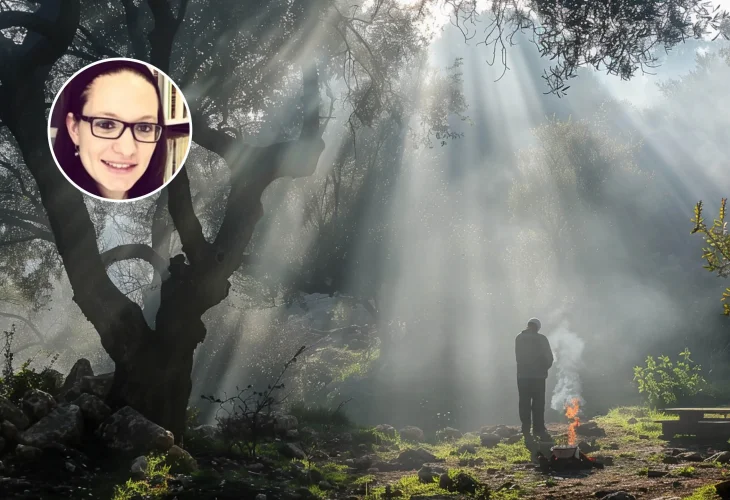
Lag BaOmer is the festival associated with the hidden dimensions of Torah. Hundreds of thousands of people will travel to Meron, the burial place of Rabbi Shimon bar Yochai, whose name is deeply connected with Jewish mysticism and the teachings of Kabbalah.
Across the world, bonfires, parades, and celebrations will mark the day. At its heart, Lag BaOmer teaches us that reality contains a deeper layer, a hidden dimension. There is more beneath the surface than what first meets the eye.
Rabbi Shimon sought to help us uncover that secret.
On the surface, the Jewish people often appear divided, argumentative, and fragmented. Yet who has not felt the extraordinary unity that binds us together despite all our differences? On the surface, everything seems rational and explainable. Experts and commentators fill television studios with confident analysis. Yet who has not sensed that a much larger story is unfolding before our eyes, one filled with unexpected twists, profound meaning, and a purpose that transcends headlines?
Not long ago, such ideas might have sounded strange, perhaps even fanciful. But since the horrors of October 7, 2023, something has begun to emerge through the darkness and pain.
Look at the eyes of Eli Sharabi. He shared that when he recounts his experiences, there are times when his psychologist begins to cry, and he finds himself comforting and strengthening her.
Look at the memorial stickers honoring fallen soldiers. So many of them display radiant smiles alongside uplifting messages that reveal the extraordinary spirit behind these young lives.
Without fully realizing it, our language is changing. Beneath the daily news cycle, we are beginning to discover the secret.
The Hostages and the Power of Prayer
The story of Agam Berger may be the most widely known, but dozens of former hostages have shared remarkably similar testimonies. We only need to listen.
I interviewed Eliya Cohen, who told me: "I felt every prayer you prayed for me. Every mitzvah you performed gave me strength. I felt it physically."
Oded Ben Ami, after returning from captivity, told Avi Ohana, father of hostage Yosef Chaim Ohana: "I'm a kibbutznik, and I'm telling you: keep praying. We felt those prayers while we were in captivity."
Omer Shem Tov moved Jews around the world when he spoke publicly about his relationship with God during his captivity.
His mother, Shelly, told me that Orthodox schools abroad have shown students the segment in which Omer described how, every day, he would ask God how He was doing. In other words, he was concerned not only with his own suffering, but with what Jewish mysticism refers to as the "pain of the Divine Presence."
Only afterward would he thank God. Only then would he pray for his own needs.
Vered Ben Baruch, grandmother of Edan Alexander, surprised international media when she recited an entire Psalm and explained the significance of the day her grandson was released: Pesach Sheni, the "Second Passover."
Among Russian-speaking Jews, Sasha Troufanov has become a symbol of spiritual awakening after celebrating his first bar mitzvah upon returning from captivity.
Many of these stories never make the headlines.
A New Language of Faith
I attended a birthday gathering in Kfar Chabad hosted by Bracha Shilat, who invited women from across Israeli society to participate in an evening of sharing and reflection.
Among those present was dancer Leah Yanai, sister of Moran Stella Yanai, who was kidnapped from the Nova music festival.
There were prominent rabbis' wives and religious educators in attendance. Yet with remarkable simplicity, Leah offered all of us a living example of the hidden truth that seems to be emerging.
"This new frequency didn't exist before October 7," she began.
"On October 7, our lives expanded. We encountered darkness beyond anything we could have imagined, but we also encountered light beyond anything we could have imagined."
She then shared four lessons she had written in her phone.
"First, faith. Pure prayer. The understanding that we do not understand everything, and that life is far more than the physical world we can see."
"Second, gratitude."
Many in the room seemed surprised. Gratitude? From the sister of a hostage?
Leah continued: "Gratitude for the challenge. Gratitude that it ended the way it did. It was an awakening, a transformation."
"This leads to the third lesson: purpose. If a person goes through a profound trial, they cannot simply return to their old comfort zone. They have been given a mission."
"When you live with that sense of mission, it heals the soul and fills it with meaning."
"And fourth, unity. Throughout this unbelievable journey, I discovered that the Jewish people are unbreakable. We are a holy nation."
It is not every day that a judge on a television dance competition delivers a speech that teachers in religious schools later ask to share with their students.
Perhaps that, too, is part of this new era.
Invisible Connections
A man named Brody arrived in Israel from Boston. During his visit, he toured the Cave of the Patriarchs in Hebron, where he met Mordechai Hellinger, who helped him put on tefillin for the very first time in his life.
During their conversation, Brody learned about Captain Uri Shani of Kiryat Arba, who fell heroically in battle on October 7.
Deeply moved by Uri's story, Brody made a decision. From that day forward, he would put on tefillin every day in Uri's memory. He immediately purchased his own pair and began sending photographs of himself wearing them.
Uri's father, Yehoshua Shani, soon received an unexpected phone call informing him that his son's legacy was inspiring the soul of a Jewish man living thousands of miles away in Boston.
Since then, the bereaved father regularly receives photos of Brody wearing tefillin "in memory of your son."
At almost exactly the same time, in the intensive care unit at Shaare Zedek Medical Center, Rivka Moshel sat beside her son Yoni, who had been critically injured in a car accident that the family believes was a nationalist attack.
The family had immigrated from America.
Rivka told a friend about Yoni's devotion to tefillin. Since his bar mitzvah, he had never missed a single day. Now he lay unconscious, connected to machines.
The next day she received an unexpected message: "My name is Steve. I'm an American student. I heard about Yoni from your friend. I don't really know how to put on tefillin, and I don't remember the last time I did. But I want to begin doing it for Yoni. Every day I'll send you a selfie of myself wearing tefillin."
Every morning since then, Rivka has received another photo.
"It's my oxygen," she said.
The Secret of Lag BaOmer
These are not typical times.
This year's Lag BaOmer reminds us that there is a secret. And that secret is being revealed precisely at a moment when we think everything is visible.
Beneath the surface, in the deeper reality that Rabbi Shimon bar Yochai wanted us to discover, another truth is beating strongly.
We are connected in ways we never fully understood, and we affect one another in ways we never imagined.
And that connection is stronger than anything, and anyone, trying to tear us apart.
Originally published in Yedioth Ahronoth.

