

Behind the News
Netanyahu Finished Testifying Today. Here’s a Catch-Up Guide to the Trial
After 98 hearings on the witness stand, the years-long case is entering a new phase. Here are the charges, Netanyahu’s defense and what comes next
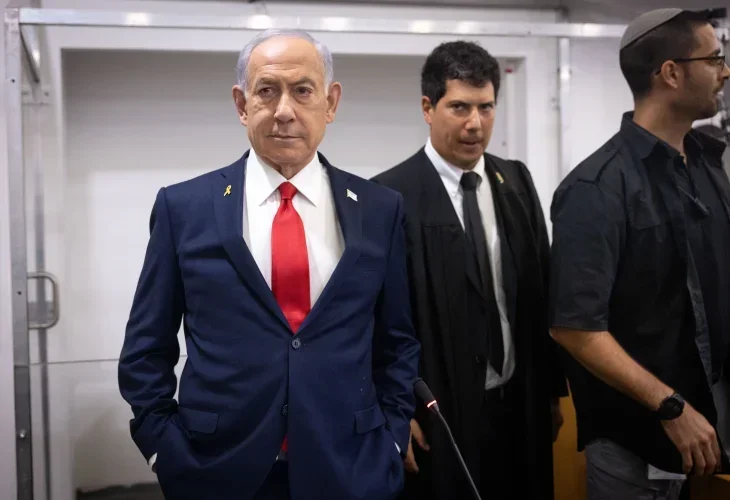 Netanyahu (Miriam Alster/Flash90)
Prime Minister Benjamin Netanyahu finished testifying today in his corruption trial, ending 98 hearings on the witness stand after roughly a year and a half of testimony. The trial itself is not over, but one of its most important stages has now ended.
Netanyahu is on trial in three corruption cases known as Case 1000, Case 2000 and Case 4000. He was indicted in 2019, and the trial opened in 2020. Since then, the court has heard prosecution witnesses, reviewed evidence and dealt with repeated delays tied to politics, war and security.
Case 1000 is the gifts case. Prosecutors allege that Netanyahu and his wife received expensive gifts from wealthy businessmen, including cigars and champagne. The prosecution says the gifts were improper and connected to Netanyahu’s position. Netanyahu denies that the gifts amounted to criminal conduct.
Case 2000 centers on Israeli media. Prosecutors allege that Netanyahu discussed more favorable coverage with Arnon Mozes, publisher of Yedioth Ahronoth. In exchange, they say, Netanyahu discussed possible steps that could weaken Israel Hayom, a rival newspaper. Netanyahu denies that there was any criminal agreement.
Case 4000 is considered the most serious case because it includes a bribery charge. Prosecutors allege that Netanyahu advanced regulatory benefits for Bezeq, a major Israeli telecom company, while Bezeq’s controlling shareholder, Shaul Elovitch, also controlled the Walla news site. According to the prosecution, Netanyahu received favorable Walla coverage in return. Netanyahu and his defense say prosecutors focused on selected evidence and wrongly portrayed ordinary political and media dealings as criminal conduct.
Since taking the stand in late 2024, Netanyahu has argued that prosecutors took ordinary political contacts, media requests and regulatory decisions and wrongly presented them as criminal conduct. His defense says Walla was not controlled by him and that Bezeq-related regulatory decisions were not tied to favorable coverage.
That argument was at the center of today’s tense hearing at the Tel Aviv District Court. Netanyahu’s attorney, Amit Hadad, accused the prosecution of presenting misleading material, including over meetings and witness statements related to Case 4000. Netanyahu responded sharply during the hearing, saying: “There is a web of lies here.”
The end of Netanyahu’s testimony does not mean the court has reached a decision. It also does not mean Netanyahu has been cleared or convicted. The defense phase can continue with additional witnesses and legal arguments before the judges weigh the evidence and eventually issue a ruling.
Politically, the trial has remained one of the deepest dividing lines in Israeli public life. Netanyahu’s supporters see it as selective enforcement and political persecution, saying the legal system was used to weaken a leader repeatedly chosen by voters. His critics say the case is about accountability and whether a sitting prime minister can be judged by the same legal standards as anyone else.
The trial has also drawn in President Trump, who has publicly called for it to be canceled or for Netanyahu to receive a pardon, arguing that the case distracts him from leading Israel during wartime. Netanyahu has made a similar argument in court, saying testimony has interfered with his ability to handle national security and diplomatic matters. His critics argue that the legal process must continue independently, even during war
For now, Netanyahu no longer remains the central witness on the stand. But the case that has followed him through elections, coalition battles and war is still moving forward, and the next stage will determine whether the court accepts the prosecution’s theory or the defense’s claim that the charges were built on weak and selective evidence.

