

Israel News
Netanyahu: “We’ll Be the First in the World to Solve the Explosive Drone Threat”
Prime Minister Benjamin Netanyahu outlined Israel’s wartime gains and plans to rebuild the north. At the same time, concern is growing in Jerusalem over the possibility of Syrian forces entering Lebanon following recent remarks by President Donald Trump.
- Yuval Aviv
- | Updated
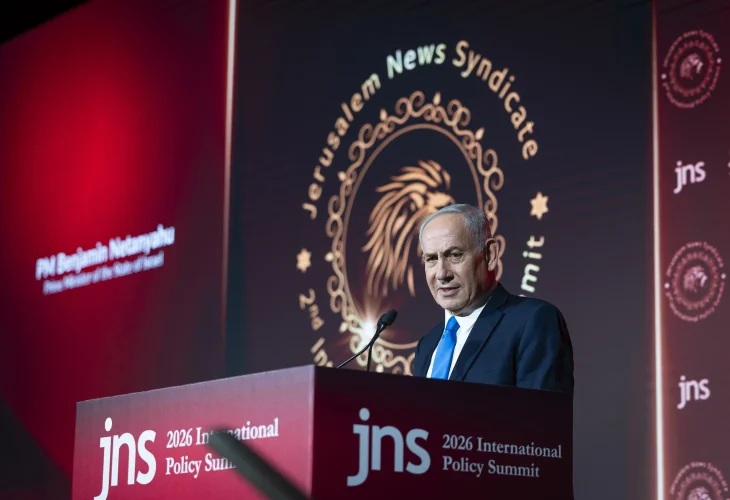 Netanyahu (Photo: Chaim Goldberg, Flash90)
Prime Minister Benjamin Netanyahu spoke today (Wednesday) at the Local Government Conference, addressing the security situation and the impact of the war. According to him, the government recently approved "a series of decisions for the benefit of the north totaling 29 billion shekels." He added that "just as we brought renewal to the south, כך נביא תנופה לצפון", and noted that "the Central Bureau of Statistics shows it — the growth surge in the Gaza border region is something remarkable."
Regarding the fighting in Lebanon, he said, "We’ll be the first in the world to solve the problem of explosive drones." He also said: "The most important thing we did in this war was break the barrier of fear." According to him, "We were attacked in a horrific way in the October 7 massacre. Today we are sitting in nearly 70% of the Gaza Strip and choking Hamas."
According to media reports, Prime Minister Benjamin Netanyahu is expected to hold a limited security discussion on Syria and Lebanon. This comes against the backdrop of recent developments and President Donald Trump’s statements regarding the possibility that Syrian forces could operate in Lebanese territory against Hezbollah. Israel strongly opposes the entry of Syrian forces into Lebanon, but the defense establishment is closely and anxiously monitoring steps that, according to its assessment, may indicate movement in that direction.
The discussion, according to the reports, is intended to examine the possible implications of such a scenario and prepare for it in advance. This follows Trump’s interview with Fox News, in which he said he was disappointed that Israel had not succeeded in "moving" Hezbollah away from the border area. According to him, the IDF "can’t do anything without bringing down buildings," and he is considering strengthening Syrian President Ahmed al-Sharaa so that his forces would be the ones to enter southern Lebanon and fight the Shiite terrorist organization.
Al-Sharaa himself addressed the remarks and clarified that Trump’s words had been misinterpreted: "The president expressed his concern about what is happening in Lebanon and wants to stop the war there. He spoke about Syria’s role in finding a safe solution." He noted that "the statement was interpreted incorrectly, as if Syria is about to invade Lebanon tomorrow morning."
The Syrian president added that while his country is indeed in deep conflict with Hezbollah, it is not interested in worsening the crisis with Lebanon: "We have a deep problem with Hezbollah, but we do not want all of Lebanon to die." According to him, "The state cannot remain trapped between the possibilities of civil war and war with Israel," and he added that "the Shiites in Lebanon need quiet, not more fears and confrontations." He further said that "we will sit with Hezbollah at the same table if it serves the interests of both Syria and Lebanon," but clarified that "there are objective conditions that must be met for real peace with Israel — Hezbollah is stealing the authority of the Lebanese state in matters of war and peace."
Trump’s statements on the issue are not entirely new. Just five days ago, during the G7 summit, the American president was asked whether an agreement with Iran could hold up even in the event of escalation in Lebanon. Trump replied that "yes, it can," and added: "I see it as a small war. Iran was the big story. But we have that same little problem that keeps coming up again and again, and that is Hezbollah." On that occasion, he publicly raised for the first time the possibility that the Syrian president would be the one to "handle" the Shiite terrorist organization.

