

Magazine
A Mother's Prayer: Facing Her Son's Duchenne Diagnosis
When Chaya Nakash learned that her son had Duchenne muscular dystrophy, she felt her world collapse. Today, she shares a powerful story of faith, prayer, and unwavering hope.
- Michal Arieli
- | Updated
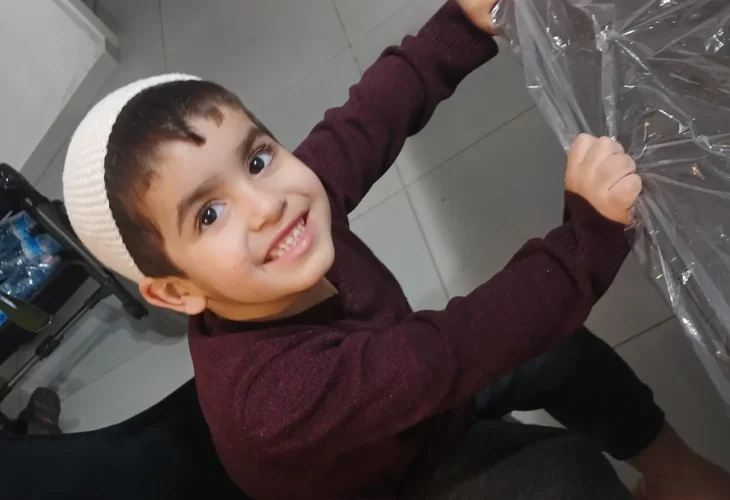 Chaim Yehuda Nakash
When Chaya Nakash was pregnant with her fifth child, doctors discovered that the baby was missing a kidney and had only one umbilical artery instead of three. The news shook her deeply.
"The one thing I always ask of the Creator of the world is, 'Please don't test me with medical challenges,'" she shares. "I always felt that if, G-d forbid, a serious illness were discovered in one of my children, I wouldn't be able to handle it."
At that stage, however, no one knew for certain whether there was actually a problem.
"The doctors told us there was a 50 percent chance that the baby would be born with a medical condition," she recalls. "We were concerned, but we didn't panic. We consulted with the Puah Institute, and they advised us to undergo amniocentesis."
The results would take two weeks.
"During those days, I poured my heart out in prayer. One day, I attended a Torah class at the synagogue and noticed the curtain of the ark. On it appeared the name of the tribe of Yehuda alongside an image of a lion. Right then, I decided that if the baby was born healthy, I would name him Yehuda. I felt he would grow up to be righteous and strong."
When the results finally arrived, they were normal.
"We could finally breathe again."
A Promising Beginning
The birth went smoothly, and nothing appeared unusual.
"The brit milah took place on time," Chaya says. "We had the privilege of having Rabbi Reuven Elbaz serve as the mohel, while Rabbi Yitzchak Yosef was the sandak. We felt incredibly blessed. Even then, I felt that, with Hashem's help, we would raise a very special child."
For several months, everything seemed perfectly normal.
Then, when Yehuda was about five months old, Chaya began noticing that he was not lifting his head properly.
"At first, I blamed myself," she admits. "He was my fifth child, and I thought perhaps I wasn't spending enough time helping him develop."
She began taking him to physical therapy, assuming he simply had a mild developmental delay.
The Diagnosis That Changed Everything
When Yehuda was about a year and a half old, routine blood tests revealed abnormal results.
"We repeated the tests, and again the numbers were very unusual. That led to a day hospitalization at Schneider Children's Medical Center."
There, a doctor raised concerns about a possible muscle disorder and referred them to a geneticist.
"The geneticist was the one who officially gave us the diagnosis," Chaya recalls. "She told me, 'I'm sorry to tell you that your child has a disease called Duchenne.'"
Duchenne muscular dystrophy is a genetic condition that causes progressive muscle degeneration.
"I couldn't hear much after that," Chaya says quietly. "I felt as though my entire world had collapsed."
For months, she struggled to function.
"I couldn't focus at home or at work. I couldn't bear the thought that my child would become disabled. For two months, I lived in denial."
A Difficult Conversation
Eventually, the family met with a neurologist.
"I arrived terrified," Chaya recalls. "That morning, when I dropped Yehuda off at daycare, I noticed a sticker that said: 'Where reason ends, faith begins.' I felt like Hashem was preparing me for what I was about to hear."
She began speaking to Hashem throughout the day.
"I said, 'I know You are testing me, and I know You will be with me every step of the way.'"
The appointment itself was difficult.
"The doctor asked whether I had read about the disease. When I said no, she looked at me and said bluntly: 'You should know that people with this disease die by age 30.'"
The words hit Chaya hard.
"It happened to be around my own 30th birthday. To me, 30 felt like the beginning of life. How could someone decide my child's fate like that?"
The neurologist explained that while no cure currently existed, steroid treatments could help slow the disease's progression, reduce falls, and preserve mobility for a longer period.
"It was very hard to hear," Chaya says.
Turning to Prayer
After leaving the appointment, Chaya asked her husband for one thing.
"I wanted to go pray at the grave of Yehuda, the son of Yaakov, after whom our son was named."
Standing there, she poured out her heart.
"I cried and begged, 'Yehuda son of Yaakov, this child is named after you. Please pray for his recovery.'"
When she left, she felt unexpectedly strengthened.
"I can't explain it, but I felt certain that we would see great salvations. I believed that with Hashem's help, this child would be healthy."
Gathering Blessings and Strength
Over the following months, Chaya and her husband sought blessings from many rabbis.
"We felt we needed all the strength we could get," she says.
According to Chaya, Rabbi David Abuchatzeira assured them that "there will be a great salvation." Rabbi Yigal Cohen blessed Yehuda with health, and they also received blessings from Rabbi Yitzchak Zilberstein and many others.
Still, Chaya felt she needed the prayers of the wider community.
She organized a large hafrashat challah gathering in her neighborhood in Yehuda's merit.
"About 150 women attended. They accepted good resolutions and prayed together. It was incredibly moving."
Around that time, the family added the name Chaim to Yehuda's name.
"Since then, Chaim Yehuda ben Chaya has become the child of the neighborhood. Everyone knows him and prays for him."
Hoping for New Treatments
Today, Chaim Yehuda receives steroid treatment, but the family continues to hope for additional medical breakthroughs.
"There are medications that can slow the disease and provide more healthy years," Chaya explains. "Unfortunately, some are not included in the national health basket and cost enormous amounts of money."
She notes that researchers around the world are actively working on treatments for specific genetic mutations, including the mutation Chaim Yehuda carries.
"We need great miracles," she says. "But miracles can also come through natural means. We believe that prayer has tremendous power, and we ask the Jewish people to continue praying for him."
"Please Pray for Chaim Yehuda"
At this point, Chaya's husband joins the conversation.
"We pray every day that an effective treatment will arrive as soon as possible," he says. "At the same time, Duchenne causes irreversible damage with every passing day."
He explains that even now, Chaim Yehuda struggles with activities that come easily to many children his age.
"Climbing stairs and jumping are already difficult for him. Naturally, we worry about what the future may bring."
Still, the family remains determined to hold onto hope and faith.
"I want to ask everyone reading this article to pray for the complete recovery of Chaim Yehuda ben Chaya," he says. "We believe with complete faith that Hashem can send a full recovery through whatever means He chooses. We hope and pray that we will yet merit to share good news and great salvations with everyone."

