

Between the Straits (The Three Weeks)
Through His Tears: My Father's Longing for Jerusalem
His face reflected every season of the Jewish calendar, but during the Three Weeks, one message shone above all others: redemption is closer than we think.
- Menucha Fox
- | Updated
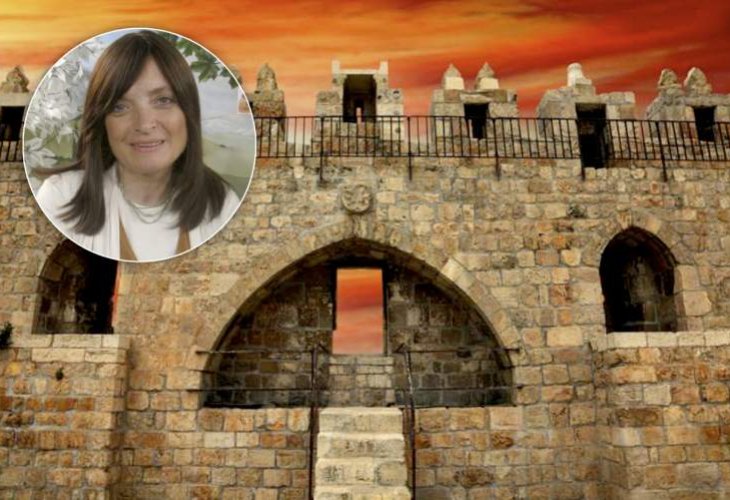
A few short years ago, my father, Rabbi Elazar Brandwein zt"l, passed away. Yet those years feel like an eternity to me.
Every day without him feels like a day without the crown of holiness that adorned our family from the time I was a child until the day he left this world.
My father's face spoke volumes.
From his expressions alone, we, his children, knew exactly how to act and how to conduct ourselves.
His face said everything.
His expressions painted the atmosphere of our home.
When a holiday arrived, his face radiated holiness and joy. No matter what kind of day we had experienced, his happiness would fill our hearts and lift our spirits.
And when the days were marked by sorrow, we felt the pain of exile together with him.
A Life Built Around Torah
Throughout the year, my father would rise before dawn to learn Torah and pray.
During Bein HaMetzarim, he would wake at midnight to recite Tikkun Chatzot. If we happened to wake before sunrise, we would often find him sitting at the kitchen table, bent over a sefer, completely immersed in his learning.
When I look back, I honestly do not know how he managed it all.
My father taught countless students, many of whom remember him to this very day. One former student once told me, "There are teachers you simply never forget."
At the same time, in order to support his family, he taught Torah subjects and Hebrew to adults during the afternoons and evenings.
How did he still find the strength to rise in the middle of the night?
I remember him as the father of small children. When a baby cried during the night, he would let my mother sleep, get up quietly, rock the cradle, and soothe the child. Yet even then, a Torah book would be open before him.
Living the Mourning of Jerusalem
During the Three Weeks, my father's Torah learning took on a different intensity.
He never allowed himself to sink into sadness or despair. But he lived with a deep longing for redemption and an unwavering anticipation that Mashiach could arrive at any moment.
For many years, he served as the rabbi and prayer leader of Heichal Ovadia in the Bayit VeGan neighborhood of Jerusalem. He was known for his beautiful voice and regularly led the prayers both in the synagogue and at home.
Everything he did was accompanied by song.
Yet during the Three Weeks, he was careful not to sing at all. Not with instruments, not with his voice, not even casually.
Instead, throughout our home, day and night, we heard the haunting melody of Megillat Eichah.
In most homes, Eichah is read only on Tisha B'Av.
In our home, it accompanied the entire Three Weeks.
Again and again, my father would repeat the words:
"How does the city sit solitary, that was full of people."
It was as though he was trying to absorb every word, to feel the destruction of Jerusalem in every fiber of his being.
Tears of Longing, Eyes of Faith
To this day, I remember waking in the middle of the night and finding my father quietly reciting Eichah through tears.
"She weeps bitterly in the night, and her tears are upon her cheek; she has none to comfort her."
As a child, I did not fully understand the depth of those words.
But I remember looking at my father and seeing something remarkable.
Alongside the tears was complete faith.
When he lifted his eyes from the sefer, I could see absolute certainty in the coming redemption.
Every year during the month of Av, when people would ask how he was doing, he would often answer with the mournful words of Eichah:
"For this our heart is faint, for these things our eyes are dim: for Mount Zion, which lies desolate; foxes prowl over it."
Those words lived within him.
Waiting to Sing Again
Yet what I remember most is not the sadness.
It is the joy that appeared on my father's face when Tisha B'Av came to an end.
He truly believed that Mashiach could arrive at any moment.
He often quoted the words of our sages that whoever mourns for Jerusalem will merit seeing her joy.
For him, this was not a distant promise. It was a living reality.
We had mourned for Jerusalem, and now we stood ready to witness her redemption.
My father would wait eagerly for the moment when singing was once again permitted.
The instant Tisha B'Av ended, he would burst into song:
"Bring us back, Hashem, to You, and we shall return; renew our days as of old."
His voice was filled with longing, gratitude, hope, and love.
He was not waiting to listen to music.
He was waiting to sing from the depths of his soul.
And when he did, his eyes shone once again. The tears disappeared, and his face became radiant.
Even if Mashiach had not yet arrived, and the redemption had not yet come, we felt that it had drawn infinitely closer.

