

World News
Denmark Weighs Nationwide Ban on the Muslim Call to Prayer: "We’re Not a Suburb of Islamabad"
The government in Copenhagen is preparing a legal review to examine a nationwide ban on the Muslim call to prayer. The move, pushed by Immigration Minister Morten Bødskov, aligns with the tough immigration line Denmark’s government has pursued in recent years.
- Yuval Aviv
- | Updated
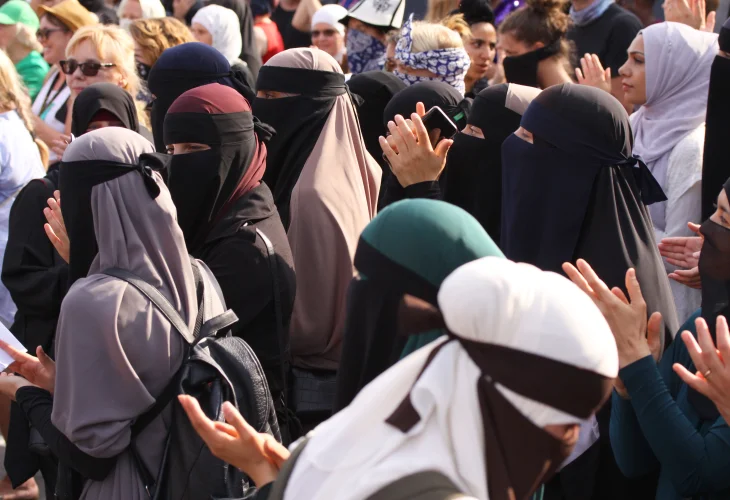 Muslim women protest in Denmark against a ban on wearing burqas (Credit: shutterstock)
Denmark’s government is planning to ban the public broadcast of the Muslim call to prayer across the country. Danish Immigration Minister Morten Bødskov announced that the government will reopen a legal review of the issue, saying publicly that the call "has no place in Denmark." In an interview with the Danish news agency, he added: "The call to prayer should not be heard over Denmark’s rooftops, and there should be no reason for you to wonder whether you’ve arrived in a suburb of Islamabad when you’re walking around in Denmark."
This is the third attempt by a minister from the Social Democratic Party to advance such a move. Previous failed efforts were made in 2020 and 2025. This time, Bødskov said the review will examine how a ban could be applied on a national level while preserving Denmark’s constitutional protections for freedom of religion.
Under the proposal, the government will examine the balance between constitutional protection for freedom of worship and residents’ right to quiet and to the use of public space. Denmark’s constitution guarantees the right to public worship, but it also allows exceptions, including bans on anti-democratic preaching and on receiving funding from prohibited groups. Bødskov argued that "creeping Islamization" is taking up too much space in the public sphere.
The muezzin’s call, which is heard five times a day, is already restricted in parts of the country. In Copenhagen, for example, strict local noise regulations effectively prevent mosques from broadcasting the call over loudspeakers. The city’s largest mosque does not broadcast an external call at all, under an agreement signed with the authorities.
Denmark, with a population of about six million, is home to roughly 270,000 Muslims. About 100 mosques operate in the country. Other European countries, including Germany and Britain, impose limits on the hours and volume of the muezzin’s call, but do not ban it outright. Any attempt to impose a blanket ban is expected to face complex legal challenges.
The move comes against the backdrop of the hardline immigration policy of Prime Minister Mette Frederiksen’s government, which recently began its third term. Under the controversial "ghetto" laws, Danish authorities are allowed to force immigrants to relocate from neighborhoods where the share of foreign residents is deemed too high. In addition, asylum seekers whose applications are denied do not receive financial assistance.
Last December, only 130 people filed a first-time asylum application in Denmark, a historic low since record-keeping began. For comparison, at the height of the 2015 refugee crisis, 21,000 asylum seekers arrived in the country in a single year. In all of 2025, fewer than 2,000 applications were recorded, the lowest figure in 40 years. Only about 690 new refugees were actually distributed among local municipalities.
The government review has not yet officially begun, and the government will need to draft a proposal that can withstand legal scrutiny. So far, no official response has been published in Denmark from Muslim organizations or legal bodies regarding Bødskov’s latest announcement.

