

5 Minutes of Torah a Day
The Nine Days: Key Halachot and a Powerful Life Lesson
What should we avoid during the Nine Days, and what can Parashat Masei teach us about life's unexpected twists and turns? A practical and inspiring guide.
- Rabbi Ronen Chaziza
- | Updated
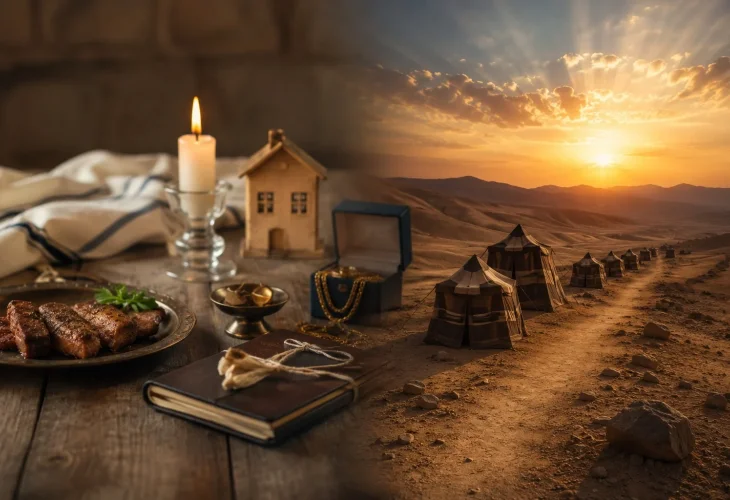
As the days leading up to Tisha B'Av approach, Jewish communities adopt various customs of mourning in remembrance of the destruction of the Beit HaMikdash. Alongside these practical halachot, the Torah portion of the week offers a powerful lesson about life's challenges, setbacks, and unexpected blessings.
Halachot for the Nine Days
1. Buying Furniture, Clothing, and Jewelry
During these days, one should not purchase clothing, furniture, or jewelry intended for a groom and bride. Such purchases should be postponed until after Tisha B'Av.
However, if time is limited, such as when the wedding will take place immediately after the fast, or if there is concern that prices will rise significantly, it is permitted to make the purchase during this period.
Strictly speaking, it is permitted to buy new furniture and household items for regular use in the home. The prohibition specifically relates to purchases associated with the joy of a wedding.
One who is able to delay even these purchases until after Tisha B'Av is worthy of blessing.
Shopkeepers may continue conducting business as usual.
2. Refraining From Meat
The custom is not to eat meat from the second of Av until the night following the tenth of Av.
This restriction applies to both beef and poultry. Fish, however, remains permitted.
3. Meat at a Seudat Mitzvah
The restriction on meat applies only to ordinary meals.
At a seudat mitzvah, it is permitted to serve and eat meat. Examples include:
Shabbat meals
A brit milah meal
Pidyon haben
A bar mitzvah celebrated at the proper time
Sheva brachot
A siyum masechet
However, meat should not be served at a Brit Yitzchak gathering held on the night before a brit milah.
4. Who May Eat Meat During These Days?
Certain individuals are permitted to eat meat during the Nine Days, including:
Someone who is ill
A pregnant woman
A woman within thirty days after giving birth
A nursing mother whose baby is weak
Young children who are not yet old enough to understand the mourning over the destruction of Jerusalem
Children who do understand the significance of the Churban, as well as healthy adults, should refrain from eating meat.
If someone mistakenly recited a blessing over meat during these days, he should taste a small amount so that the blessing will not have been recited in vain.
5. The Main Thing Is Tisha B'Av
There are people who are very careful not to eat meat during the Nine Days, yet do not fast on Tisha B'Av itself.
This is a serious mistake.
The custom of avoiding meat is a preparation for Tisha B'Av and serves to deepen our sense of mourning. The fast itself, however, is the primary obligation.
How can someone be meticulous about a secondary custom while neglecting the central requirement?
Parashat Masei: The Journey of Life
Parashat Masei repeatedly describes the travels of the Jewish people:
"They traveled... and they camped... and they traveled... and they camped."
At first glance, the repetition seems unnecessary.
But if we look closely, it sounds very familiar.
In daily life, we often experience a similar rhythm.
At work: success and setbacks.
In finances: gain and loss.
In relationships: disagreements and reconciliation.
In our emotions: moments of joy and moments of struggle.
Life is rarely a straight line.
Why can't we always be happy? Why can't everything run smoothly all the time? Why do we experience both light and darkness?
The answer is that this is precisely how Hashem designed the world.
Without darkness, we would not appreciate light.
Without challenges, we would not appreciate success.
Without periods of distance, we would not value closeness.
The combination of highs and lows is what gives life its depth and meaning.
The Hidden Blessing
There was once a Jewish man who could neither read nor write.
For many years he worked in a factory. One day, the owner announced that all employees would need a basic education in order to advance. Since the man did not meet the requirements, he lost his job.
Heartbroken, he headed home.
Along the way, he noticed a box lying on the ground. Curious, he opened it and discovered a treasure.
Over time, he invested wisely, built a successful business, and became very wealthy.
Years later, while preparing to sign an important business deal, he turned to his wife and said:
"I can't sign it. You'll have to sign for me."
The businessman sitting across from him was stunned.
"You're such a successful man, and you still don't know how to write?"
The wealthy man smiled.
"That's exactly why I'm wealthy," he replied. "If I had known how to write, I would never have lost my job. And if I hadn't lost my job, I would still be working in that factory today."
Sometimes what appears to be a setback is actually the beginning of something far greater.
Like the journeys described in Parashat Masei, life includes both traveling and camping, movement and waiting, challenge and growth.
Only in hindsight do we often discover that what seemed like an obstacle was actually leading us exactly where we needed to go.

