

Israel News
Several IDF Service Disputes Move in One Day as Army Balances Different Sectors
Hesder yeshivas will send students to the Armored Corps, Zamir defended the need for every fighter, and reports said the IDF is planning a separate Chareidi training base
- Brian Racer
- | Updated
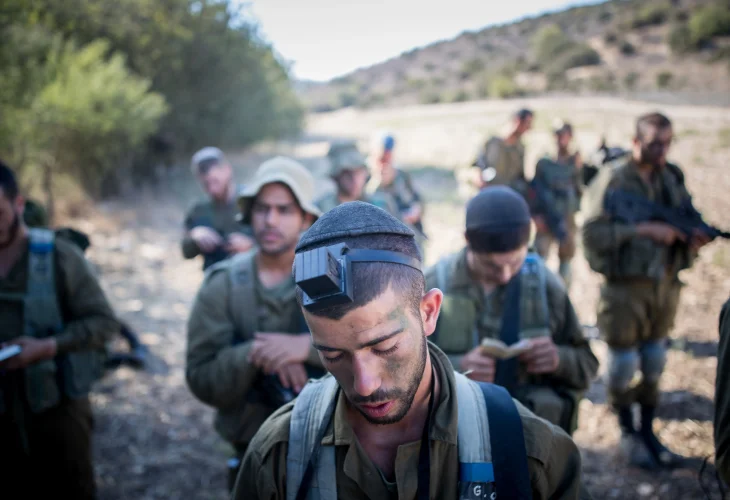 IDF (Yonatan Sindel/Flash90)
Several different IDF service disputes moved forward on Thursday, involving religious-Zionist yeshivas, female combat roles and Chareidi enlistment frameworks. The developments came as the IDF continues to deal with a manpower shortage during wartime, as the army tries to keep one military framework while adjusting service conditions for different parts of Israeli society.
The first development came from the hesder yeshivas. After a meeting of nearly 50 hesder yeshiva heads, the Association of Hesder Yeshivas decided by a large majority that students will enlist in the Armored Corps in the upcoming August draft.
The decision followed weeks of tension over the IDF’s planned pilot program to integrate female combat soldiers into the Armored Corps in November. Some rabbis had warned that the move could harm the ability of observant soldiers to serve in accordance with halacha and the IDF’s mixed-service rules.
Rabbi Elikim Levanon, head of the Elon Moreh yeshiva, said the August enlistment would go ahead for now.
“At the meeting of yeshiva heads, it was decided that in August we are sending students to the Armored Corps, and afterward, depending on developments, a decision will be made,” he told Arutz Sheva.
Several other rabbis who had recently signed a letter opposing the women-in-armor pilot also said they would send their students to the Armored Corps in August. They included Rabbi Dr. Eliyahu Rahamim Zini, Rabbi Noam Waldman, Rabbi Baruch Wieder, Rabbi Chagai Londin and Rabbi Tal Shaulian.
The decision eased the immediate threat of a disruption to the August draft, but did not end the dispute. The rabbis’ main concern remains the November pilot and whether religious soldiers will be able to continue serving in armor without facing mixed-service conditions they say violate halacha. The IDF has said the issue will be handled under the mixed-service order, and that religious soldiers will not be excluded from combat service.
Hours later, IDF Chief of Staff Eyal Zamir addressed the wider dispute at a combat officers’ graduation ceremony. Zamir said the army needs all available combat soldiers and commanders.
“We need every male combat soldier and every female combat soldier, every male commander and every female commander,” Zamir said. “This people has no other army, and this army has no other people.”
Zamir said the IDF’s challenge is to balance the needs of different populations while preserving a shared military framework.
“The challenge facing the IDF is to find a balance between accommodating diverse populations and preserving a shared and unified framework that enables it to carry out its missions effectively,” he said.
Pressure also came from the other direction. More than 250 female reserve officers recently signed a letter warning against any retreat from women’s combat service. The officers argued that female soldiers are already part of the IDF’s operational reality.
“Female soldiers are not a matter for debate or a problem to be stopped, but a set operational fact and a strategic asset,” the letter said.
At the same time, Channel 13 reported that the IDF is advancing plans for a large Chareidi training compound in the Jordan Valley. According to the report, the base would cost tens of millions of shekels and include training for Chareidi combat soldiers, support troops and officer courses.
The compound is expected to include synagogues, mikvehs and a separate external area for women. It would serve several Chareidi tracks, including combat and support frameworks, as the army tries to expand Chareidi enlistment under conditions acceptable to religious recruits.
The plan comes as the IDF expects Chareidi enlistment to rise, though still below its official goals. According to a report Thursday, the army expects more than 3,500 Chareidim to enlist in the current draft year, compared with about 2,800 in 2024 and about 2,200 in 2023. The final number is expected to become clear soon, at the end of the 2025 draft year.
Thursday’s developments did not resolve the deeper debate over who serves, where and under what rules. For now, hesder students are expected to enter the Armored Corps in August, the women’s armor pilot remains set for November, and the IDF is preparing separate frameworks for Chareidi recruits.
The army’s challenge is no longer only how to recruit more soldiers. It is also how to keep different sectors inside one military while maintaining the readiness needed for war.

