

Parashat Pinchas
Why Does the Jewish Day Begin at Night? The Profound Meaning Behind the Hebrew Calendar
Discover how the Torah's view of time teaches us to live from light to light, from spring to spring, with faith, hope, and purpose
- Rabbi Moshe Sheinfeld
- | Updated
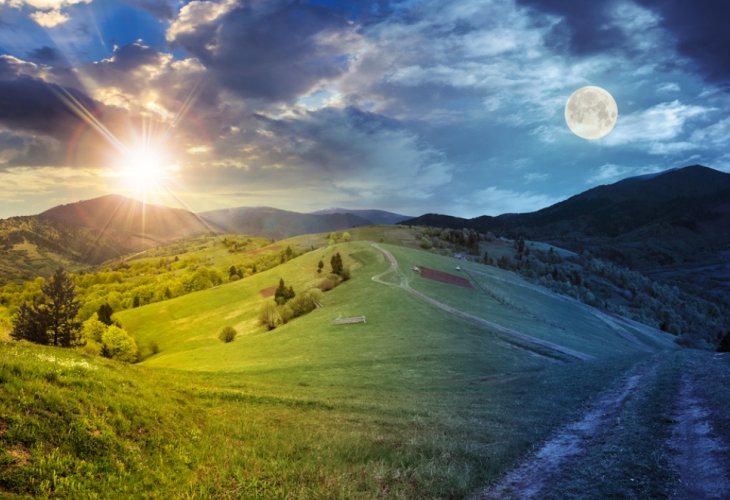 (Photo: shutterstock)
The Hebrew calendar differs fundamentally from the calendar commonly used throughout the Western world. Even the Jewish day of rest, Shabbat, is different from the world's traditional day of rest, Sunday.
In Jewish practice, we are accustomed to the fact that a new day begins with the preceding night. Shabbat begins on Friday evening and concludes after nightfall on Saturday. Jewish festivals also begin at night and end at night. Likewise, during the Counting of the Omer, we count the next day's number during the evening prayer service.
This principle originates in the Book of Genesis. At the conclusion of each day of Creation, the Torah declares, "And there was evening, and there was morning..." Evening is mentioned before morning, teaching us that the Jewish day begins with the night.
When the Day Comes Before the Night
Surprisingly, there are places in the Torah where the opposite order appears. In these instances, the day precedes the night, and the night belongs to the day that came before it.
One example is the service of the Holy Temple. In the Temple, the daily cycle began in the morning and continued until the following morning (Talmud, Chullin 83a). This is why the limbs of sacrifices could continue to be burned on the altar during the night following the offering, and certain sacrifices could still be eaten throughout that night.
The Torah also follows this pattern in passages unrelated to Jewish law. During the account of the Flood, it states, "The rain fell upon the earth for forty days and forty nights" (Genesis 7:12). Here, the day is mentioned before the night, indicating that the forty day period concluded with the end of the final night.
Similarly, after the Flood, God promises, "As long as the earth endures, seedtime and harvest, cold and heat, summer and winter, day and night shall never cease" (Genesis 8:22). Once again, day comes before night.
The same wording appears when Moses ascended Mount Sinai: "Moses was on the mountain for forty days and forty nights" (Exodus 24:18). This indicates that his time on the mountain concluded with the end of the final night rather than the end of the final day.
We therefore learn that although the Jewish day generally begins at night and ends at night, there are occasions when it begins in the morning and concludes the following morning.
This distinction carries a profound spiritual meaning.
Two Beginnings to the Jewish Year
The Jewish year also has two beginnings and, consequently, two endings.
Rosh Hashanah, which commemorates the creation of humanity, falls in the autumn at the beginning of the month of Tishrei. Yet the Torah teaches that the months of the Jewish year are counted beginning with the month of Nissan, in the spring: "This month shall be for you the first of the months; it shall be the first month of the year for you." Accordingly, Tishrei is referred to in the Torah as the seventh month.
What is the significance of these two different beginnings?
Parashat Pinchas contains the Torah's description of the festivals and sacred occasions of the Jewish year.
The festivals were not established merely to commemorate historical events or preserve the memory of the past. Their primary purpose is to strengthen the future and inspire hope by allowing us to absorb the unique spiritual light that shines during each festival. Every holiday offers its own distinctive spiritual opportunities and blessings.
Two Ways of Measuring Life
The day established at Creation, the natural cycle of time that passes whether we choose it or not, begins with night and ends with night. Physical existence, when left without spiritual purpose, likewise begins and ends in darkness.
Night symbolizes a life that is spiritually dark, superficial, materialistic, and focused solely on earthly concerns. Even if moments of sunrise and brightness appear along the way, everything eventually returns to darkness.
The Temple day, however, represents an entirely different way of living. It symbolizes a life centered on holiness.
When a person brings God's sanctuary into their home and daily life, approaching ordinary existence with faith, holiness, and spiritual awareness, their day begins with light. Even if darkness comes in the middle, through struggles, setbacks, or failures, they know that the light will soon rise again. They live from light to light.
Autumn or Spring?
The year that begins in Tishrei and ends in Tishrei represents the cycle of physical creation and the affairs of this world.
By contrast, the year that begins in Nissan and ends in Nissan represents the Jewish year of redemption. It is the calendar by which a Jew measures life while living in partnership with God.
This dual method of counting both days and years teaches us about our own dual nature. Human beings exist between two realities: the temporary, passing world of material existence, often marked by uncertainty and darkness, and the eternal, radiant world of the spirit, filled with renewal and hope.
This raises one of life's most fundamental questions: In which direction is creation moving?
Is it from light to greater light, or from darkness back into darkness? From winter to winter, or from spring to spring?
A Vision of Jewish Time
Rabbi Samson Raphael Hirsch beautifully explains the deeper meaning of this dual calendar:
"Remove from your life everything that identifies you as a Jew. Remove from human civilization everything it has received from Judaism and everything that draws it toward Judaism. Then count your days, and the days of humanity, from night to night and from autumn to autumn. Existence will become an endless autumn, without blossoms, without renewal, without sunlight. Even if the sun shines for a time upon material success and human pride, it will eventually disappear into the shadows of night, just as the tree of earthly life flourishes in summer before autumn arrives with storms and cold, leaving it stripped of its green leaves. That which comes from dust ultimately returns to dust. Everything passes away and is lost.
The spirit of Judaism counts according to the spring. It teaches us that nothing in life ever truly disappears. Everything is eternal and filled with the living spirit of God. Even hardship, exhausting labor, grief, and sorrow can be transformed into joy and happiness. Even the fleeting moment and the seed that sprouts for only a short time become, through God's spirit within humanity, part of a greater perfection. Here, happiness blossoms even in ordinary gray days, and spring is renewed even out of the darkness of the storm. From morning to morning, from spring to spring, this is how the Jew lives and measures life.
This is the entire message of redemption."

