

Wonders of Creation
Why the Human Brain Is Even More Extraordinary Than We Imagined
New research reveals that a single neuron can process information in astonishing ways, highlighting the incredible complexity of the human brain.
- Yehosef Yaavetz
- | Updated
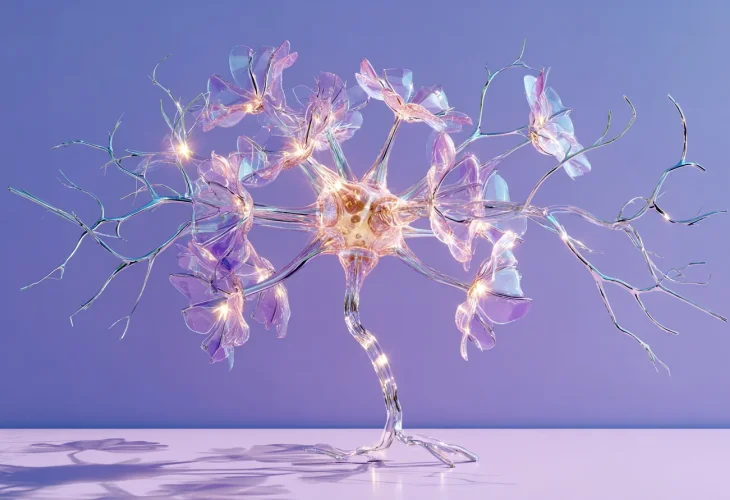
The human brain is often described as the most complex structure in the known universe. For many years, scientists believed that its remarkable abilities came mainly from the vast number of nerve cells and the countless connections between them. But recent discoveries suggest that the brain's incredible complexity begins much earlier, at the level of a single cell.
A Single Brain Cell Is Far More Powerful Than Once Believed
A nerve cell, known as a neuron, was once viewed as a simple messenger. It receives signals from other neurons, combines those signals, and if they reach a certain threshold, sends an electrical impulse to the next cell.
In this traditional view, each neuron functioned much like a switch in a computer network, either turning a signal on or off.
Today, scientists know the story is far more remarkable.
Modern research has revealed that a single neuron is not merely a biological switch. It is an intricate living system capable of processing information within its own structure before sending messages to other cells.
The Hidden Intelligence of Dendrites
Much of this discovery centers on structures called dendrites.
Dendrites are the branching extensions that grow from the body of a neuron. They receive most of the incoming signals from neighboring nerve cells. Under a microscope, a neuron resembles a tree, with the cell body acting as the trunk and the dendrites spreading outward like branches.
For many years, scientists believed dendrites simply carried electrical signals to the cell body, much like wires transmitting electricity.
Researchers now know they do much more.
Rather than acting as passive cables, dendrites can process information independently. Different branches can respond to different types of incoming signals, perform local computations, and even generate their own electrical impulses through specialized calcium channels.
What was once considered a simple transmission system has become an entire field of neuroscience known as local neural computation.
The Brain Inside the Brain
Scientists now sometimes describe an individual neuron as "the brain inside the brain."
Each neuron contains thousands of potential connections, branching networks, ion channels, calcium signaling systems, and constantly changing synapses. Different parts of the same cell can perform different computational tasks at the same time.
In other words, a neuron is not simply passing information along. It is analyzing, organizing, and responding to information before it ever reaches the rest of the brain.
At the same time, no neuron works alone. Every cell is part of an immense network, cooperating with billions of others to produce thought, memory, sensation, and movement.
How Does the Brain Organize So Much Information?
Think about what happens during an ordinary walk down the street.
You hear passing cars, a conversation on your phone, footsteps nearby, and perhaps someone calling your name. You see buildings, traffic lights, people, signs, and movement in every direction. At the same time, you feel the ground beneath your feet, the phone in your hand, and perhaps your wallet in your pocket. You smell fresh bread from a bakery or, less pleasantly, a nearby garbage bin.
Every second, your brain receives an enormous amount of information.
How does it avoid becoming overwhelmed?
One emerging theory suggests that dendrites help solve this problem by sorting information before it reaches the brain's larger processing centers.
Signals that require immediate attention, such as an approaching vehicle, a loud siren, or a hole in the sidewalk, are prioritized. Less important information, like a fluttering leaf or a flashing advertisement, is processed differently and fades into the background.
Only after this filtering process does the brain assemble the complete picture that we consciously experience.
Your Brain Performs Countless Calculations Every Second
Our conscious mind receives information that has already been carefully organized.
When you read a sentence, you simply understand the words. You are not aware that your brain first recognized each individual letter, combined those letters into words, retrieved their meanings from memory, and assembled them into a complete thought, all within fractions of a second.
The same happens when you recognize a familiar face.
In an instant, your brain analyzes facial features, searches stored memories, identifies the person, recalls their name, remembers your relationship with them, and even retrieves personal details, allowing you to ask, "How is your brother doing?"
Behind every seemingly simple moment lies an astonishing amount of biological computation.
Tiny Structures That Help Us Learn and Remember
Dendrites are covered with microscopic protrusions known as dendritic spines.
These tiny structures often serve as the points where communication between neurons takes place. They also play an important role in learning and memory.
Scientific research shows that dendritic spines can change over time, strengthening or weakening connections between neurons based on experience. These changes are considered one of the biological foundations of learning and long term memory.
Why the Brain Is Unlike Any Computer
Although the brain is often compared to a computer or even to artificial intelligence, the comparison has clear limits.
In a traditional computer, processing, memory, storage, and communication each occur in separate components.
The brain works very differently.
A single neuron can receive information, process it, modify its own behavior based on previous activity, strengthen or weaken its connections, store aspects of learning, and communicate with thousands of other neurons, all at the same time.
Rather than functioning as a collection of separate parts, every neuron is a dynamic biological system that performs multiple roles simultaneously.
The more scientists learn about the human brain, the more they discover that even its smallest building blocks possess an extraordinary level of complexity, revealing yet another glimpse into one of the most remarkable creations in the natural world.

