

Between the Straits (The Three Weeks)
Why God Placed His Name on the Jewish People: A Powerful Message from Parashat Pinchas
A timeless Torah insight that offers hope, comfort, and responsibility for the Three Weeks, exile, and life's personal struggles
- Rabbi Moshe Sheinfeld
- | Updated
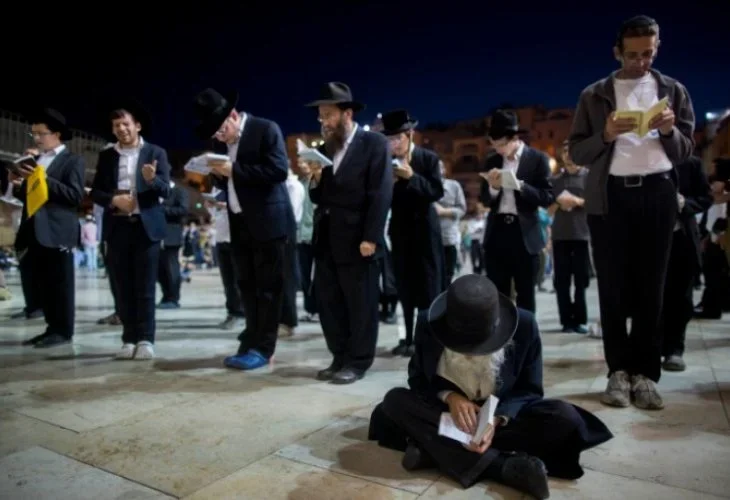 (Photo: Jonathan Sindel / Flash 90)
Parashat Pinchas is usually read during, or immediately before, the period known as the Three Weeks (Bein HaMetzarim). During these days, we mourn the destruction of both the First and Second Holy Temples.
This is not an easy task.
It is difficult to mourn something we have never personally experienced. We are like a child whose mother passed away at the moment of birth. Because the child never knew her, he cannot fully grasp what he has lost. In much the same way, we were born into a long exile. Jerusalem remains in ruins, the Holy Temple has not yet been rebuilt, and we have never known a different reality. It is therefore challenging to truly connect with the depth of this loss.
The Jewish people continue to endure exile. We face hardships from within and from without. Yet this week's Torah portion offers a profound message of hope, one that encourages us both in our national exile and in the personal struggles each of us experiences.
The Three Censuses of Israel
The Torah records three occasions on which God commanded Moses to count the Jewish people.
The first took place after the sin of the Golden Calf, the second followed the completion of the Tabernacle, and the third appears in Parashat Pinchas, after the plague that struck the nation following the sin of Baal Peor.
As the Torah lists the tribes and their respective families, an unusual pattern emerges. The names of the families are modified by adding the Hebrew letter hei at the beginning and the letter yud at the end. For example, the descendants of Chanoch become HaChanochi, those of Pallu become HaPallui, and so on.
These two letters, yud and hei, together form one of the sacred Names of God.
Why does the Torah insert God's Name into the names of the families of Israel?
God's Testimony to Israel
Rashi explains the straightforward meaning.
The nations of the world mocked the Jewish people, questioning the purity of their lineage. Since the Egyptians had enslaved the Israelites, they claimed that perhaps they had also violated their women, making it impossible to know the true ancestry of the tribes.
To refute this slander, God placed His own Name upon the families of Israel. By attaching the letters hei and yud to their names, He testified that they were indeed the true descendants of their fathers. As King David later declares, "The tribes of God are a testimony to Israel" (Psalms 122). God's Name itself serves as that testimony.
The King Who Tied the Key to Himself
The Sages of the Jerusalem Talmud (Ta'anit 2:6) offer another explanation, one especially relevant during the Three Weeks.
They compare the situation to a king who possessed the only key to his treasury. Fearing that he might lose it, he fastened the key to himself with a chain. Wherever the king went, the key remained securely attached to him.
So too, God bound the Jewish people to His own Name so that they would never be lost. The placement of God's Name upon the names of Israel symbolizes that God has tied Himself to His people.
A Source of Comfort During Exile
This teaching offers tremendous comfort during our long exile.
It assures us that God will never abandon His people because He has, so to speak, attached His own Name to them. If the Jewish people are disgraced, God's Name is also desecrated in the eyes of the world.
For this reason, even when we may not be worthy of redemption because of our own deeds, God will ultimately redeem us for the sake of His own holy Name.
This idea is beautifully reflected in the festival prayers.
We begin by declaring: "You have chosen us from among all the nations. You have loved us and desired us."
The passage concludes: "You have called Your great and holy Name upon us."
The highest expression of God's love for Israel is not merely that He chose us, but that He placed His own Name upon us.
This truth is not only comforting. It is also deeply demanding.
Every Jew represents God through every action, every word, and every choice. When we live according to His will, we sanctify His Name before the world. When we fail to do so, we diminish, so to speak, the honor of the One whose Name we bear.
As the Siftei Chaim explains, this places an enormous responsibility upon every individual.
Israel's Cause Is God's Cause
The same idea appears later in the Torah.
Before the battle against Midian, Moses tells the people: "Arm men from among yourselves for the army... to carry out the vengeance of God against Midian."
One might have expected the verse to say "the vengeance of the Children of Israel." Why does it instead call it "the vengeance of God"?
Rashi explains: "Whoever stands against Israel is regarded as standing against the Holy One, blessed be He."
Such is the depth of God's bond with His people.
God Is With Us in Every Personal Exile
This message is not limited to the Jewish nation as a whole. It applies equally to every individual.
A person may feel trapped in a private exile, overwhelmed by difficulties, loneliness, illness, financial hardship, or emotional pain. At times, it is easy to feel forgotten or abandoned.
The Torah teaches that God is always with us. He is present in times of joy and in times of mourning, in happiness and in sorrow, in prosperity and in poverty, in health and in illness.
Just as He bound His Name to the Jewish people throughout history, He remains inseparably connected to every Jew through every stage of life.
Even in exile, we are never alone.

